
Oshi-Katsu Meets Hotels: Concept Rooms, Two-Rooms-a-Day Plans and What They Cost
Hotels in Japan now sell rooms styled after a work’s world, and stay plans that bundle limited-edition goods and events. What perks to add to an ordinary stay, and how to set the price and the number of rooms, are the questions a project has to settle.

Limited concept rooms, regular rooms with benefits and programs involving VTuber interaction provide different ways to combine a stay with fandom. These examples were announced or sold during 2024–2026. We compare their prices, allocations and benefits. Some have ended, so check each property’s official information for current availability.
The Climate Pushing Lodging Toward Oshi-Katsu
First, the numbers that set the stage. According to Teikoku Databank’s national “Ryokan and Hotel Market” trend survey (in Japanese), the market in fiscal 2025 was expected to reach about ¥6.5 trillion (roughly $43 billion), a new record. A Tokyo Shoko Research survey found that 12 listed hotel operators averaged ¥17,818 per room in fiscal 2025, up 8.6% on the previous year, with occupancy of 83.3% (Tokyo Shoko Research, in Japanese).
- ¥6.5 trillion
- Ryokan and hotel market, FY2025 (expected record)
- ¥17,818
- Average room rate, 12 listed operators (+8.6%)
- 83.3%
- Average occupancy, 12 listed operators, FY2025
Ryokan are traditional Japanese inns.
Sources: Teikoku Databank (market size, in Japanese); Tokyo Shoko Research (room rate and occupancy, in Japanese)
The 12-operator sample describes one part of the hotel sector. It does not establish conditions at every property or measure the effect of an IP collaboration. A planning team needs to decide whether its own priority is a higher room rate, use outside the busiest periods or reaching guests who first learn about the property through a franchise.
One source on demand is Oshi-Katsu Soken’s 2026 survey. Conducted January 15–22 among 23,125 residents of Japan aged 15–69 and weighted for age and gender, it estimated 19.4 million participants and a market of about ¥4.1 trillion. Average annual spending was ¥209,716, down from ¥255,035 the previous year (Oshicoco and CDG’s survey announcement, in Japanese). These are not accommodation-only figures. A hotel should not turn that annual average into a budget for one night. It needs separate information on what its intended guests want to spend money on.
Four Design Patterns Seen in the Cases
These historical examples differ in how they combine limited allocations with ways to participate.
Sunshine City Prince Hotel x Attack on Titan: Stays and Dining
This example offers stays and restaurant visits as distinct ways to participate.
As its approach, the hotel ran a Christmas stay plan from December 1 to 25, 2025 and a collaboration restaurant from December 1, 2025 to January 25, 2026. It commissioned new art of Eren, Levi, Hange and Erwin from the hit manga and anime, and combined 38 dishes expressing the world of the series, a collab afternoon tea, a guests-only photo spot, goods exclusive to the stay plan and perks for restaurant visitors (Attack on Titan official, in Japanese).
The Oshi Lab’s view: You can’t physically add rooms, but a restaurant turns over. Giving fans who couldn’t stay a way to still end with “I went” is this project’s practical invention. It carries the design thinking of the collab cafe over to lodging. The trick reads easily across industries: when your main product has a hard cap, add a second one that doesn’t.
Hotel New Otani x Tales of Xillia and The Rose of Versailles: Limited Rooms and Different Franchises
This example combines a two-room daily allocation with stay plans for different franchises, allowing a comparison of their dates and benefits.
As its approach, the long-established Hotel New Otani offered a collaboration stay plan, bookable online only and limited to two rooms per day, from October 30, 2025 to February 28, 2026 (Hotel New Otani official, in Japanese). It also offered a collaboration room with The Rose of Versailles from April 26 to July 31, 2025 (Hotel New Otani official, in Japanese), and began offering one with My Happy Marriage on March 10, 2026, later extending the run from the original June 9 to October 31 (Hotel New Otani official, in Japanese).
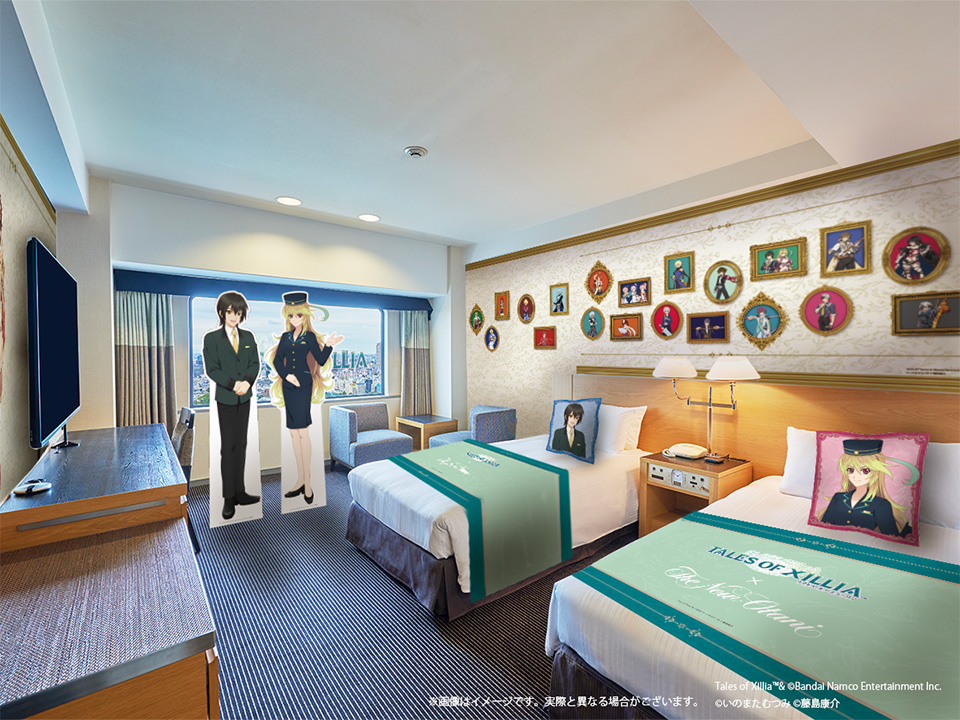
The official room concept combines commemorative artwork on the wall, character panels by the window and cushions on the beds. It uses a conventional hotel room while placing references to the work in several directions. This is a published concept image of the room, not a promise that guests can take every item home. Booking information should distinguish decorations enjoyed during the stay from benefits guests receive to keep.
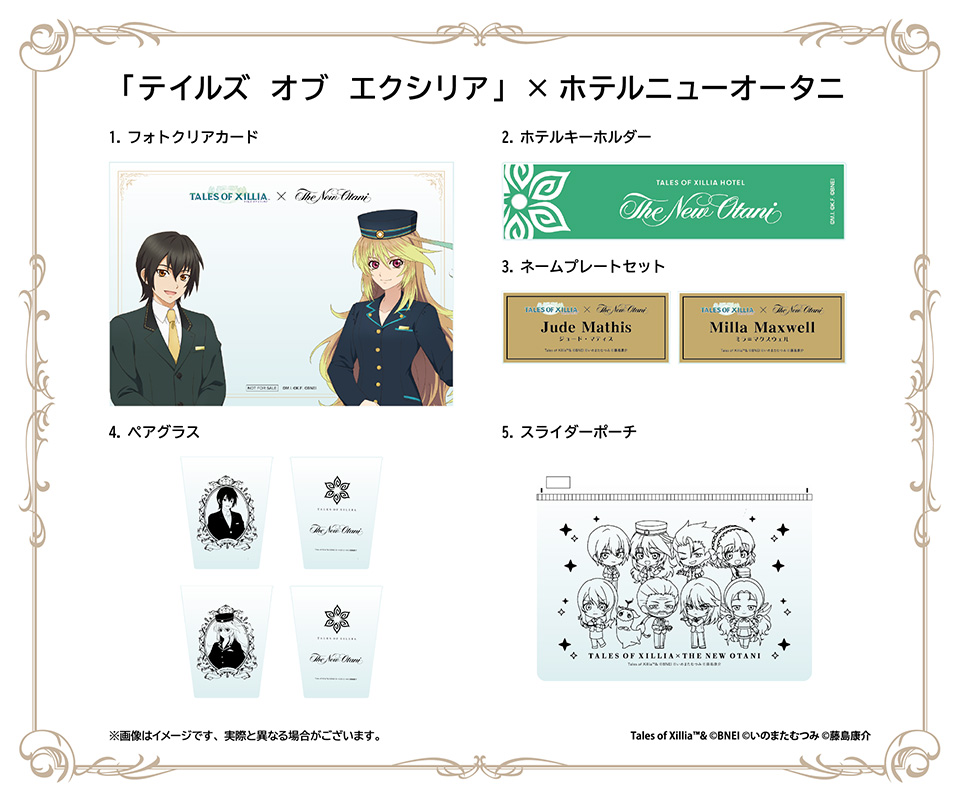
The take-home illustration includes a hotel key holder, nameplates and glasses. Hotel branding and newly drawn uniformed characters make these objects both franchise merchandise and a record of staying in that particular place. The official page says benefits are supplied for each guest. Clearly stating whether an item is provided per room or per person is useful information for fans booking together.
The Oshi Lab’s view: Limiting the allocation defines which rooms require special decorations and benefits. It does not, on its own, establish a small operational burden. Setup, cleaning, inventory management and replenishing benefits add work to a conventional stay. Comparing plans for different franchises by the same fields—dates, decorations and take-home items—helps a planner consider what can carry over and what needs to be remade.
Shibuya Excel Hotel Tokyu x My Hero Academia: Decorated Rooms and Regular Rooms With Benefits
This example provides a decorated-room option and an option centered on receiving stay benefits.
The approach was “HOTEL PLUS ULTRA,” which ran from January 15 to April 30, 2026. Alongside two concept rooms themed on “the Final Battle” and “U.A. High School Class 1-A” from the superhero anime, the hotel offered a regular guest-room plan with perks for guests only (Tokyu’s official collaboration website, in Japanese).
The Oshi Lab’s view: Guests can choose between enjoying a decorated room and receiving benefits with a regular room. The official information prohibits removing room decorations, exhibits and equipment. Separating take-home benefits from the room experience helps align expectations with the offer. For another discussion of participation options, see Gen Z oshi-katsu spending.
Concept rooms only
- Participation depends on the decorated-room allocation
- A dedicated room experience
Concept rooms plus regular plan
- Regular room with guest-only perks in the middle
- The choice becomes how I stayed
- Guests choose the type of stay that suits them
HOTEL PLUS ULTRA, Shibuya Excel Hotel Tokyu, January 15 to April 30, 2026.
Independent VTubers and Small Properties: Experiences Involving a Performer
Other announced offers combine accommodation with experiences involving a performer.
One approach was the collab between the VTuber Rica Hanamiya and the Kyoto inn “Fushigi na Yado” (“Mysterious Inn”), announced for November 1 to December 31, 2025. The offer combined wallpaper with newly drawn art, an original diffuser she blended herself and a stamp rally through restaurants and experience venues around Kyoto (PR TIMES, in Japanese). &AND HOSTEL also announced a collaboration stay event with the VTuber agency Vjidai for May 10, 2025, using an entire Akihabara property. The offer included rooms with merchandise, one-on-one sessions and a limited live stream. The announcement made the event conditional on reaching at least 80% of accommodation bookings during the sales period (and factory press release, in Japanese).
The Oshi Lab’s view: These offers create contact beyond decoration. Hanamiya’s project also includes restaurants and experience venues outside the inn. Interaction programs require decisions about appearance times, streaming facilities, cancellation conditions and refunds. An announcement is different from demonstrated revenue or visitor results. Movement through local businesses also invites comparison with pilgrimage travel.
Fan-Participation and General-Purpose Offers
Other approaches involve fans in developing a project or provide activities that are not tied to one franchise.
Tokyo Dome Hotel marked its 25th anniversary by planning a “Dream Oshi-Katsu Room” with Oshicoco, a media outlet devoted to oshi-katsu. Announced on April 10, 2025, with stays that began June 1, it used a participatory process: roughly 8,000 votes on social media decided the interior. The room started at ¥37,300 a night for a twin with two guests and was limited to three rooms a day (PR TIMES, in Japanese). Prospective users took part in choosing the interior, and the process itself was publicized. The historical price included breakfast, service charges and taxes.
Shin Yokohama Prince Hotel’s June 10, 2026 announcement (in Japanese) describes its plushie dress-up stay plan, with a sales period from June 20, 2026 to March 31, 2027. The room offer includes about 100 outfits from the Nui-fuku Shichakushitsu plushie-clothing service for guests to try. Rather than specifying a franchise, it proposes bringing one’s own plushie to enjoy dressing and photographing it. Check the loan items’ sizes and use conditions against the plushie a guest wants to bring.
A General Plan for Staying With Your Plushie
The Toyoko Inn oshi-katsu plan feature introduces a stay set with a bed and gown for a guest’s own plushie or acrylic stand. This offers a different point of participation from a room dedicated to one franchise. Check eligible properties and sales conditions on the official plan page.
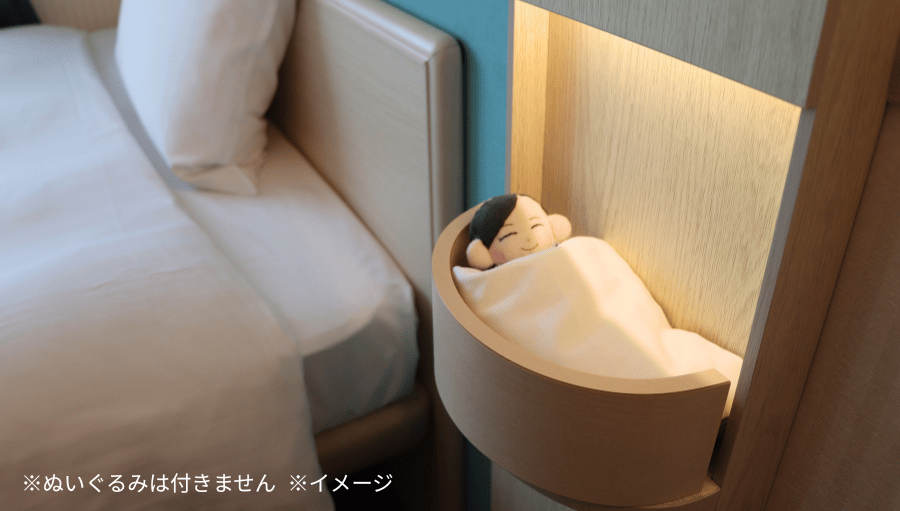
The small bed sits beside the guest bed in the official image. It gives a guest’s own plushie a place in the stay, rather than supplying a franchise character with the room. The image explicitly says the plushie is not included. Showing what comes with a plan and what guests bring themselves helps prevent misunderstandings before booking.
Comparing the Design Patterns
Comparing the published offers by what guests can choose makes their different ways to participate easier to see. Because price levels and room allocations vary by property, date and conditions, they are not ranked on a single scale.
| Format | Published examples | What the guest can choose |
|---|---|---|
| Limited concept room | New Otani, Tokyo Dome Hotel | A room with dedicated decorations or equipment |
| Concept room and regular room with benefits | Shibuya Excel Hotel Tokyu | A room experience or a benefits-centered stay |
| Stay and dining | Sunshine City Prince Hotel | Accommodation or a restaurant visit |
| Performer interaction | Fushigi na Yado, the announced &AND HOSTEL event | A stay combined with specified performer involvement |
| General oshi-katsu plan | Prince Hotels, Toyoko Inn | Equipment or amenities for the guest’s own activities |
A hotel fan offer
- Decorated roomA dedicated room experience
- Regular room with benefitsA different way to receive the stay’s merchandise
- DiningA restaurant option alongside accommodation
- Performer programCheck announced content and cancellation conditions
- Equipment and amenitiesSupport for the guest’s own fan activities
Source: The Oshi Lab’s comparison of the official examples in this article
Reviewing Guest Experience and Operations
During planning, consider whether several ways to participate are feasible, whether people unable to stay in a limited room could enjoy another offer, and whether the project could support a later run. Choose according to the purpose, cost and operating capacity rather than assuming all three must be introduced together.
Before launch, check whether the benefits are clear relative to the price, whether the actual decoration matches the promotional images and whether the booking process is understandable. Sellout speed alone cannot answer those questions about the guest experience. Explain information checks and the conditions for name changes, transfers and cancellations under the property’s own rules. Group bookings and arrangements made on someone else’s behalf also exist, so distinguish the information required from the process for changing it.
Steps for Planning Teams
To balance ease of joining with operational burden, decide things in order, starting from the purpose.
- Set the main objective and supporting measures: If the goals include room rate, awareness and quieter-period demand, decide their priorities and how to measure them.
- Define a manageable trial: Decide how many rooms the property can support, measure decoration costs, stock needs and cleaning work, then consider expansion.
- Create a way to participate for people who can’t stay: Design at least one of a restaurant, a day-use plan, merchandise or online sales at the same time.
- Confirm who the contracting party is: A production committee or a publisher, an agency or the person. In direct contracts with independent VTubers, consistency between what is posted and the official account also becomes an issue.
- Decide and announce the reservation method first: Lottery or first-come, start date and time, per-person cap, even the method of identity checks.
- Verify with your own data: Use the same month last year or your regular plans as the comparison. Line up rate, ancillary sales, repeat guests and number of inquiries.
- 01Choose the aimPrioritize goals and their measures
- 02Start smallA trial allocation the property can support
- 03Offer another way to participateFor people who can't stay
- 04Confirm the contractCommittee, agency, or the person
- 05Announce the methodLottery or first-come, caps, ID
- 06VerifyCompare with your own data
Decide from the purpose first, then the operating load.
Pre-Launch Checklist
- Prepared both a high-priced plan and an affordable way to take part
- Can explain the basis for the limited room count from operational load, not sales
- Had a third party confirm that the cost and quality of goods and perks match the price
- Stated reservation fairness (lottery method, cap, identity check) in the announcement
- Explained guest-information checks and the conditions for changes or transfers under the booking rules
- Asked the IP side to supervise the world of the work and checked everything down to the interior, fixtures and signage
- Estimated the labor for room cleaning and restoration
- Ready to verify rate, ancillary sales and repeat guests against the same month last year
Notes From The Oshi Lab: Plan How Guests Will Use the Room
Hotel fan offers can address the wish to stay in a favorite work’s setting and the wish to decorate a space with one’s own merchandise. Keeping franchise appeal and the use of the space as separate questions helps a planner decide what to provide.
For a birthday party for an absent oshi, some people may be concerned about space at home, family members or decorating without damaging walls. A hotel also has conditions: permitted decorations, attachments to walls, sound, cleaning and restoration. Renting a room does not mean every activity is permitted. Equipment and use rules belong in the choice of plan.
Combining limited concept rooms with general-purpose plans is one option, but it does not guarantee a more stable business. Test it against the property’s guests, quieter periods and staffing. Alongside sellout speed, ask whether guests left satisfied, staff could manage the work and people chose a later project too. We would include those conditions for continuity in the evaluation.
Related articles: How to Plan a Collab Cafe / What Is Oshi-Katsu Marketing? / How to Plan an Oshi-Katsu Event / The Oshi-Katsu Market Size (2026 edition)
FAQ
How do oshi-katsu plans differ from collab rooms?
General oshi-katsu plans let guests celebrate an oshi of their own, using features such as balloons or video equipment. Collaboration rooms focus on the decorations and benefits of a particular work. Prices and eligible rooms vary by property and plan.
How much do collab rooms cost?
Tokyo Dome Hotel and Oshicoco’s 2025 announcement listed a twin room for two from ¥37,300 per room per night. That historical package included breakfast and other stated charges; it is not a general market rate. Compare occupancy, dates, meals and benefits on the same basis.
Why sell only two or three rooms a day?
A limited allocation defines which rooms require special decoration and inventory. A small room count does not guarantee profitability or attention. Estimate cleaning, replenishment and restoration work before deciding how many rooms to offer.
Does a collab really raise occupancy?
A collaboration does not automatically increase occupancy. Compare occupancy, average room rate and ancillary sales with regular plans or the same period last year.
What is the most important thing to watch when planning one?
Make sure the decorations and benefits match the announcement, and explain reservation conditions clearly. Look beyond how quickly a plan sells out to guest satisfaction, staff workload and repeat use.


