

Castle in the Sky Pilgrimage: 8 Places on Tomogashima and at Official Ghibli Sites
Tomogashima, off the coast of Wakayama Prefecture, has brick gun batteries wrapped in forest. At Battery No. 3, underground rooms and the gun emplacements above are connected by stairways, so you can see how the complex was arranged as you walk across the island.
The scenery is known as a place that brings Castle in the Sky to mind, but we could not confirm any official statement identifying the island as a model for the film. Studio Ghibli names Wales in the United Kingdom as a place that inspired the movie. This guide separates the island’s real history from official facilities that recreate the work, introducing eight places to visit.
Source: Studio Ghibli — Response about places that inspired the film (in Japanese)
Eight Landscapes to Encounter on Tomogashima and at Official Ghibli Sites
① Battery No. 3 Ruins
The main battery of the Yura Fortress, where you can enjoy a landscape of brick and trees.
Explore Battery No. 3 Ruins② Battery No. 2 Ruins
A military ruin overlooking the Kitan Strait, with a different position and role from Battery No. 3.
Explore Battery No. 2 Ruins③ Tomogashima Lighthouse
First lit in 1872. Learn about the real sea and history on an island that evokes the film.
Explore Tomogashima Lighthouse④ Takanosu-yama Observatory
From the island’s highest point, look out across the Kitan Strait toward Shikoku and the Rokko Mountains.
Explore Takanosu-yama Observatory⑤ Battery No. 4 Ruins
A supporting battery for Battery No. 3, with a circular gun emplacement that could aim in every direction.
Explore Battery No. 4 Ruins⑥ Battery No. 5 Ruins
A battery that guarded the Nonoura area, a blind spot for Batteries No. 3 and No. 4.
Explore Battery No. 5 Ruins⑦ Ghibli Museum
Meet the Robot Soldier in the rooftop garden and explore the work of animation.
Explore Ghibli Museum, Mitaka⑧ Ghibli’s Grand Warehouse
Experience the world of the film in three dimensions in the Garden in the Sky.
Explore Ghibli’s Grand Warehouse1 Battery No. 3 Ruins on Tomogashima | The island’s past in brick structures
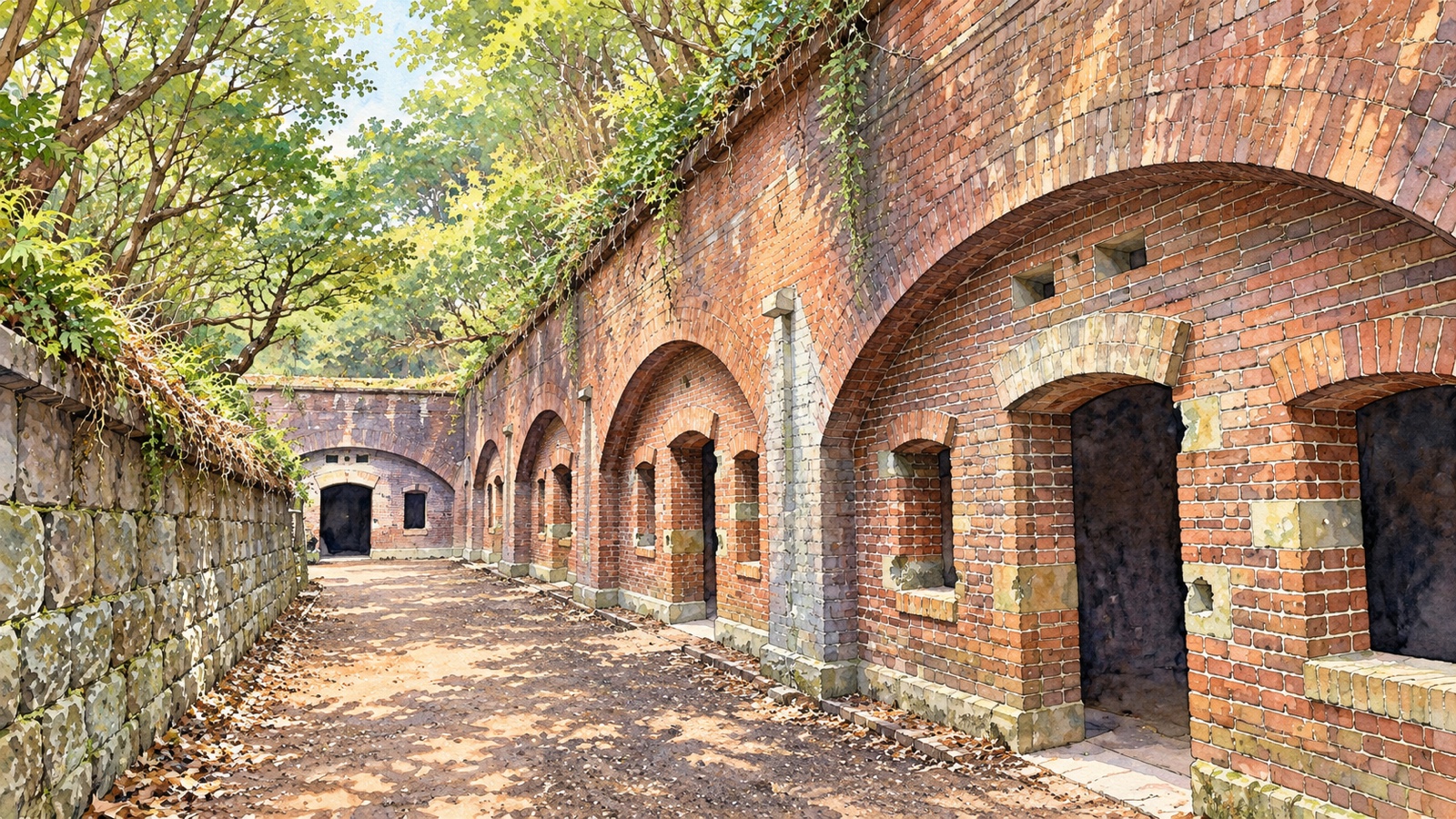
Tomogashima is the collective name for four islands: Okinoshima, Jinoshima, Torashima, and Kamishima. The regular passenger ferry from Kada Port takes visitors to Okinoshima. The Battery No. 3 ruins often seen in photographs are also on this island.
Battery No. 3 is surrounded by forest, with brick underground rooms connected by stairways to the gun emplacements above. The scenery may call to mind a garden in ruins, but the site was originally a coastal-defense battery. Along with Awaji Island across the strait and Kada and Miyama on the Wakayama shore, it formed part of Yura Fortress.
Batteries No. 3 and No. 4 were designed for indirect fire, sending shells over hills or buildings. Battery No. 3 was the main battery on Tomogashima. Its circular gun emplacements could aim in every direction, and it had its own power station and guardhouse. Its location and role differed from those of Battery No. 2, which faced directly out to sea.
Wakayama City’s information, updated in August 2026, says heavy rain has continued to damage the paths. Shinjagaike Pond and Torashima are closed to visitors. The underground areas of Battery No. 3 include dark spots and uneven footing, and the city advises visitors to bring a flashlight.
The underground rooms held a shell storage area and a shell-hoisting mechanism. These were used to move heavy ammunition up to the guns above. Even though the guns themselves are gone, the depressions of the emplacements, stairs leading underground, and connecting passageways show the route from storage to firing position.
In October 2019, the “Tomogashima Battery No. 3 Art Museum” began using this underground space. It is not a museum with newly installed exhibits; instead, visitors listen to audio through the Tomogashima audio-AR tourism app. The city describes this as a way to experience the existing ruins themselves, including their darkness and quiet.
Sources: Wakayama City — Battery No. 3 structure and sound art (in Japanese) / Wakayama City — Battery ruins guide (in Japanese) / Island closures and trail conditions (in Japanese)
Until the island that was closed to the public became a place to explore
Tomogashima was considered a key point in the defense of Osaka Bay even before the Meiji era, dating back to the time of the arrival of the Black Ships. According to Wakayama City, the Kishu Domain established a Tomogashima magistrate’s office at the shogunate’s order. Later, the former Imperial Japanese Army developed the islands as a large fortress, where about 600 soldiers were stationed.
The island was closed to the general public until the end of World War II. The island now reached by regular ferry was not originally developed to show visitors its seascapes. Thick walls, underground rooms, and paths to observation posts remain, while the military purpose has ended and the ruins are now covered by woodland.
Knowing this history adds another meaning to the quiet impression of photographs of the batteries. The landscape may resemble an uninhabited garden from an imaginary world, but the information boards also tell visitors that many people were once stationed here to monitor the strait.
- Location
- Okinoshima, Tomogashima, off Kada, Wakayama City, Wakayama Prefecture
- Connection to the work
- Ruins on the island where brick batteries wrapped in forest evoke the garden in Castle in the Sky
- Getting there
- About a 20-minute ferry ride from Kada Port to Tomogashima; explore on foot from Nonoura Pier
- Visitor advisory
- Bring a flashlight: some underground areas are dark and have uneven footing.
Source: Wakayama City — Yura Fortress and the Tomogashima battery group (in Japanese)
2 ② Battery No. 2 Ruins on Tomogashima | View the coastal fortification
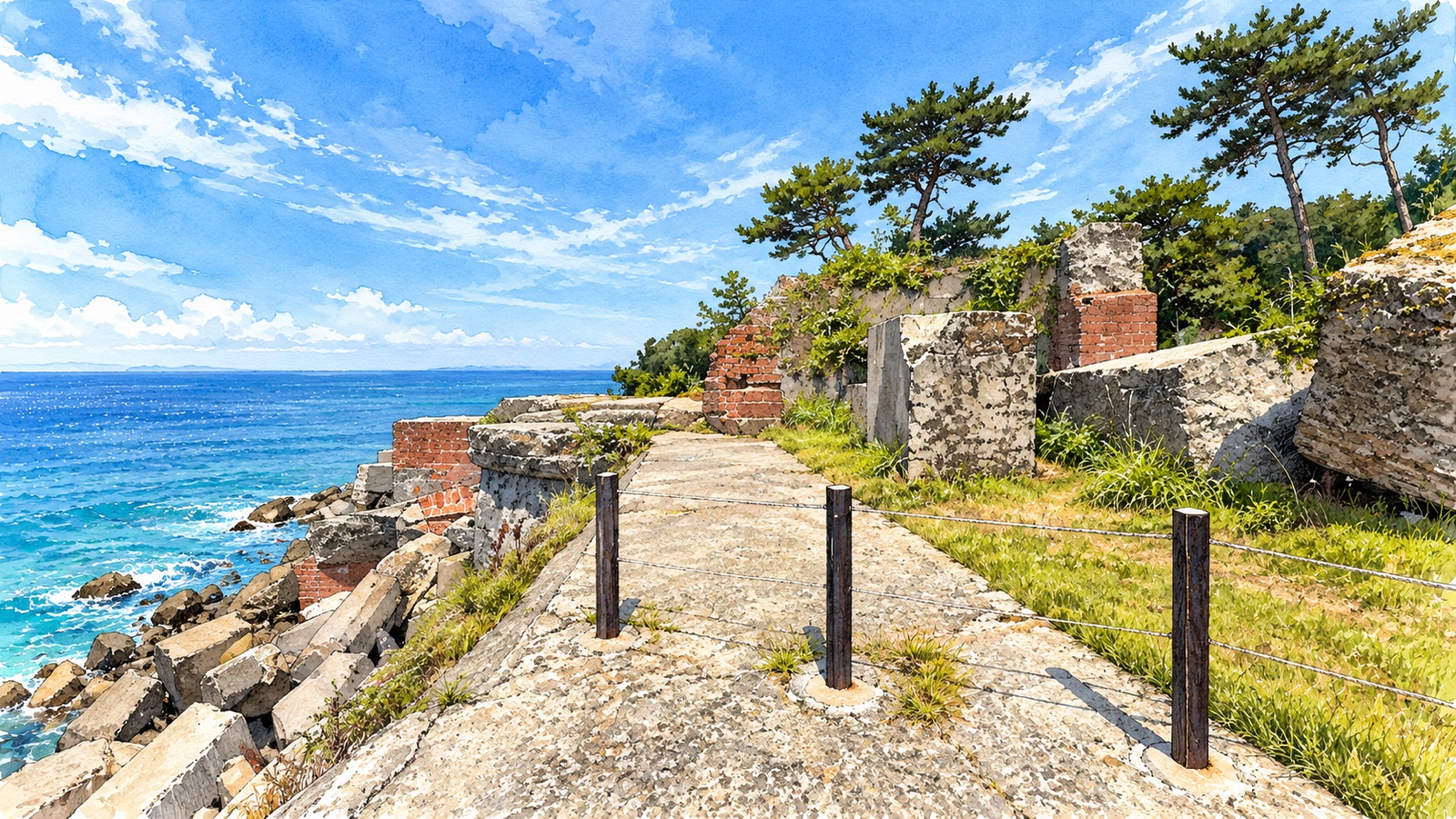
Battery No. 2 stands near the northwestern end of Okinoshima, low on the coast. It was an “interception battery,” built to fire broadside at ships trying to pass through the Kitan Strait into Osaka Bay. Across the strait, it faced the batteries in the Yura area of Awaji Island.
The low position opening onto the sea was also exposed to attack. For that reason, the structure was covered with concrete about two meters thick, except for the openings for the gun barrels. Today, erosion from wind and waves has damaged the walls, and the interior is closed. Visitors can view the ruins and the sea from outside the fence.
Unlike the visit inside the underground levels of Battery No. 3, this is a place to understand the layout from outside. Looking across the water toward the Yura area shows that the defenses were not confined to Tomogashima; they were arranged on both sides of the strait.
- Location
- Near the northwestern coast of Okinoshima, Tomogashima, off Kada, Wakayama City, Wakayama Prefecture
- Connection to the work
- A coastal interception battery where visitors can trace the island’s history alongside the Battery No. 3 ruins
- Structure
- Built with concrete about two meters thick to fire broadside at ships in the Kitan Strait
- Visitor access
- The interior is closed; view the exterior and the strait from beyond the fence.
Sources: Wakayama City — Battery No. 2 layout and visitor access (in Japanese) / Official Wakayama tourism site — Tomogashima (in Japanese)
3 ③ Tomogashima Lighthouse and Meridian Plaza | Look beyond the island
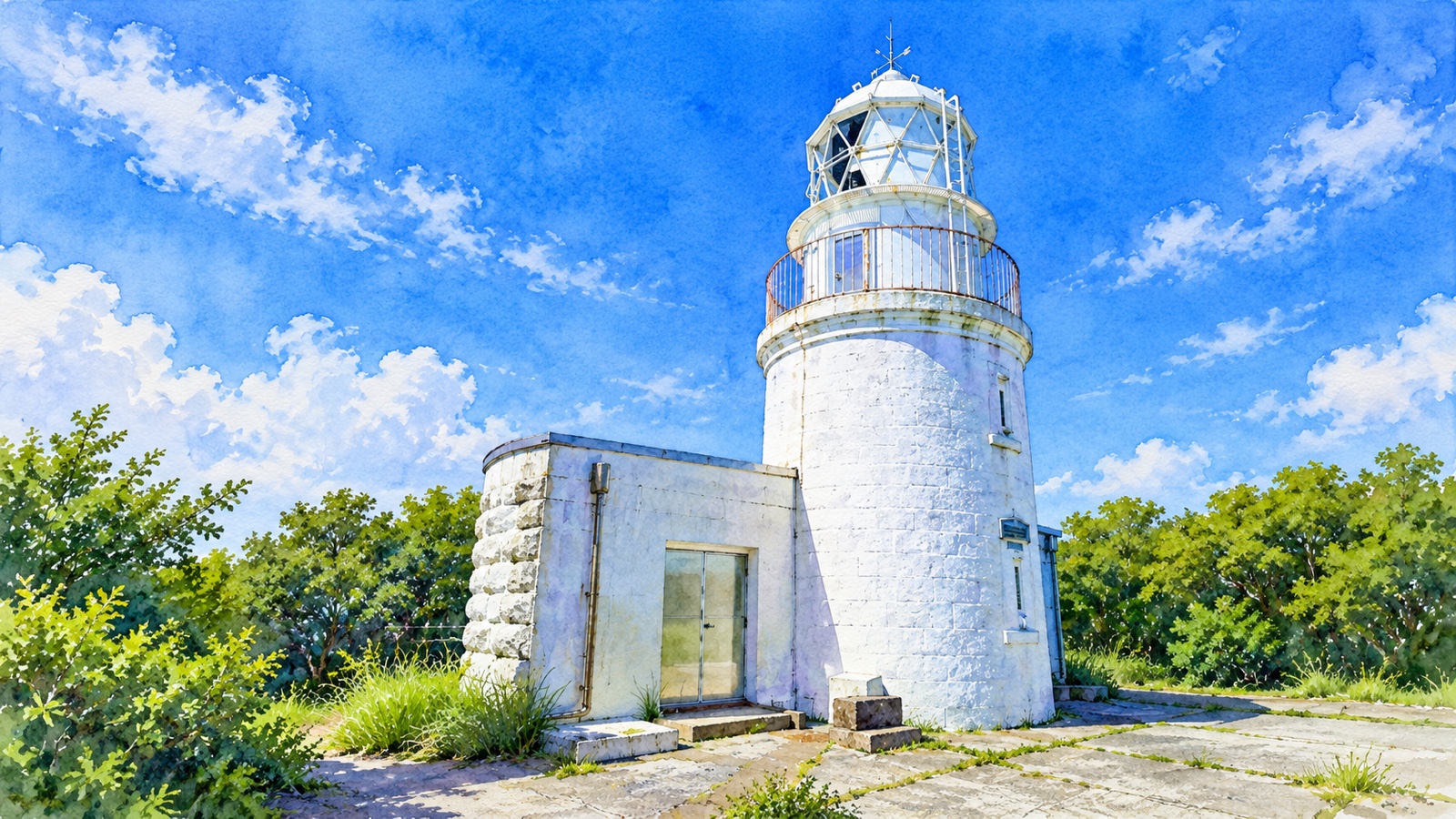
Tomogashima Lighthouse is a stone-built Western-style lighthouse that was first lit on June 25, 1872. Richard Henry Brunton, a British engineer invited by the Meiji government, determined that a lighthouse was needed in the Kii Channel ahead of the opening of Hyogo Port. Construction began on April 7, 1870, and took about two years and two months.
The lighthouse originally stood about 25 meters closer to the sea than it does today. It was relocated when the former Imperial Japanese Army built the fortress. The white lighthouse predates the batteries; its position changed later as the island was developed for military use.
In March 1945, the lighthouse was damaged in an attack by U.S. aircraft and temporarily extinguished in response to the Japanese military’s tactical requirements. Temporary repairs were completed on August 16, and its light began guiding ships again. In November 2015, the lighthouse was registered as a Tangible Cultural Property.
The 135th meridian, Japan’s standard-time meridian, passes through Meridian Plaza west of the lighthouse. Wakayama City describes it as the southernmost point of land in Japan crossed by the meridian. In June 2021, the Wakayama Prefecture Association of Land and House Surveyors donated a meridian-tower monument. Here, visitors can see both the island lighthouse and the location of the standard-time meridian.
- Location
- Western tip of Okinoshima, Tomogashima, off Kada, Wakayama City, Wakayama Prefecture
- Connection to the work
- An early-Meiji stone lighthouse and a plaza on the 135th meridian to visit alongside the battery ruins
- First lit and cultural designation
- First lit June 25, 1872; registered as a Tangible Cultural Property in November 2015
- Highlights
- The white stone lighthouse and a nearby monument marking the southernmost point of Japan’s standard-time meridian
Sources: Wakayama City — Lighthouse history (in Japanese) / Meridian Plaza information (in Japanese) / Wakayama City — Tomogashima highlights and related information (in Japanese)
4 ④ Takanosu-yama Observatory | Look down over the Kitan Strait from the island’s highest point
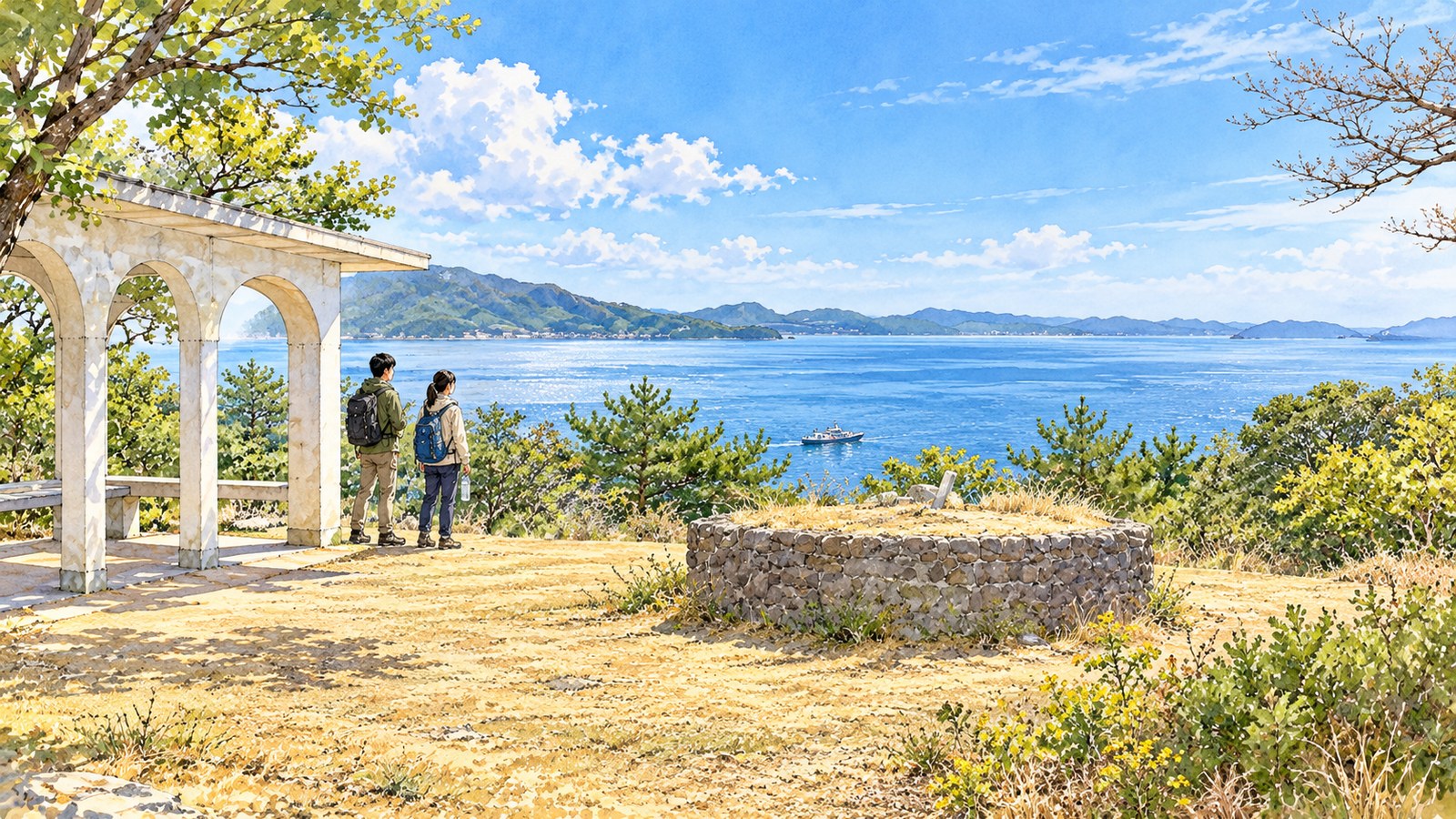
From near the Battery No. 3 ruins, stairs lead up to Takanosu-yama Observatory, the highest point on Okinoshima at 119.70 meters. The viewpoint looks down over the Kitan Strait; on a clear day, visitors can see as far as Shikoku, the Rokko Mountains, and the Izumi-Katsuragi range. A first-order triangulation point is also located here.
On the walking route recommended by Wakayama City, the Battery No. 3 ruins and Takanosu-yama Observatory are about 0.9 kilometer, or 20 minutes, from Nonoura Pier. There is no restroom at the observatory; the nearest one is below Battery No. 3, about a five-minute walk down the stairs.
- Location
- Okinoshima, Tomogashima, off Kada, Wakayama City, Wakayama Prefecture
- Connection to the work
- The island’s highest viewpoint, to visit along with the Battery No. 3 ruins
- Elevation
- 119.70 meters (first-order triangulation point)
Source: Wakayama City — Tomogashima nature and Takanosu-yama Observatory (in Japanese)
5 ⑤ Battery No. 4 Ruins on Tomogashima | A nearly intact battery that supported No. 3
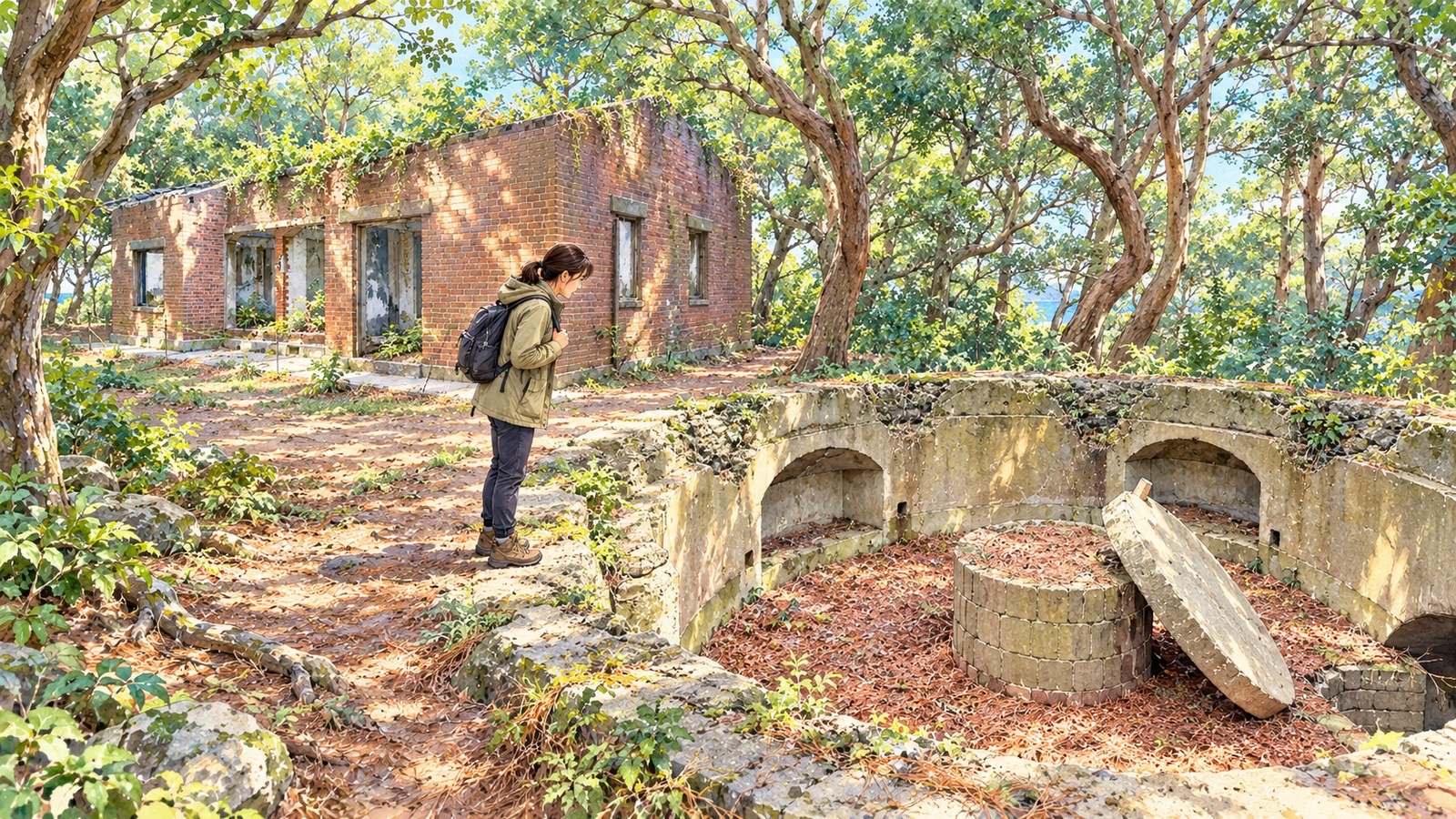
Like Battery No. 3, Battery No. 4 was a “counter-battery” designed to fire shells over the hills, and it supported the main Battery No. 3. It is somewhat smaller, but its circular gun emplacement could aim in every direction.
The battery was not dismantled after it was decommissioned in 1906 and remains close to its original form. Visitors can compare its gun emplacement with Battery No. 3, whose underground areas can be entered.
- Location
- Okinoshima, Tomogashima, off Kada, Wakayama City, Wakayama Prefecture
- Connection to the work
- One of the Tomogashima batteries that remains close to its original form, alongside the Battery No. 3 ruins
- Highlights
- A circular gun emplacement that could aim in every direction
Sources: Wakayama City — Battery No. 4 ruins (in Japanese) / Wakayama City — Roles of the battery ruins (in Japanese)
6 ⑥ Battery No. 5 Ruins on Tomogashima | Guarding Battery No. 3 and No. 4’s blind spots
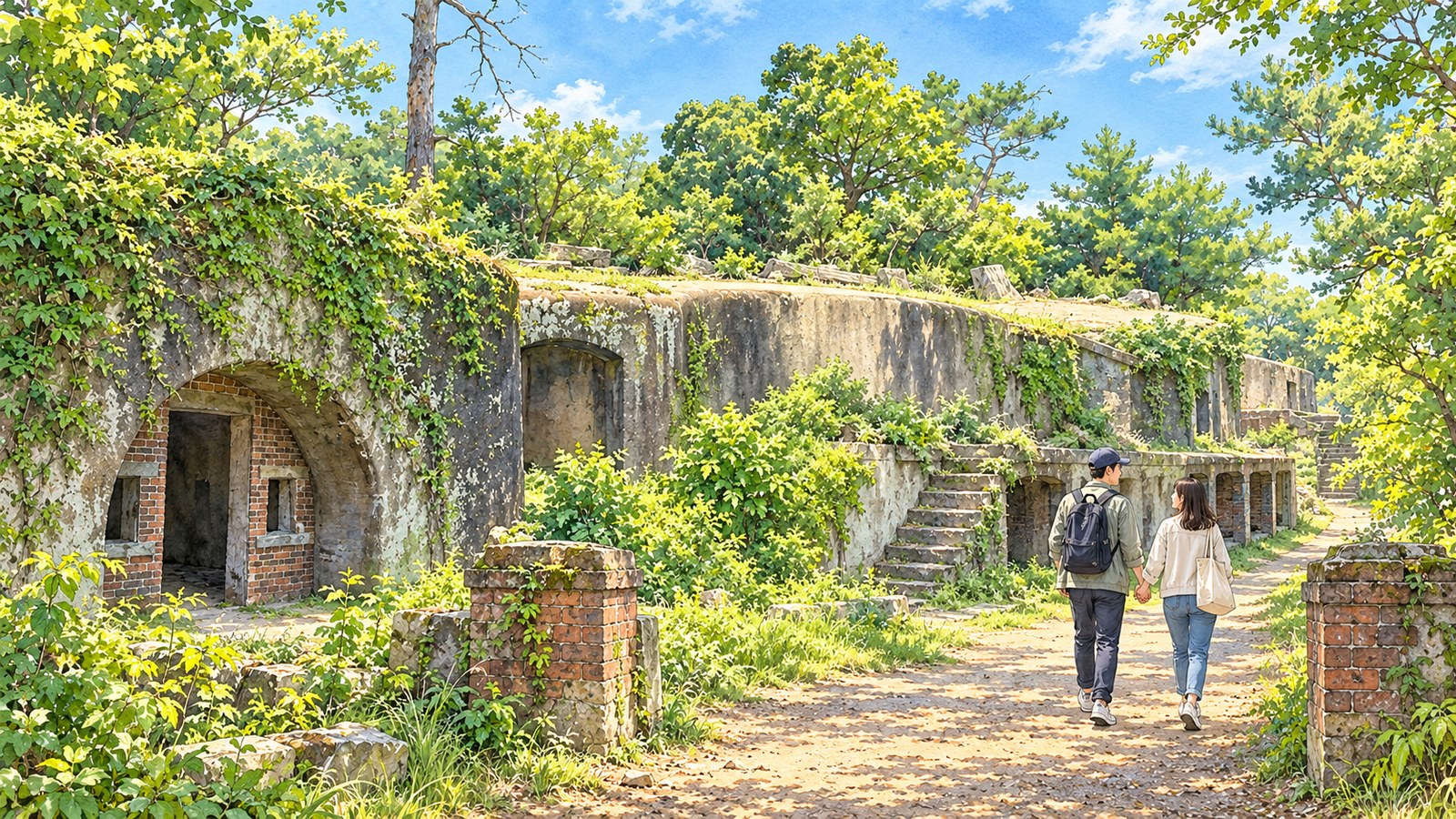
Battery No. 5 was built in 1904. It was designed to protect the Nonoura area, which Batteries No. 3 and No. 4 could not target, as well as the central northern part of Okinoshima. Barracks, a power station, and an ammunition depot once stood in this area.
The battery is near Nonoura Pier and the Tomogashima Information Center, making it one of the first ruins visitors encounter after arriving on the island. Wakayama City’s trail-closure map shows restrictions on the paths toward Shinjagaike Pond and Torashima.
- Location
- Okinoshima, Tomogashima, off Kada, Wakayama City, Wakayama Prefecture
- Connection to the work
- One of the Tomogashima batteries, built to cover blind spots for Batteries No. 3 and No. 4
- Built
- 1904
Sources: Wakayama City — Battery No. 5 ruins (in Japanese) / Wakayama City — Tomogashima trail closure map (July 31, 2026 edition) (in Japanese)
7 ⑦ Ghibli Museum, Mitaka | The Robot Soldier on the rooftop
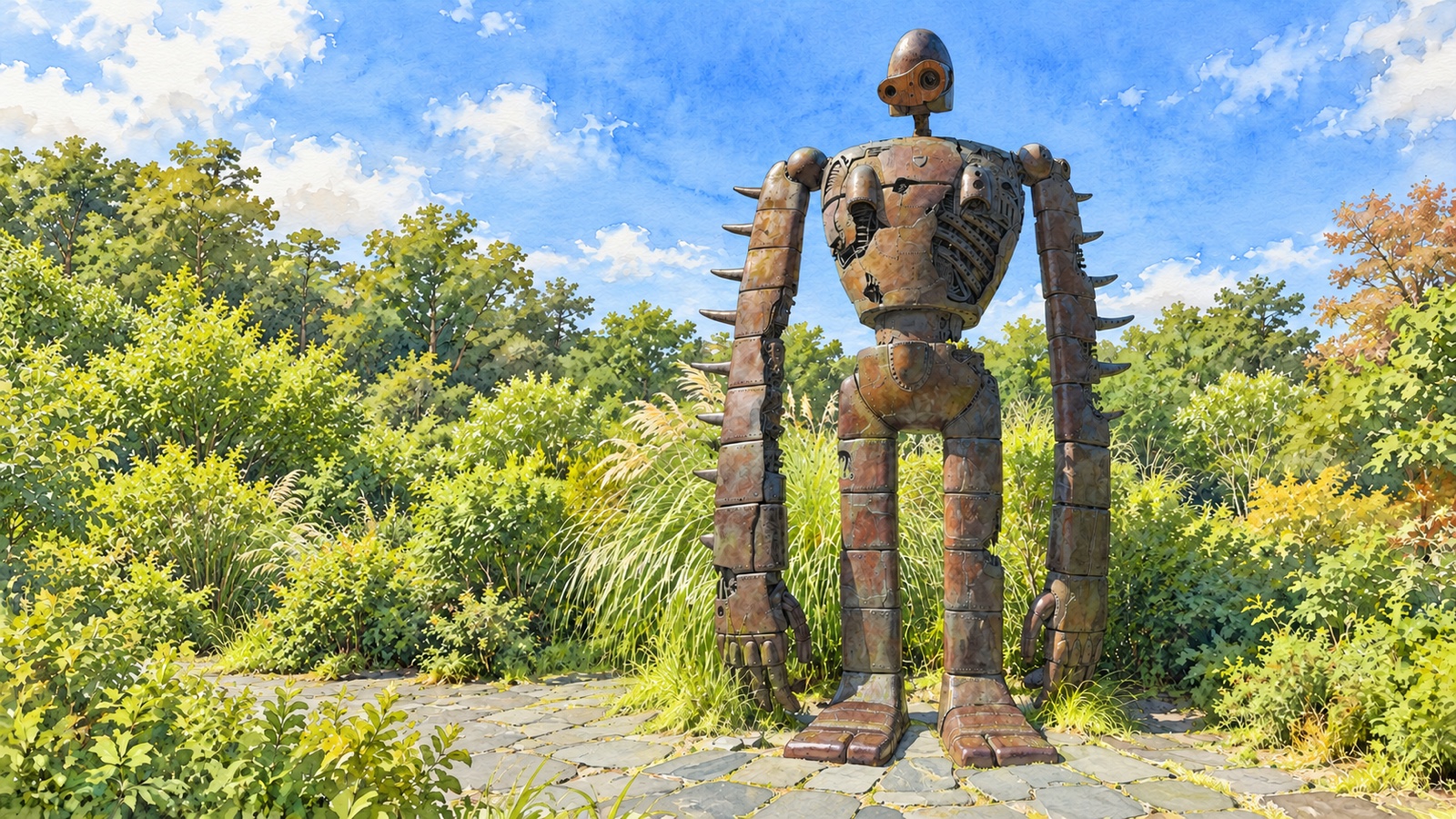
For an encounter with the designs from the film itself, visit the Ghibli Museum in Mitaka, Tokyo. A Robot Soldier about five meters tall stands in the rooftop garden.
Visitors reach the rooftop by taking the spiral staircase beside the Catbus Room. The museum’s official guide calls the statue the museum’s guardian deity. The rooftop garden is inside the museum; it is not an area that visitors can freely enter from nearby Inokashira Park.
The museum’s journal entry dated February 28, 2001, records the day the statue was lifted to the rooftop. It took about a year and a half to make. The installation record lists it as 4.5 meters tall and 2.5 metric tons. A truck arrived early in the morning, and a large crane hoisted the statue up. Museum staff watched alongside the reporting crew, and Director Hayao Miyazaki came by near the end of the installation.
A May 25, 2023 journal entry records that Shachikimaru, who made the statue, came to maintain it. That day, they checked the rooftop statue and also polished a smaller Robot Soldier on the museum’s basement level. The record shows works by the same artist displayed both inside and outdoors.
Sources: Museum journal — February 2001 installation record (in Japanese) / Museum journal — May 2023 maintenance (in Japanese)
Five rooms below the rooftop trace how a film is made
The museum’s permanent exhibit, “Where a Film Is Born,” consists of five small rooms. The first room is arranged like a studio, filled with books, glass marbles, unfinished drawings, pencils, and wall-sized sketches—objects the artist loved and things that sparked ideas.
Model airplanes and a pteranodon hang from the ceiling. As visitors move through the rooms, the exhibit traces the process from a small idea to a completed film. The Robot Soldier on the rooftop is a finished sculpture; below, visitors encounter the interests that came before drawing and the work in progress.
Even the admission ticket handed out at reception is made from 35 mm film that can be used for an actual screening. From the towering Robot Soldier to a fragment of film small enough to fit in your palm, the museum weaves hands-on making of art and objects into spaces throughout the building.
- Location
- 1-1-83 Shimorenjaku, Mitaka, Tokyo, in the West Garden of Inokashira Park, Tokyo Metropolitan Park
- Connection to the work
- The official Studio Ghibli museum, with a roughly five-meter Robot Soldier in the rooftop garden
- Hours and closing days
- 10 a.m.–6 p.m.; last admission slot at 4 p.m.; generally closed Tuesdays
- Admission
- Timed entry by reservation: adults and university students ¥1,000; junior and senior high school students ¥700; elementary school students ¥400; children ages 4–6 ¥100
Source: Ghibli Museum, Mitaka — Museum guide and ticket information (in Japanese)
8 ⑧ Ghibli Park’s Ghibli’s Grand Warehouse | Step into the Garden in the Sky
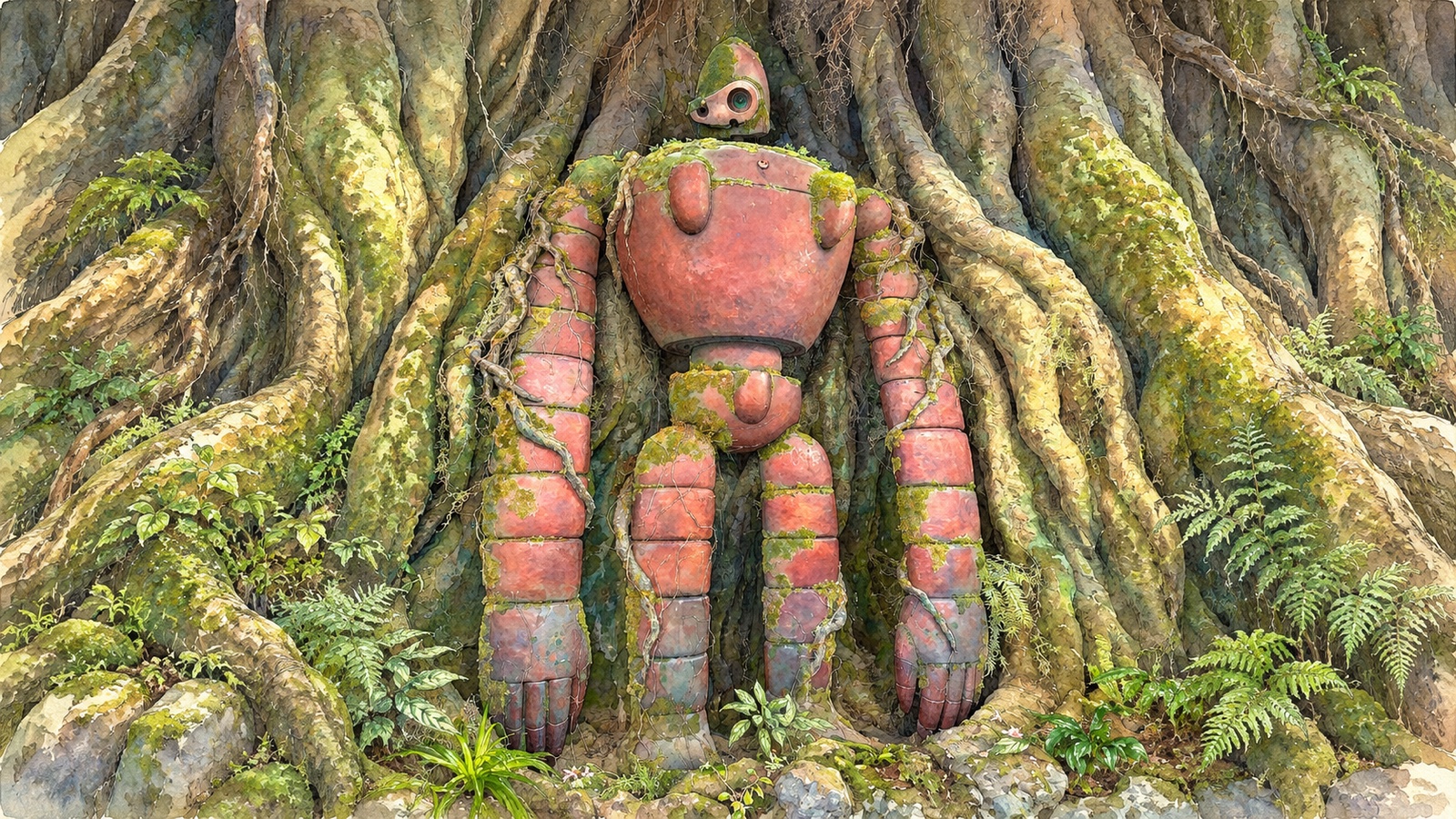
At Ghibli Park in Nagakute, Aichi, a space called “Garden in the Sky” is located inside Ghibli’s Grand Warehouse. It recreates the garden from Castle in the Sky, where a Robot Soldier awaits visitors.
The Grand Warehouse also has a “Open Warehouse” (Open Warehouse), which stores objects and sets used at the Ghibli Museum in Mitaka and at exhibitions in Japan and abroad. Some are shown to visitors, and the displays change over time. Areas recreating scenes from the works, such as the Garden in the Sky, sit alongside spaces that store objects from past exhibitions in the same facility.
The central staircase connects the first and second floors and is decorated with colorful tiles. Above it, under a skylight, a large ship slowly moves with its propellers turning. From the staircase, visitors can look up through the atrium at a flying object set against the full height of the building.
The “Panorama Box Exhibition” features 31 picture boxes created especially by Hayao Miyazaki. Characters and backgrounds are arranged in layers inside each box, creating a sense of depth when viewed through the opening. The works include feature films from Nausicaä of the Valley of the Wind through The Boy and the Heron, as well as short films and original subjects.
A standalone ticket for Ghibli’s Grand Warehouse costs ¥2,000 for adults and ¥1,000 for children ages 4 through elementary school. Morning entry is from opening until 1 p.m.; afternoon entry is from 1 p.m. to 4:30 p.m. Tickets go on sale at 2 p.m. on the 10th of the month two months before the visit. Children ages 3 and under enter free.
Visitors do not need a ticket covering every area of the park to visit the Garden in the Sky, Open Warehouse, video exhibition room, cafe, and shop in the Grand Warehouse. The “Satoyama Stroll Ticket,” however, does not include the Grand Warehouse. For a visit focused on the Grand Warehouse, its standalone ticket is the direct option.
- Location
- 1533-1 Ibaragabasama Otsu, Nagakute, Aichi, inside Expo 2005 Aichi Commemorative Park
- Connection to the work
- The Garden in the Sky, recreating the garden from Castle in the Sky, and a permanent Robot Soldier display
- Entry slots
- Reservation required; morning entry is from opening until 1 p.m., and afternoon entry is from 1 p.m. to 4:30 p.m.
- Admission
- Standalone Ghibli’s Grand Warehouse ticket: ¥2,000 for adults and ¥1,000 for children ages 4 through elementary school
Sources: Ghibli Park — Ticket types and entry times (in Japanese) / Ghibli Park — Ghibli’s Grand Warehouse (in Japanese) / Official Ghibli Park website (in Japanese)
From Wales to Laputa: How real landscapes become a story
The difference between an inspiration and a completed world
Studio Ghibli’s official Q&A explains that many films combine elements from multiple places to create their settings. Although Wales is named in connection with Castle in the Sky, that does not mean every building or mountain in the film has a one-to-one real-world model.
Studio Ghibli’s first feature-length film
Castle in the Sky was released on August 2, 1986. Hayao Miyazaki wrote and directed the film; Isao Takahata produced it, and Joe Hisaishi composed the music. After the release of Nausicaä of the Valley of the Wind, Studio Ghibli was established in 1985 and went on to release this feature-length film.
When the studio was founded, it operated from one floor of a rented office building in Kichijoji. About 70 people were brought together for each film, then disbanded after its completion. Isao Takahata proposed this approach. The studio’s official history recalls that the plan assumed the company would make another film if one succeeded and end if one failed.
In Japan, Castle in the Sky drew 775,000 theatergoers, compared with 915,000 for Nausicaä. It did not begin with the enormous box-office success its later reputation might suggest. After the success of Kiki’s Delivery Service in 1989, the studio shifted to employing staff on a permanent basis, introducing fixed salaries, and hiring new employees regularly.
Sources: Studio Ghibli — Film information (in Japanese) / Studio Ghibli history (in Japanese)
A pre-release guidebook held a gift for director Miyazaki
At the time the film was being made, Toshio Suzuki was an editor at Tokuma Shoten working on the Castle in the Sky Guide Book. He asked the writer Yoshie Hotta to contribute an essay. Suzuki and Miyazaki both read Hotta’s work, and Suzuki made the request because he wanted to encourage the director as he worked on the film.
In a 2004 recollection, Suzuki said Hotta did not agree immediately. During their meeting, Suzuki asked him to write about the future of humanity, and Hotta’s essay “To the People Who Make Animation” was born. Suzuki kept the contribution secret from the director, hoping to surprise him with the finished book.
The guidebook was published before the film’s release and included a report from the production site and a roundtable discussion with the director. It was more than an explanation of the completed film: it was also a book meant to support the people making it. When you browse the museum’s bookshelves or related publications, this story connects the work to the editor and writer beyond the film itself.
Source: Toshio Suzuki recounts requesting an essay from Yoshie Hotta (in Japanese)
Dola’s strength and the wish Pazu inherited from his father
A Nippon TV movie column identifies Miyazaki’s mother as the model for Dola. It describes her as a forceful personality who, despite being bedridden for a long time, was more than a match for her sons. The strength of the airship captain thus carries a memory of someone close to the director.
In the film, Dola appears as a pirate pursuing Sheeta, but eventually welcomes the two children into her crew. Scenes in which she puts Sheeta in charge of the ship’s kitchen or scolds her sons show both the leader of an organization and the head of a family. A portrait of her as a young woman inside the ship is a prop that hints at a life beyond her fierce current appearance.
Family is also part of why Pazu sets out for the castle in the sky. He carries on the wish of his late father, an adventurer, and believes Laputa exists. The story is not only a search for unknown treasure: Pazu wants to see for himself the record of a father whom others did not believe.
Sources: Nippon TV — Column on Dola and her family story (in Japanese) / Nippon TV — Film overview (in Japanese)
Before reaching the floating castle, the two have different lives
The official film introduction describes Pazu as an apprentice mechanic and Sheeta as a girl descended from the Laputian Empire. They do not meet with the same goal. A boy living in a working town and a girl who falls from the sky while being pursued begin traveling together because of the levitation stone.
The floating island named “Laputa” also appears in Jonathan Swift’s Gulliver’s Travels. The original story, screenplay, and direction for this film, however, are by Hayao Miyazaki. The official staff listing says the same; the film is not presented as a screen adaptation of one episode from the novel.
Toshiro Nozaki and Nizo Yamamoto worked on the art, and Tsukasa Tannai was the animation director. “Carrying You” was written by Miyazaki, composed by Joe Hisaishi, and sung by Azumi Inoue. The film’s images and music reflect the work of several creators, not only the director. After your trip, you can follow the views of sky and buildings that stayed with you into art books, or trace the melodies into albums, to learn about each contributor’s work through other sources.
Pazu
An apprentice mechanic who works in a mining town. He believes Laputa exists and carries on the wish of his late father, an adventurer.
Sheeta
A girl descended from the Laputian Empire. She meets Pazu after falling from the sky with a levitation stone.
Dola
An air pirate who leads the airship Tiger Moth with her sons. She pursues Sheeta and Pazu, then eventually welcomes them aboard. A Nippon TV column identifies Miyazaki’s mother as her model.
Hayao Miyazaki
He wrote the original story and screenplay, directed the film, and wrote the lyrics to “Carrying You.” Castle in the Sky was the first feature-length film released by Studio Ghibli, founded in 1985.
Joe Hisaishi
He composed the music, including “Carrying You.” Before the soundtrack album, the image album The Girl Who Fell from the Sky was also created.
Sources: Official home video materials — Story and staff / Studio Ghibli — Film information (in Japanese)
Remembering the Robot Soldier’s two sides
Laputa’s Robot Soldier remains memorable for its immense power and its connection to the small lives in the garden. The contrast between its hard metal body and the softness of flowers and greenery makes the garden scene unforgettable.
Pazu’s work changes the feel of the adventure
Pazu works in a mining town and handles machinery even before fleeing with Sheeta. After joining the air pirates’ ship, he helps with repairs and lookout duty. The adventure does not rely on the mysterious power of the levitation stone alone; practical work with tools and cooperation with others give the story its footing.
Dola’s ship is also a place to live
Aboard Dola’s airship, the Tiger Moth, Pazu helps in the engine room and Sheeta works in the kitchen. The two, who had been on the run, become crewmates with assigned jobs. Dishes, pots, machinery, and the lookout deck make the ship both a means of travel and a home for everyone aboard.
The levitation stone’s glow and sunlight in the garden
The blue light of the levitation stone illuminates characters’ faces and the surrounding rocks in dark tunnels and night scenes. In the garden, the Robot Soldier stands amid the brightness of green and sky. Though the mechanical body is the same, the surrounding light and movement shift between scenes of military power and scenes of protecting the small lives in the garden.
The garden, where human-made structures remain among plants, is the scene most often compared with the ruins on Tomogashima. The real batteries, however, have specific structures for moving shells and defending the strait. Even if a visual resemblance to the film is what first draws you there, learning the site’s actual purpose helps keep the island from being explained only as a fictional castle.
The film and its destinations over time
- June 25, 1872Tomogashima Lighthouse is first litOn the island
- August 16, 1945Tomogashima Lighthouse is temporarily repaired and relitOn the island
- 1985Studio Ghibli is foundedStudio history
- August 2, 1986Castle in the Sky is releasedFilm
- February 28, 2001The Robot Soldier is lifted to the rooftop in MitakaMuseum exhibit
- November 2015Tomogashima Lighthouse is registered as a Tangible Cultural PropertyOn the island
- October 2019The Battery No. 3 sound-art project beginsOn the island
- March 30, 2021The museum releases a video of the rooftop garden at duskMuseum exhibit
- May 2023The museum journal records maintenance of the Robot SoldierMuseum exhibit
- August 1, 2026Wakayama City updates island closure and trail-condition informationOn the island
- From admissions for November 2026 onwardThe museum plans to switch its electronic tickets to a browser-based formatVisitor information
What to know before visiting the island
Tomogashima ferry schedules and same-day boarding tickets
The Tomogashima Kisen ferry takes about 20 minutes from Kada Port to Nonoura Pier on Okinoshima. Under the fare revision effective July 1, 2026, a round-trip ticket costs ¥2,800 for adults and ¥1,250 for children. From March through December, ferries generally do not run on Wednesdays, though they may operate on holidays and during busy seasons. From January through February, they generally run only on Saturdays, Sundays, and holidays, with additional year-end and New Year closure dates.
During the regular season, scheduled departures from Kada Port are at 9 a.m., 11 a.m., 1 p.m., and 4 p.m.; ferries leave Tomogashima at 9:30 a.m., 11:30 a.m., 1:30 p.m., and 4:30 p.m. Extra services may operate during busy periods, but the 3 p.m. departure from Kada is reserved for a pickup and is not available to visitors making a day trip.
Same-day boarding tickets are distributed for the second departure and later. Each ferry carries up to 100 passengers. Distribution may end early during busy periods, and advance reservations are not accepted. Unlike a reserved train ticket, choosing a departure time and arriving at the port does not guarantee a place on board.
Source: Tomogashima Kisen — Service and boarding information (in Japanese)
Prepare for the forest ruins and trails
The island is not a place where you walk only on paved paths through a developed tourist facility. Wear shoes with good grip and bring water. Wakayama City says drinks are sold only around Nonoura Plaza.
On the trail-closure map dated July 31, 2026, closed sections are marked before Shinjagaike Pond and on the path leading to Torashima. The city also explains that restrictions are in place while trees at risk of falling are cut down. Even if an older walking map shows a path, do not enter these closed sections.
The sightseeing route on that map is about 3.3 kilometers and takes around three hours. Though the distance may seem short, the walk includes battery stairs and mountain trails. If you take the 1 p.m. ferry to the island, only about three hours and ten minutes remain before the regular final ferry. A full loop including the Battery No. 3 ruins, ammunition-depot ruins, and Kosukematsu Beach takes about three hours; the 1 p.m. ferry leaves about three hours and ten minutes before the 4:30 p.m. final return boat.
Source: City trail-closure map, July 31, 2026 edition (in Japanese)
Choose between Mitaka and Aichi based on your visit
The museum in Mitaka is open from 10 a.m. to 6 p.m., with the last admission slot at 4 p.m. Visitors choose an entry time between 10 a.m. and 4 p.m. in one-hour increments and must enter within an hour of the selected time. The museum does not use timed sessions that require visitors to leave at a set time. It is generally closed on Tuesdays, with additional extended closures.
Admission costs ¥1,000 for adults and university students, ¥700 for junior and senior high school students, ¥400 for elementary school students, and ¥100 for children ages 4 and up. Children under 4 enter free and do not need a reservation. Tickets for the following month go on sale at 10 a.m. on the 10th of each month; tickets are not sold at the museum entrance. Starting with admissions for November 2026, electronic tickets will move from a smartphone app to a browser-based format. Paper tickets can be picked up at Lawson stores.
Source: Ghibli Museum, Mitaka — How to buy tickets (in Japanese)
Enjoy the afterglow of the film through exhibits and music
Five different music albums for the same film
Tokuma Japan introduces The Girl Who Fell from the Sky, an image album created before the soundtrack. The album was based on ideas Hayao Miyazaki and Isao Takahata shared with Joe Hisaishi; it helped shape the film’s musical identity before the animation was complete.
The soundtrack, which collects music used in the film, is titled The Mystery of the Levitation Stone and includes “Carrying You.” The symphonic album The Tree of Heaven features more than 60 musicians performing pieces from the image album. Even when the melody is the same, the arrangements differ between music used in the film and music reworked for orchestra.
There is also the two-disc drama album Let There Be Light Again!, with dialogue, music, and sound effects, as well as a Hi-Tech series exploring other musical approaches. Albums on the same “Laputa music” shelf include different listening experiences: the complete sound of the film, individual songs, and new arrangements.
The original vinyl jackets also differ. The Girl Who Fell from the Sky uses the theatrical poster image of Pazu and Sheeta, while The Mystery of the Levitation Stone features the Tiger Moth. The official product information also describes a double jacket that includes a reproduction cel.
Source: Tokuma Japan — Laputa music releases (in Japanese)
You can revisit the film itself on Blu-ray and DVD released by Disney.
Following the sky’s depth through background art
Nizo Yamamoto’s Background Art Collection combines an art book with explanations of painting techniques. It features backgrounds and art boards from films he art-directed, including Castle in the Sky, Grave of the Fireflies, and Princess Mononoke, and discusses how to depict the sky and clouds, water, earth, and fire.
Yamamoto was born in Goto, Nagasaki, in 1953 and studied architecture in high school. While attending an art vocational school, he began working at an animation art studio. He first served as art director on the 1978 TV series Future Boy Conan. He spent a long career drawing the places where characters run, work, and look up at the sky.
The table of contents includes “Washing and Inking,” so the book covers the process of drawing as well as finished art. It opens with a text by Isao Takahata and later includes a contribution by Hayao Miyazaki and an interview with Yamamoto himself. It is a book recommended by the Ghibli Museum’s official shop for anyone interested in background art.
Source: Ghibli Museum Official Shop — Nizo Yamamoto Background Art Collection (in Japanese)
The rooftop garden at dusk in an official video
The museum’s official video journal includes a short film of the rooftop garden at dusk, released in 2021. Trees and sky surround the Robot Soldier. Regular public hours currently end at 6 p.m.; this video does not announce an evening opening for general visitors.
Source: Museum official video journal — Rooftop garden at dusk (in Japanese)
Research note | A business perspective: connect an association to local history
Even though Tomogashima has not been confirmed as a filming location, it still welcomes visitors to its ruins. One specific initiative by the city is the Battery No. 3 sound-art project, launched in 2019. Rather than adding a large exhibition facility, it combines the existing darkness and quiet with an audio app, offering another way to experience the battery space.
The Mitaka museum’s records, meanwhile, describe a year and a half of work to make the statue, a crane lifting its 2.5 metric tons, and maintenance by its creator. This is the work required to preserve an exhibit that brings a design into three dimensions. A region with scenery that evokes the film and an official facility that creates its forms differ not only in what draws visitors but also in how each place is maintained.
Sources and pages to open before your trip
Tomogashima Kisen posts daily service notices, and Wakayama City’s Tourism Division publishes information about island trail closures. Strong-wind forecasts can cancel every ferry, so whether it is sunny is not enough to determine if the island is accessible.
FAQ
Is Tomogashima an official model for Castle in the Sky?
No. Studio Ghibli names Wales as a place that inspired the film. Tomogashima is known for brick battery ruins surrounded by forest that bring the movie to mind.
Can visitors freely explore every battery and island on Tomogashima?
No. Some areas are closed or restricted, and not every island is open to visitors.
Where can I see an official Robot Soldier display?
In the rooftop garden at Ghibli Museum, Mitaka, and in the Garden in the Sky at Ghibli Park’s Ghibli’s Grand Warehouse. Check ticket and entry requirements for each.
Does the Tomogashima ferry run every day?
No. Ferries generally do not run on Wednesdays from March through December, and winter service is limited to weekends and holidays. Strong winds can cancel service. Same-day boarding tickets are used from the second departure onward, and advance reservations are not accepted.
Can I enter Battery No. 2 and Battery No. 3 under the same conditions?
No. The interior of Battery No. 2 is closed, so visitors view it from outside. The open areas of Battery No. 3 include underground rooms, but check local restrictions and prepare for darkness and uneven footing.
Can I visit only the rooftop garden at the Ghibli Museum in Mitaka?
You need admission to the museum, which includes the rooftop garden. Tickets are ¥1,000 for adults and university students and require a reserved entry time. You cannot enter the rooftop directly from nearby Inokashira Park.
Do I need a ticket covering every area of Ghibli Park?
No. A standalone ticket for Ghibli’s Grand Warehouse, which includes the Garden in the Sky, costs ¥2,000 for adults and ¥1,000 for children ages 4 through elementary school. Choose a morning or afternoon entry slot. The Satoyama Stroll Ticket does not include the Grand Warehouse.
More in Pilgrimage

Soccer Pilgrimage: National Stadium, 2002 World Cup Venues, and blue-ing!

Film "Kokuhou" Pilgrimage Guide: Izushi Eirakukan, Biwako Otsukan, Kyoto Kaburenjo Theaters & Dojo-ji Temple
