
Tamagotchi at 30: From the Sellout Lines of 1996 to 100 Million Units and a Digimon Swap
On November 23, 2026, Bandai’s Tamagotchi turned 30. At 10 a.m. that same day, preorders opened for an anniversary set that swaps its characters with another Bandai series, Digimon. It is a pair of devices: you raise Digimon inside a Tamagotchi shell, and Tamagotchi inside a Digimon shell.

Feed the little creature on the screen, clean up its poop, and watch it grow. That loop has not changed in 30 years. What has changed, several times over, is why Tamagotchi sold and where people played with it. Bandai itself divides the toy’s history into four numbered booms: the original in 1996, the infrared model of 2004, the color screens, films and anime from 2008, and the Heisei-retro revival of the 2020s. This article walks through those four booms and the projects launched for the 30th anniversary, with dates and the conditions for taking part laid out side by side.
Thirty Years at a Glance
| When | What happened |
|---|---|
| November 1996 | The original Tamagotchi goes on sale |
| 1997 | Shortages continue; an English-language version launches in the United States in May |
| Fiscal year to March 1999 | The boom ends with surplus stock and an extraordinary loss of about ¥6 billion |
| March 2004 | Kaettekita! Tamagotchi Plus, with infrared communication, goes on sale |
| August 2007 | The first official shop, Tamagotchi Department Store, opens at Tokyo Dome |
| November 2008 | Tamagotchi Plus Color, with a color screen, goes on sale |
| 2018 | Original Tamagotchi launches overseas; Japan follows in 2022 |
| November 2021 | Tamagotchi Smart, worn on the wrist, goes on sale for the 25th anniversary |
| July 2023 | Tamagotchi Uni, which connects over Wi-Fi, launches worldwide at the same time |
| July 2025 | Tamagotchi Paradise goes on sale; cumulative shipments pass 100 million |
| November 2026 | The 30th anniversary; preorders open for the Digimon set |
The events in this table are drawn from Bandai’s announcement of its 30th anniversary initiatives (in Japanese), its announcement of 100 million units shipped (in Japanese) and the history page on the official Tamagotchi website (in Japanese).
1996: From a Wristwatch Plan to a Toy on a Schoolbag
According to Bandai, the Tamagotchi began its development as a wristwatch. The idea was that owners could wear it all the time and care for their pet whenever it needed them. The name reflects that plan: it combines the egg (tamago) shape with the word “watch.”
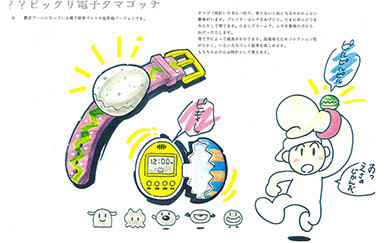
As street surveys and development went on, the design changed, and the toy went on sale as something worn on a ball chain. Bandai recalls that after the launch on November 23, 1996, many high school girls could be seen with Tamagotchi clipped to their schoolbags, caring for them through the day.
The starting point, as one account tells it (in Japanese), was a newspaper article. Akihiro Yokoi of the planning company WiZ read about the popularity of Aquazone, a PC game in which players raise tropical fish. In that game, fish die if you stop feeding them for a few days. Yokoi combined the idea with his own experience of keeping pets.
Bandai credits several things for the toy’s popularity. It was a pioneer of the digital pet. It took on the idea of death so that the pet would feel like a living creature. And its characters were quirky beings that nobody could quite identify.
1997: Ten Thousand Calls a Day From People Who Could Not Buy One
At the time, the Japanese toy industry considered a product that sold one million units a big hit. The Tamagotchi reached 10 million units in Japan and overseas within eight months of its launch, and it sold 40 million in two and a half years.
Production could not keep up. Calls from people saying they could not buy one passed 10,000 a day, and Bandai took the unusual step of running a newspaper apology.
Overseas, an English-language TAMAGOTCHI went on sale in the United States in May 1997. At the flagship store of FAO Schwarz, the long-established New York toy store, 10,000 units sold within 24 hours of going on sale.
That year, “Tamagotchi” made the top ten of Japan’s annual buzzword awards (in Japanese). The Ig Nobel Prizes, which honor research and achievements that first make people laugh and then make them think, gave the 1997 Economics Prize to Akihiro Yokoi of WiZ and Aki Maita of Bandai. The citation credited them with diverting millions of person-hours of work into the husbandry of virtual pets.
New models kept coming. From Shinshu Hakken!! Tamagotchi (“New Species Discovered!!”) in February 1997 to Umi de Hakken!! Tamagotchi (“Discovered at Sea!!”) in March 1998, five new models went on sale in Japan in just over a year.
But according to Bandai, the boom ended, partly because counterfeit products flooded the market, and the company was left with large amounts of unsold stock. In the fiscal year ending March 1999, it booked an extraordinary loss of about ¥6 billion (roughly $40 million).
2004: Infrared Links Let Friends Connect Their Tamagotchi
Around 2002, Bandai heard that high school girls were playing with the old Tamagotchi again. The company says this convinced it that raising a pet was a kind of fun that does not go out of date. For the new model, it drew on the lesson of the many counterfeits that had appeared with the original. It reused the original body shape, which it had protected with a design registration, the legal right that protects a product’s look, and it kept the product design out of advertising before launch.
The new feature was infrared communication. Bandai noticed that adults at the time were swapping email addresses and photos over the infrared ports of their mobile phones. Kaettekita! Tamagotchi Plus (“Tamagotchi Plus Is Back!”), released in March 2004, was the first model that let owners link their Tamagotchi with each other.
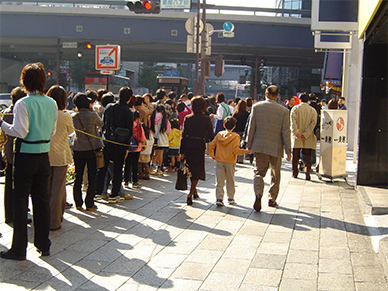
On release day, parents and children formed lines outside stores. Against a sales plan of two million units a year, about five million sold in the first year. Bandai explains that the toy caught on among children who wanted to play at doing what adults did, and spread among elementary school students as a way to keep in touch with friends.
A Tamagotchi-only event held in 2006 for the 10th anniversary drew 50,000 people over two days. In 2007, cumulative shipments in Japan and overseas passed 70 million. On August 10 that year, the first official shop, Tamagotchi Department Store, opened at Tokyo Dome. It has since closed.
In November 2008, Tamagotchi Plus Color brought a color screen, which could show the time of day and the seasons through sunsets and snow. Tamagotchi then became films and a TV anime series, and the characters became known beyond the toy itself. This period from 2008 is what Bandai calls the third boom.
From 2018: Tamagotchi Chosen in an Oshi Color
At the center of what Bandai calls the fourth boom is Original Tamagotchi. The series is based on the Western versions of the original and Shinshu Hakken!! Tamagotchi, released in a wide range of shell colors and patterns. It launched overseas in 2018 and in Japan in 2022, as Heisei retro, the trend of enjoying things that were popular in the Heisei era with fresh eyes, was gaining ground, and it has been through many collaborations with fashion brands and artists. Cumulative sales of the series reached 11.52 million units by the end of July 2025.
Bandai notes that many young people now clip a Tamagotchi in their oshi color, the color that stands for the person they support, to their clothes or bags. The device that high school girls hung on their schoolbags in 1996 is now chosen in an oshi color and carried around.
The features have changed too. On November 23, 2021, the 25th anniversary, Bandai released Tamagotchi Smart (in Japanese), a wearable model for the wrist, at ¥6,380 including tax. Tamagotchi Uni, which connects over Wi-Fi, launched worldwide at the same time in July 2023, and the latest model, Tamagotchi Paradise, joined the lineup in July 2025.
On July 31, 2025, cumulative shipments of the series in Japan and overseas passed 100 million units. Bandai has released 38 models so far, and Tamagotchi is now sold in more than 50 countries and regions.
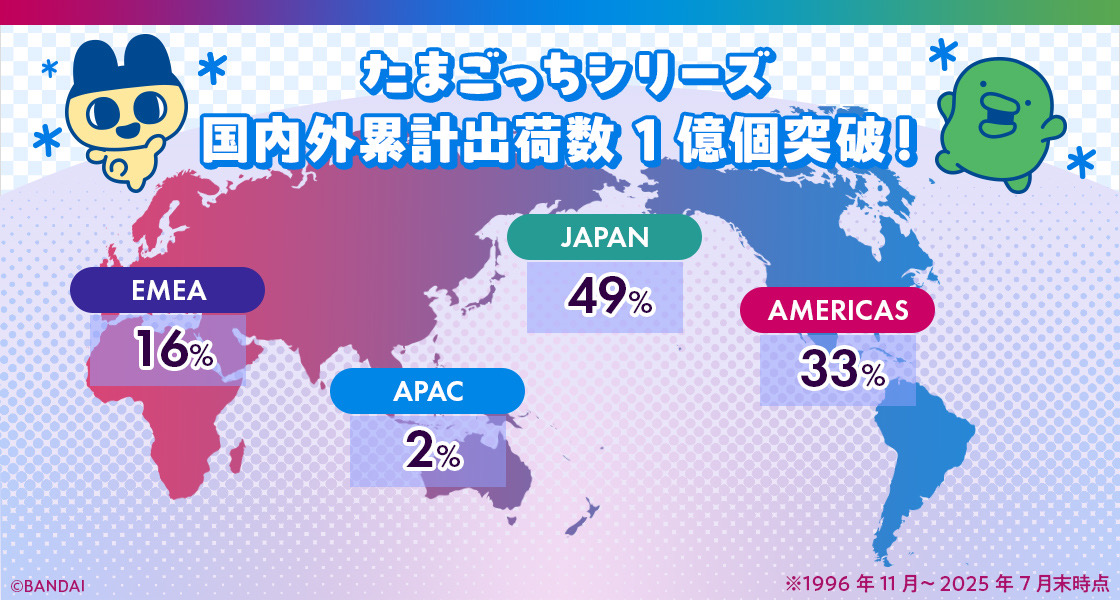
Of those 100 million units, 49% went to Japan. The Americas took 33%, Europe, the Middle East and Africa 16%, and Asia-Pacific outside Japan 2%, so more than half were shipped overseas. According to Bandai, worldwide sales of Tamagotchi devices and related merchandise, excluding games, grew roughly sevenfold in the five years from 2019.
- 49%
- Japan
- 33%
- The Americas
- 16%
- Europe, the Middle East and Africa
- 2%
- Asia-Pacific outside Japan
More than half of all Tamagotchi have been shipped outside Japan.
Bandai also says that around the world, people who raised a Tamagotchi as children have become parents and are playing with one again alongside their own kids.
When the 100 million milestone was announced, Taro Tsuji, a managing director of Bandai who oversees character strategy for Tamagotchi as its “CTO,” or Chief Tamagotchi Officer, looked ahead to the 30th anniversary the following year.
The Tamagotchi series will celebrate its 30th anniversary next year. We would be delighted to keep bringing everyone lots of laughter and joy through the days they spend with their Tamagotchi, as “pets that stay close to people’s hearts.”
—Taro Tsuji, Managing Director and CTO, Bandai (from the announcement of 100 million units shipped, in Japanese; our translation)
The 30th Anniversary Projects, in the Order They Began
Bandai launched its “Tamagotchi 30th anniversary year” on November 23, 2025. Here are the main projects, listed in the order they began.
| When | Project and place |
|---|---|
| From November 22, 2025 | Permanent store Tamagotchi Factory! (Tokyu Plaza Harajuku “Harakado”) |
| December 19, 2025 | Uniqlo’s UT Tamagotchi collection goes on sale |
| From January 7, 2026 | The 30th Anniversary Grand Tamagotchi Exhibition (touring Japan from Tokyo) |
| From May 1, 2026 | The Everyone Gather! Tamagotchi Shop pop-up store (touring Japan) |
| November 6, 2026 | Original Tamagotchi Stranger Things announced |
| November 7 to December 6, 2026 | Super Tamagotchi Festival in ShibuHara (Harajuku and Shibuya) |
| From November 13, 2026 | Tamagotchi fair at 7-Eleven (nationwide) |
| November 21, 2026 | Tamagotchi Paradise – Neon Planets goes on sale |
| November 22, 2026 | Tamagotchi Times Square Spectacular (New York, local time) |
| November 23, 2026 | Preorders open for the Digimon set; a 30th anniversary animation is released |
Tamagotchi at 30An anniversary year that began on November 23, 2025
- A permanent storeTamagotchi Factory! in Harajuku
- A touring exhibitionFrom Tokyo across Japan into 2027
- A street festivalExhibits and a stamp rally in Harajuku and Shibuya
- Convenience storesA nationwide 7-Eleven fair
- OverseasA screen takeover in Times Square
- Online playAn anniversary event on Roblox
- A collector's setDigimon and Tamagotchi swap places
A Permanent Store in Harajuku and an Exhibition That Tours Japan
Tokyu Plaza Harajuku “Harakado” is a shopping complex in Harajuku, Tokyo. On November 22, 2025, the permanent store Tamagotchi Factory! opened on its third floor. It builds on the merchandise range of Tamagotchi no Omise, the existing official Tamagotchi shops, and adds hands-on activities. One of them is exclusive to this store: Minitama Tsumehodai, where visitors fill a special bottle with small Tamagotchi figures.
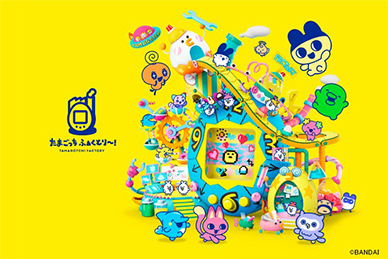
The 30th Anniversary Grand Tamagotchi Exhibition (Dai Tamagotchi Ten) combines a look back over 30 years of history with experiences designed to feel like stepping inside a Tamagotchi. It opened in Tokyo and has been touring Japan since.
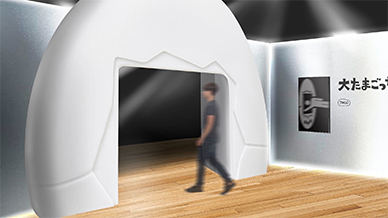
According to the official website (in Japanese), the venues and dates are as follows.
| Venue | Dates |
|---|---|
| Tokyo: Roppongi Museum | January 7 to February 2, 2026 |
| Aichi: Nagoya PARCO | March 6 to April 5, 2026 |
| Ibaraki: Mito Keisei Department Store | April 24 to May 6, 2026 |
| Hokkaido: Sapporo Factory | June 6 to June 28, 2026 |
| Osaka: Daimaru Umeda | August 6 to August 26, 2026 |
| Fukuoka: Fukuoka Mitsukoshi | December 29, 2026 to January 25, 2027 |
| Ishikawa and Hyogo | Spring 2027 (details to be announced) |
The national tour is scheduled to end around winter 2027. At the Tokyo venue, merchandise sold out on the first day. The organizers apologized and offered visitors to the Tokyo venue an after-event mail-order sale, in which some exhibition-exclusive goods are sold by mail order once the run has ended. Another after-event mail-order sale of some exclusive goods is planned once the national tour is over.
The pop-up store Everyone Gather! Tamagotchi Shop (in Japanese) is also touring stations and shopping centers, from Tokyo Station in May 2026 to Tennoji in Osaka in March 2027. Sold there is Original Tamagotchi Happy 30th! (in Japanese), an anniversary model with a clear shell based on the original, priced at ¥4,500 including tax.
Super Tamagotchi Festival and “Excavated” Relics From 3,000 Years Ago
From November 7 to December 6, 2026, the “Happy 3,000th Anniversary!? Super Tamagotchi Festival in ShibuHara” is running, with its main venue on the fourth floor of Harakado. ShibuHara is a blend of Shibuya and Harajuku. The “3,000th anniversary” in the name comes from a storyline. On August 26, while the venue for the Tokyo Toy Show was being set up, a “mysterious stone tablet” was found carved with figures resembling the characters Mametchi and Kuchipatchi, and a theory arose that Tamagotchi were really 3,000 years old. The venue displays that tablet and other “excavated relics” (Mynavi News, in Japanese).
The venue also has a display of past models, a pop-up cafe and photo sticker booths with Tamagotchi frames. Stamp rally cards for collecting stamps at participating shops around Harajuku and Shibuya are handed out free of charge. On the first two days, November 7 and 8, visitors needed numbered tickets, allocated by lottery in advance, to enter the exhibition and shop areas.
There is more to do outside the venue. In Tama Atsume (“Tamagotchi Collecting”), visitors search the streets of ShibuHara for 30 kinds of Tamagotchi hidden around the neighborhood, using hints posted on the official website. When you find one, you report it on social media with the hashtag #たまあつめ. Two days before the festival opened, the official Tamagotchi YouTube channel announced the game in a video of about a minute, framed as an “emergency news report from the Tamagotchi Lab.”
Collaboration Food and an Exclusive Tamagotchi at 7-Eleven
7-Eleven stores across Japan began rolling out a Tamagotchi fair (in Japanese) from November 13. It includes six collaboration items, such as Mametchi’s custard and milk cream crepe and a Tamagotchi cheese steamed bun, and shoppers who buy selected snacks, ice cream or drinks receive exclusive goods while supplies last. A campaign to collect digital Tamagotchi stickers in the LINE messaging app runs until December 2.
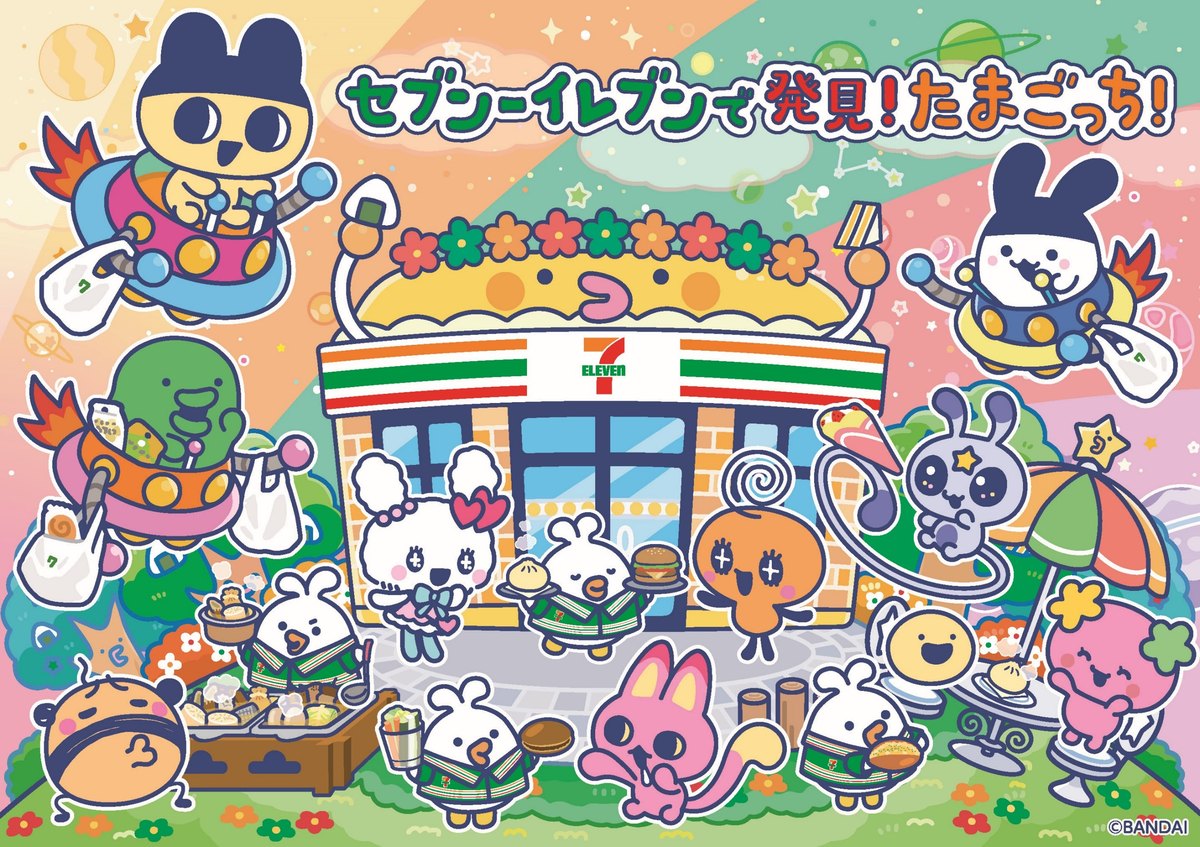
In the announcement, a Seven-Eleven Japan representative explained why the company planned the fair.
We hope the fair will let people feel nostalgia at being reunited with the Tamagotchi they raised so devotedly as children, and give children who enjoy Tamagotchi today an easy way to join in.
—A Seven-Eleven Japan representative (from the November 10, 2026 announcement, in Japanese; our translation)
The store-exclusive device, Original Tamagotchi Gourmet Star, uses 30th anniversary artwork and costs ¥3,080 including tax. In June 2026, Seven-Eleven Japan set up an “IP & Content Strategy Department” that serves as a single point of contact for companies that hold the rights to works and characters (AdverTimes., in Japanese). We also covered the background to the fair in our weekly oshi-katsu news for November 13, 2026.
New York, Netflix and Online Games
Overseas, the Tamagotchi Times Square Spectacular (in Japanese) took place in New York on November 22, local time. The giant screens of Times Square played a 30th anniversary show, and nearby Duffy Square hosted a pop-up where visitors could meet Mametchi and Mimitchi. Past models and the latest Tamagotchi Paradise were available to try, and admission was free.
A collaboration model with the Netflix series Stranger Things, Original Tamagotchi Stranger Things, was announced (in Japanese) on November 6. It uses a special screen designed to represent the show’s Upside Down and is scheduled to go on sale on February 27, 2027. On November 21, a new Tamagotchi Paradise device, Neon Planets (in Japanese), also went on sale.
Owners of the Wi-Fi-enabled Tamagotchi Uni can download (in Japanese) anniversary accessories, a Cake Hat and a Mametchi Balloon, with a code. On Roblox, an online service where people play games made by other users, a 30th anniversary event (in Japanese) is running in a New York–themed area until December 1.
The Digimon “Swap” Set, Opened for Preorder on the Anniversary Itself
Digimon is a series that began with Digital Monster, an LCD toy that Bandai released on June 26, 1997. On its small screen, you raise a Digimon, help it evolve and pit your strengthened Digimon against others in battle (official Digimon website, in Japanese). In 1999, the TV anime Digimon Adventure began airing.
Tamagotchi turned 30 on November 23, 2026, and Digimon turns 30 on June 26, 2027. To mark both milestones, preorders opened on Premium Bandai on November 23 for the “Celebrating 30 Years Set!! DIGIMON TAMAGOTCHI & TAMAGOTCHI DIGIMON” (the maker’s announcement, in Japanese). Premium Bandai is the official online store of the Bandai Namco Group.
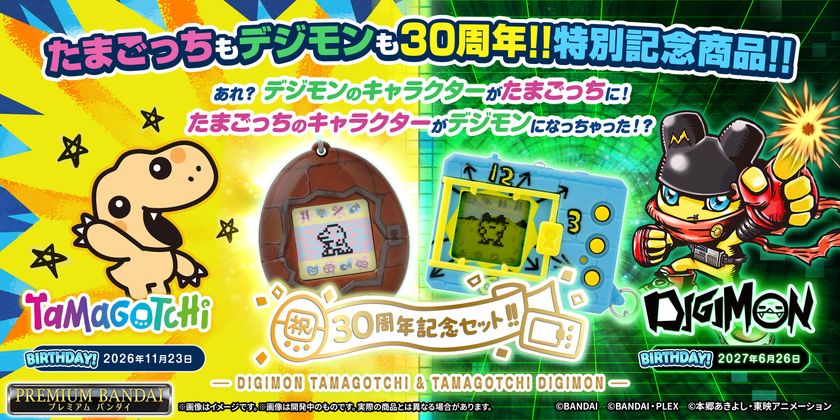
DIGIMON TAMAGOTCHI is a Tamagotchi shell in which you raise Digimon. It features Digimon reimagined as Tamagotchi, such as Agumontchi and Greymontchi. The other device, TAMAGOTCHI DIGIMON, is a Digimon shell in which you raise Tamagotchi reimagined as Digimon, such as Mamechimon and Kuchipamon. On both, the way you care for your pet changes what it grows into.
DIGIMON TAMAGOTCHI
- A Tamagotchi shell
- Raise Digimon reimagined as Tamagotchi
- Agumontchi and Greymontchi
TAMAGOTCHI DIGIMON
- A Digimon shell
- Raise Tamagotchi reimagined as Digimon
- Mamechimon and Kuchipamon
On both devices, how you care for your pet changes what it grows into.
The illustrations of Tamagotchi reimagined as Digimon were drawn by the illustrator Kenji Watanabe. On the day of the announcement, Watanabe posted on X (in Japanese) that both Tamagotchi and Digimon are characters he created (our translation), and congratulated both series on their 30th anniversaries.
| Item | Details |
|---|---|
| Price | ¥8,800 including tax (shipping and handling extra) |
| Preorder period | 10:00 on November 23 to 23:00 on December 22, 2026, Japan time (planned) |
| Delivery | June 2027 (planned) |
| Age | 8 and up |
| Batteries | One CR2032 included with each device |
It will be about half a year between preorder and delivery. The planned delivery month is the month in which Digimon turns 30. Note that TAMAGOTCHI DIGIMON can only battle by link with other units from this anniversary set.
On the anniversary itself, the official Tamagotchi YouTube channel also released a short animation of about a minute.
What to Check Before Joining the Anniversary Events
Each anniversary project has its own dates, delivery timing and conditions. Before you head out or place a preorder, check the following.
- Preorder deadline: Preorders for the Digimon set are scheduled to close at 23:00 on December 22, Japan time. Sales may also end early once the prepared quantity is reached.
- Entry: At the Tokyo venue (in Japanese), the Grand Tamagotchi Exhibition used timed-entry tickets on every day, and no same-day tickets were sold at the venue for time slots that had sold out. Check how tickets are sold at each touring venue on the official site.
- First come, first served: 7-Eleven’s exclusive goods are handed out first come, first served and end when they run out. Release dates may also differ from store to store.
- Batteries and devices: To download exclusive items at the Grand Tamagotchi Exhibition, bring your own Tamagotchi Paradise. The venue does not provide batteries.
- Age requirements: Only Roblox accounts for users aged 13 and over can receive the exclusive items in the Roblox event. If you are taking part with children, check the account conditions first.
Notes From The Oshi Lab: What Lasted 30 Years Is the Daily Care
Line up the 30 years and the features keep changing, from infrared links to color screens to Wi-Fi, but the heart of the play stays the same: carrying your pet with you and caring for it every day. The device clipped to a schoolbag in 1996 is now chosen in an oshi color and carried around. We think that the time spent wearing it and living alongside it is exactly where Tamagotchi overlaps with oshi merch.
The 30th anniversary offers many ways in: a permanent store, a touring exhibition, a street festival, convenience stores, events overseas, online games and a collector’s set. A company planning its own anniversary could list, for each of those entry points, who can take part, when, and what they need to bring. That makes it easier for newcomers to pick the project that suits them.
Preorders for the Digimon set opened on Tamagotchi’s 30th anniversary, and the set is due to arrive in the month Digimon turns 30. Linking the anniversaries of two series owned by the same company through a single product may be a useful model for other companies with long-running characters.
For advice on anniversary campaigns and character merchandise, contact KAZAORI Inc. You can also try our free Oshi Score Check.
Related reading: Why Heisei Retro Came Back as 2026 Oshi-Katsu / How Capsule Toys Became a ¥100 Billion Market / Oshi-Katsu Chronicle 1996 / Oshi-Katsu Chronicle 1997 / What Is an Oshi Color?
FAQ
When did the Tamagotchi first go on sale?
Bandai released the original Tamagotchi on November 23, 1996. November 23, 2026 marked 30 years since that launch.
How many Tamagotchi have been shipped?
According to Bandai, cumulative shipments of the series in Japan and overseas passed 100 million units on July 31, 2025. Japan accounted for 49% of them, and the remaining 51% went overseas.
Where does the name Tamagotchi come from?
According to Bandai, the toy was first planned as a wristwatch, so the name combined the egg (tamago) shape with the word watch. By the time it went on sale, it had become a toy worn on a ball chain.
When will the Digimon and Tamagotchi anniversary set arrive?
Preorders on Premium Bandai are scheduled to run from 10:00 on November 23 to 23:00 on December 22, 2026 (Japan time), with delivery planned for June 2027. The price is ¥8,800 including tax, with shipping and handling charged separately.
Where can I still see the Grand Tamagotchi Exhibition?
The official website lists a run at Fukuoka Mitsukoshi from December 29, 2026 to January 25, 2027, followed by Ishikawa and Hyogo in spring 2027. Check the official site for dates and tickets.


