

Botchan Pilgrimage: Dogo Onsen, the Restored Train, Gudabutsuan, and Tokyo Exhibits
At Dogo Onsen Main Building in Matsuyama, you can bathe and relax afterward in a private room on the third floor. That floor also has the “Botchan Room,” said to have been used by Natsume Soseki and his friend Masaoka Shiki. Taking “Sumita Hot Spring,” where the young teacher in Botchan went, as a clue, this guide visits the building and places connected with the author.
Highlights also include the Botchan Train, a restored version of the “matchbox-like train” in the novel, and an original locomotive preserved by the sea. From Matsuyama’s hot springs and literary sites to a theater in Toon and special-exhibition venues in Tokyo, this guide visits 11 places connected with the book and Soseki.
11 places connected with Natsume Soseki’s Botchan: Dogo Onsen Main Building, the Botchan Train, Gudabutsuan, and the former Tokyo School of Physics in Kagurazaka
The novel does not name the town; it calls the hot-spring town “Sumita” and the station where the train stops “Furumachi.” This guide covers eight places in Dogo and Matsuyama, a theater in Toon, and two museums in Tokyo. Event dates, opening hours, and ticket details reflect information available when this article was written. Check each official website for the latest information before your visit.
1. Dogo Onsen Main Building
This nationally designated Important Cultural Property is a public bath with a private room on the third floor—the novel’s “first-class” bath—and the “Botchan Room,” said to have been used by Soseki and Shiki.
Learn more about Dogo Onsen Main Building2. Botchan Train
This train, restored in 2001, is modeled on the steam locomotive described in the novel as looking like a “matchbox.” It runs on Saturdays, Sundays, and national holidays.
Learn more about the Botchan Train3. Botchan Karakuri Clock
Figures of characters from the novel emerge from a clock modeled on the Shirasagikaku tower. A free footbath fed directly by a hot spring is next to it.
Learn more about the Botchan Karakuri Clock4. Shiki Memorial Museum
A museum introducing the life of Masaoka Shiki, Soseki’s close friend. Its permanent exhibition includes a section on “Botchan and Matsuyama.”
Learn more about the Shiki Memorial Museum5. Gudabutsuan
The house where Soseki lodged and lived with Shiki for 52 days. It was rebuilt on July 24, 2026, and admission is free.
Learn more about Gudabutsuan6. Botchan Train Museum
A free museum displaying a life-size replica of the No. 1 locomotive and train parts not usually open to public view.
Learn more about the Botchan Train Museum7. Baishinji Park
The original No. 1 locomotive and a passenger carriage that ran for 67 years from 1888 are on display here. They are designated Tangible Cultural Properties by Ehime Prefecture.
Learn more about Baishinji Park8. Turner Island
During a fishing scene, the character Nodaiko suggests naming this island “Turner Island.” It is a nationally registered scenic monument.
Learn more about Turner Island9. Botchan Theater
This musical theater opened in 2006. A monument depicting the Botchan Train and characters from the novel stands at the entrance.
Learn more about Botchan Theater10. Soseki Sanbo Memorial Museum
A museum on the grounds of the house where Soseki spent his later years. A special exhibition marking 120 years since the novel’s publication runs through December 6, 2026.
Learn more about the Soseki Sanbo Memorial Museum11. Museum of Modern Science
This museum belongs to the university descended from the “School of Physics” from which the protagonist graduated. Its exhibition “The School of Physics and Soseki” runs through December 4, 2026.
Learn more about the Museum of Modern Science
1Dogo Onsen Main Building | The third-floor private room once called “first-class” and the Botchan Room
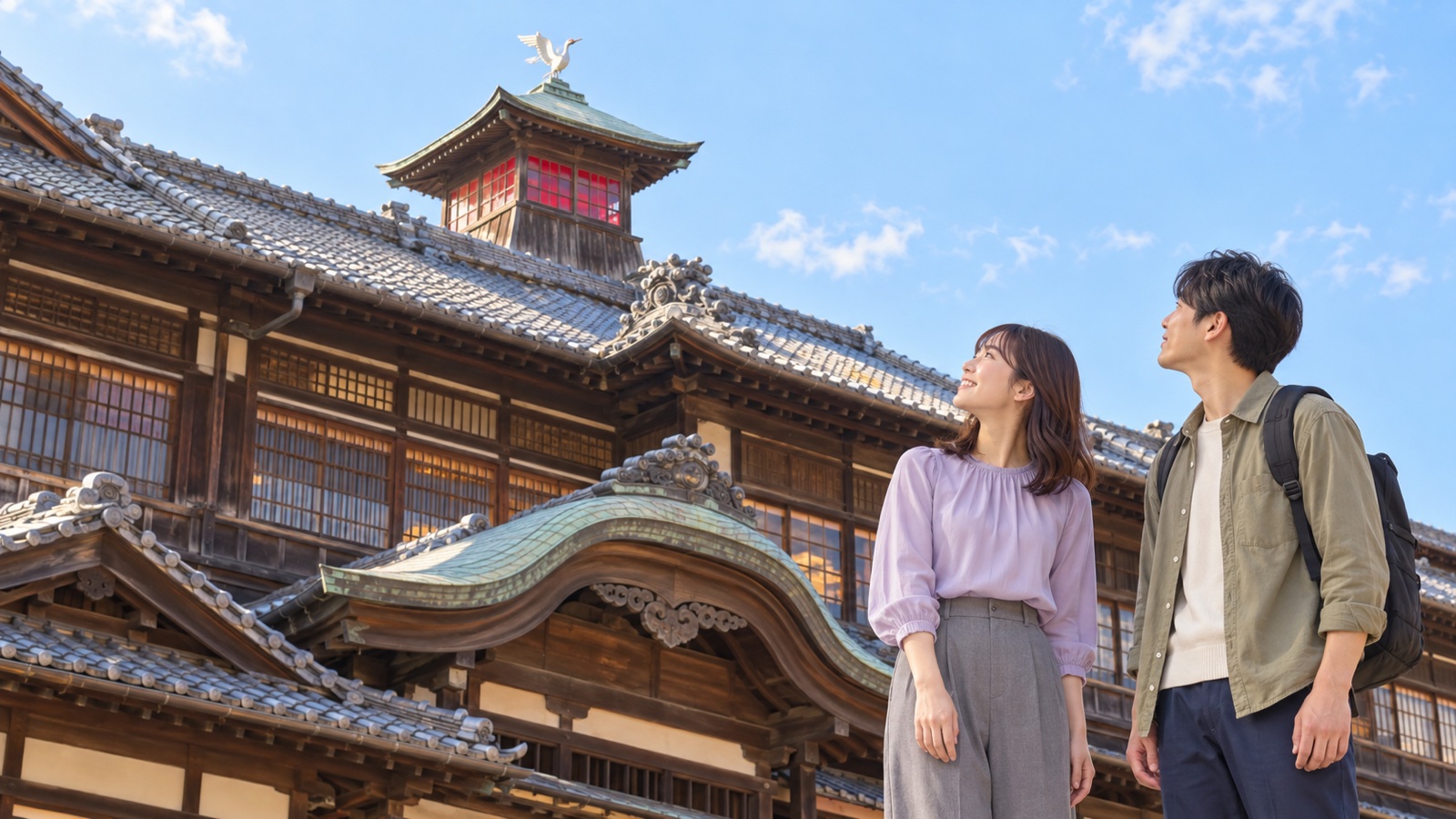
The protagonist decides to visit Sumita Hot Spring every day in the town where he has been posted. Sumita is a hot-spring town “about ten minutes by train from the castle town, or thirty minutes on foot.” Its newly built bathhouse is on the third floor; a “first-class” bath included a yukata and attendant for eight sen. The protagonist always chooses first class, and is told, “It’s extravagant to take a first-class bath every day on a 40-yen monthly salary.”
The bath was lined with granite blocks and divided into spaces about 15 tatami mats in size. When no one else was around, the protagonist swam around in it. One day, however, a sign was posted reading, “Swimming in the bath is prohibited.” Because he always carried a large Western-style towel colored by the hot-spring water and dye released from its red stripes, his students also called him “Red Towel.”
Dogo Onsen Main Building’s Kami-no-Yu wing is a three-story wooden structure completed in 1894. The baths are on the first floor and lounges on the second and third. Above the large roof rises Shirasagikaku, with red glass windows and a white heron ornament. The time drum struck from Shirasagikaku has marked the hours in Dogo since the building was reconstructed and was selected as one of Japan’s 100 Soundscapes. In December 1994, the building became the first public bathhouse designated a National Important Cultural Property.
The private third-floor room in Tama-no-Yu was once called “first-class.” Dogo Onsen Main Building introduces the room with a quotation from the novel: “I always took the first-class bath.” The adult admission is ¥2,500, including bathing in both Kami-no-Yu and Tama-no-Yu, 90 minutes of rest in a private room, and a visit to Yushinden, the bath reserved for the Imperial Family. A 60-minute rest in the large second-floor Kami-no-Yu hall, with yukata, tea, and sweets, costs ¥1,300 for adults. The hall accommodates about 70 people and has bamboo blinds from June through September. Bathing only in the lower-floor Kami-no-Yu costs ¥700 for 60 minutes.
The Botchan Room is a corner room on the northwest side of the third-floor private rooms. Soseki is said to have used it with Shiki in October 1895. In 1966, Soseki’s son-in-law, writer Yuzuru Matsuoka, gave it its name. The walls, shoji paper, and tatami mats have been restored to preserve the atmosphere of the period.
The second-floor exhibition room is open to visitors and displays historic bath tickets and tea utensils handed down at the main building. The men’s bath in Tama-no-Yu is made of Aji stone and Oshima stone, regarded as the finest grades of granite.
- Location
- 5-6 Dogo Yunomachi, Matsuyama, Ehime Prefecture
- Connection to the work
- Model for Sumita Hot Spring, where the protagonist bathes daily; the Botchan Room is associated with Soseki and Shiki
- Highlights
- The Tama-no-Yu private room on the third floor, once called “first-class”; Shirasagikaku; Yushinden; and the second-floor exhibition room
- Admission
- Adults: ¥2,500 for the Tama-no-Yu third-floor private room, ¥1,300 for the Kami-no-Yu second-floor seat, and ¥700 for the lower-floor Kami-no-Yu
Sources:Dogo Onsen official site — Dogo Onsen Main Building / Dogo Onsen official site — Preservation and repair work / Aozora Bunko — Natsume Soseki, Botchan
2Botchan Train | A restored “matchbox-like train” running from Dogo Onsen Station

After arriving at a Shikoku port by steamship, the protagonist heads to the station after learning that his middle school is about two ri away by train. “When I got on, it was a train like a matchbox”; it arrived in about five minutes, and the ticket cost only three sen. After going to the hot spring on the night he is assigned to night duty, he also takes the train back to Furumachi Station.
The model for this train is said to be the steam locomotive that ran for 67 years from around 1888, when Iyo Railway opened. At its peak, 18 locomotives ran across the Matsuyama Plain and served as everyday transport for residents. Because characters in the novel rode it, people began calling it the “Botchan Train.” The name remained popular even after electrification retired the steam locomotives.
Today’s Botchan Train is a restored vehicle that began service on October 12, 2001. It runs on a diesel engine, and the “smoke” from its smokestack is steam made to look like smoke. There are two locomotives. No. 1, modeled on an 1888 locomotive, has oval front windows and a cylindrical smokestack. No. 14, modeled on a 1908 locomotive, has round windows and a funnel-shaped smokestack.
The No. 1 locomotive’s passenger cars Ha-1 and Ha-2 each seat 18 people; the No. 14 locomotive’s Ha-31 seats 36. The train runs only on Saturdays, Sundays, and national holidays. It makes three round trips each day between Dogo Onsen Station and Matsuyama City Station, and one round trip between Dogo Onsen Station and Furumachi via JR Matsuyama Station. The trip from Dogo Onsen Station to Furumachi, a station named in the novel, takes about 29 minutes.
Fares are ¥1,300 for adults and ¥650 for children. Reservations are not accepted. For the day’s four departures from Dogo Onsen Station, numbered boarding tickets are distributed at the Dogo ticket counter from 8:30 a.m. Service on all trains was suspended in November 2023 due in part to a shortage of drivers, then resumed on March 20, 2024.
The view near the Nibanchō 4-chōme stop in front of Matsuyama City Hall is one of Matsuyama’s 100 selected scenic views, titled “Botchan Train and Matsuyama Castle.”
- Location
- Matsuyama, Ehime Prefecture; including Iyo Railway’s Dogo Onsen Station
- Connection to the work
- Restored train modeled on the “matchbox-like train” ridden by the protagonist
- Operating days
- Saturdays, Sundays, and national holidays only; routes to Matsuyama City Station and Furumachi from Dogo Onsen Station
- Fare
- Per ride: ¥1,300 for adults; ¥650 for children
Sources:Iyo Railway — Botchan Train / Iyo Railway — Botchan Train timetable / Furusato Choice — Matsuyama City’s “Let’s Run the Botchan Train” project / Matsuyama City — 100 Selected Scenic Views / Aozora Bunko — Natsume Soseki, Botchan
3Dogo Hōjoen | A mechanical clock where figures of the characters and Madonna appear, beside a footbath

When you get off the tram at Dogo Onsen Station, the Botchan Karakuri Clock stands right in front of you. It was created in 1994, the 100th anniversary of the completion of Dogo Onsen Main Building, and modeled on the building’s Shirasagikaku tower.
At the scheduled time, the lights come on and the clock rises to the sound of drums. The characters from Botchan appear from inside. Finally, a figure of the Madonna emerges from the clock face and welcomes visitors to Dogo. The mechanism runs hourly from 8 a.m. to 10 p.m., and every 30 minutes on weekends, national holidays, and during busy tourist seasons.
Next to the clock is a footbath supplied directly from a hot spring. This corner is called Hōjoen because a pond for releasing animals once stood here. The water spout is a bath cauldron formerly used at Yojō-yu, now the south wing of the main building. The footbath is free and open to everyone from 6 a.m. to 11 p.m. A free changing area is available for removing stockings and the like.
- Location
- Dogo Yunomachi, Matsuyama, Ehime Prefecture; in front of Iyo Railway’s Dogo Onsen Station
- Connection to the work
- A mechanical clock featuring figures of the novel’s characters and the Madonna
- Operating hours
- Clock: hourly from 8 a.m. to 10 p.m.; every 30 minutes on weekends, national holidays, and during busy seasons
- Footbath
- 6 a.m.–11 p.m.; free
Sources:Dogo Onsen official site — Visitor information (Botchan Karakuri Clock, Hōjoen and footbath) / Matsuyama City — Walking map of the Dogo area
4Matsuyama Municipal Shiki Memorial Museum | “Botchan and Matsuyama” and “Two Great Writers” in the permanent exhibition

Located in a corner of Dogo Park, Matsuyama Municipal Shiki Memorial Museum introduces the life of haiku poet Masaoka Shiki, who was born in Matsuyama. It opened in 1981. Shiki met Soseki when they attended the First Higher Middle School together. He was Soseki’s close friend and introduced him to haiku.
The permanent exhibition’s theme is “Masaoka Shiki as a Person.” In Gallery 1, “Shiki and His Era,” on the second floor, materials trace his early life, youth, and years as a newspaper reporter. This gallery includes “The Masterpiece Botchan and Matsuyama.” The third-floor Gallery 2, “The World Shiki Sought,” includes sections on “Two Great Writers” and “Shiki and Baseball.” “Two Great Writers” explores Shiki’s friendship with Soseki.
In July 2024, the permanent exhibition was renovated, primarily on the second floor, and a new touchscreen video display was added. Another video follows Shiki’s route to Tokyo as a boy, using photographs of ships and trains from the period. The special feature area of the permanent galleries is currently hosting the second installment of an exhibition of newly acquired materials, from October 7, 2026, to March 15, 2027. Its title is “Shiki and His Family and Relatives: Yae, Ritsu, Kanzan Ohara, and Takugawa Kato.”
On Saturdays, Sundays, and national holidays, the audiovisual room on the first floor screens the short film Message from Nobosan. The approximately 20-minute film introduces Shiki’s life, with his younger sister Ritsu as the guide. Through October 31, the museum is open from 9 a.m. to 6 p.m.; from November 1, it is open from 9 a.m. to 5 p.m. Admission is ¥500 for adults and free for elementary, junior high, and high school students.
- Location
- 1-30 Dogokoen, Matsuyama, Ehime Prefecture; a five-minute walk from Dogo Onsen Station
- Connection to the work
- The permanent exhibition “The Masterpiece Botchan and Matsuyama,” and “Two Great Writers,” which traces Soseki’s friendship with Shiki
- Opening hours
- 9 a.m.–6 p.m. through October 31; 9 a.m.–5 p.m. from November 1
- Admission
- Adults: ¥500; elementary, junior high, and high school students: free
Sources:Matsuyama Municipal Shiki Memorial Museum — Exhibition guide / Shiki Memorial Museum — Visitor information / Shiki Memorial Museum — News / Matsuyama City — Renovation of the Shiki Memorial Museum’s permanent exhibition / Soseki Sanbo Memorial Museum — The life of Soseki
5Gudabutsuan | The lodging where Soseki and Shiki lived together for 52 days, rebuilt beside Bancho Elementary School in July 2026

In 1895, Shiki moved into the lodging of Soseki, then an English teacher at Ehime Prefectural Ordinary Middle School (Matsuyama Middle School). Shiki had served as a newspaper correspondent with the military in mainland Asia and had fallen ill after returning to Japan. The two lived together for 52 days. The name Gudabutsuan comes from Soseki’s haiku pen name, Gudabutsu.
The building was destroyed in the 1945 air raids and rebuilt in 1982, but collapsed in a 2010 landslide caused by heavy rain. Matsuyama City rebuilt the hermitage on the former swimming-pool site of Katsuyama School, now Bancho Elementary School, which Shiki attended. It opened on July 24, 2026, at 4-6-1 Nibanchō.
Both the hermitage and the adjoining Guidance Building are two-story wooden structures. The hermitage’s first floor has a six-mat room and a four-and-a-half-mat room; upstairs are a six-mat room and a three-and-a-half-mat room. The layout and atmosphere of the original have been recreated as closely as possible. Admission is free, and visitors may look around freely when the rooms are not reserved. The first-floor Japanese-style room, available for haiku gatherings and tea ceremonies, can be rented for ¥800 per hour.
On the first floor of the Guidance Building, digital displays and illustrated panels introduce the relationship between Soseki and Shiki. The exhibits also provide information about historical and cultural sites around the city. Bancho Elementary School is the alma mater of Shiki and his student, haiku poet Kyoshi Takahama; a statue titled “Shiki Sets Out on His Journey” stands on the school grounds. The former site of Matsuyama Middle School, where Soseki taught, is nearby.
- Location
- 4-6-1 Nibanchō, Matsuyama, Ehime Prefecture; on the former swimming-pool site at Bancho Elementary School
- Connection to the work
- The reconstructed hermitage where Soseki, an English teacher at Matsuyama Middle School, lodged and lived with Shiki for 52 days; rebuilt in July 2026
- Highlights
- The two-story wooden hermitage recreating the original floor plan, and exhibits in the adjoining Guidance Building
- Admission
- Free entry; rental of the first-floor Japanese-style room: ¥800 per hour
Sources:Matsuyama City — Opening of Gudabutsuan (May 12, 2026) / Kumamoto Nichinichi Shimbun (Kyodo News) — Reopening of the rebuilt Gudabutsuan / Botchan Theater — 52 Days: Gudabutsuan, Two Great Writers
6Botchan Train Museum | A life-size replica of the No. 1 locomotive and rarely seen train parts
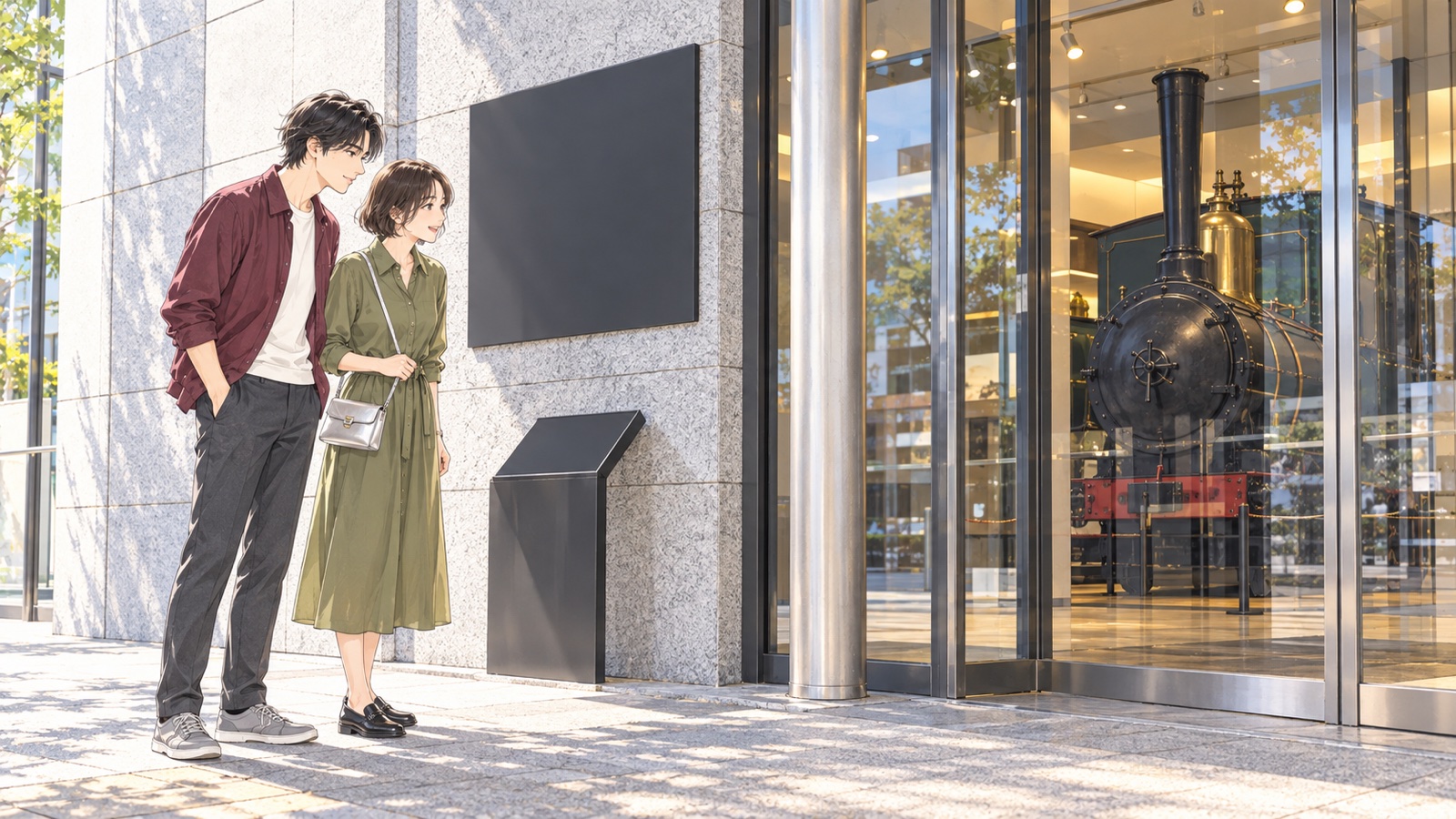
The Botchan Train Museum is on the first floor of the Iyo Railway Group headquarters building in front of Matsuyama City Station. Visitors enter through the Starbucks entrance in the same building. Admission is free, and the museum is open year-round from 7 a.m. to 9 p.m.
The centerpiece is a life-size replica of Iyo Railway’s No. 1 locomotive. Visitors can see up close a full-scale version of the train that once ran through central Matsuyama. The museum also displays train parts, documents, and video footage that have rarely been shown to the public. Allow about 15 minutes for a visit.
The Botchan Train service from Dogo Onsen Station passes Okaido before reaching Matsuyama City Station. On Saturdays, Sundays, and national holidays, you can see the original locomotive at the museum and then ride the restored train.
- Location
- First floor, Iyo Railway Group headquarters, 4-4-1 Minatomachi, Matsuyama, Ehime Prefecture
- Connection to the work
- A life-size replica of Iyo Railway’s No. 1 locomotive, the model for the train in the novel, and displays of train parts
- Opening hours
- 7 a.m.–9 p.m.; open year-round
- Admission
- Free
Sources:Iyo Railway — Botchan Train Museum / Iyo Railway — Botchan Train boarding and alighting locations
7Baishinji Park | The original No. 1 locomotive and passenger carriage that ran for 67 years

Nobuchika Kobayashi, founder of Iyo Railway, recognized the potential of light rail early on and ordered locomotives from Germany’s Krauss company. Service began on October 28, 1888, on the 6.8-kilometer route between Matsuyama and Mitsu.
Baishinji Park displays one locomotive and one passenger carriage purchased when the line opened. The locomotive is a four-wheel coupled tank engine weighing 6.81 tons; the German-made passenger carriage seats 16. They continued running through 1954 and are considered the oldest surviving light-railway rolling stock in Japan. Because the locomotive appears in Botchan, it has long been affectionately known as the “Botchan Train.”
In 1967, the locomotive was designated a monument by Japanese National Railways. The locomotive and carriage are also designated Tangible Cultural Properties (historical materials) by Ehime Prefecture. They are owned by Iyo Railway.
The park is near Iyo Railway’s Baishinji Station. It is open from 9 a.m. to 5 p.m. and closed on Thursdays (or the preceding weekday when Thursday is a national holiday) and during the New Year holidays. Admission is ¥500 for adults and ¥250 for children. The grounds have 110 red and white plum trees and 120 cherry trees.
- Location
- 1386-5 Baishinji, Matsuyama, Ehime Prefecture; near Iyo Railway’s Baishinji Station
- Connection to the work
- The original No. 1 locomotive and passenger carriage that ran from 1888 through 1954 are on display
- Opening hours and closing days
- 9 a.m.–5 p.m.; closed Thursdays and during the New Year holidays
- Admission
- Adults: ¥500; children: ¥250
Sources:Iyo Railway — Baishinji Park / Matsuyama City — Botchan Train (Tangible Cultural Property designated by Ehime Prefecture) / Iyo Railway — Botchan Train
8Shijushima (Turner Island) | The pine-covered island Nodaiko proposes naming “Turner Island”

The protagonist is invited by Red Shirt, the head teacher, and Nodaiko, the art teacher, to go fishing offshore by boat. The island the protagonist calls “Aoshima” has nothing but rocks and pine trees. When Red Shirt remarks that the shape of the pines looks “like something Turner might have painted,” Nodaiko suggests naming it “Turner Island.”
Nodaiko goes on to say that placing Raphael’s Madonna on the rock would make a fine picture. This fishing scene is also the first time the Madonna is mentioned in the novel. Unable to follow their affected conversation, the protagonist thinks, “Aoshima is good enough for me.”
The island known as Turner Island is Shijushima, about eight kilometers northwest of central Matsuyama. It consists of three reefs of varying sizes, rising up to 18 meters high with a total circumference of about 135 meters. A total of 24 Japanese black pines grow on the central and northern islets. The waters nearby are also called the Shijushima Strait and have strong currents.
Shiki wrote, “Mid-autumn spring tide—the waves pass over the pines of Shijushima.” The pines died from pine wilt disease in 1977, but were restored through planting and care by local residents. The island was registered by the national government as a scenic monument on February 6, 2007.
- Location
- Off Takahama-chō 1-chōme, Matsuyama, Ehime Prefecture
- Connection to the work
- The small island the protagonist calls “Aoshima” in the fishing scene, which Nodaiko proposes naming “Turner Island”
- Highlights
- Three reefs of different sizes, 24 Japanese black pines, and a nationally registered scenic monument
Sources:Online Cultural Heritage — Shijushima (Turner Island) / Matsuyama City — 100 Selected Scenic Views (Turner Island) / Aozora Bunko — Natsume Soseki, Botchan
9Botchan Theater | An entrance monument shows characters boarding the Botchan Train

Botchan Theater is a musical theater that opened in 2006 inside Lespas City in Minara, Toon City. It stages original musicals over year-long runs, drawing on the history, traditional culture, and notable figures of Shikoku and the Seto Inland Sea region.
Just to the right after entering the theater is a monument. A Botchan Train sits at the center of a circular base shaped like the globe, with characters from the novel boarding it. Dogo Onsen and Matsuyama Castle appear above, and the Seto Inland Sea below. Shiki watches over the scene from above, among stars, the sun, and the moon. The monument was made using local Tobe pottery and Kikuma roof-tile techniques.
Past productions include Botchan!, I Am a Tanuki, and Masaoka Shiki. 52 Days: Gudabutsuan, Two Great Writers is set in Gudabutsuan in 1895. It follows 52 days of commotion between Soseki, who is nervous and meticulous, and Shiki, who is easygoing and careless with money. The story is told humorously by a haiku-loving batting-cage owner. The theater is currently presenting its 18th production, The New Legend of Princess Tsuruhime: A White Flower on Armor, scheduled to run from April 29, 2025, through March 2027.
- Location
- Inside Lespas City, 1125 Minara, Toon, Ehime Prefecture
- Connection to the work
- A monument featuring the Botchan Train and characters, plus a past production about Soseki and Shiki’s 52 days together
- Highlights
- The entrance monument made with Tobe pottery and Kikuma roof tiles
Sources:Botchan Theater — About the theater / Botchan Theater — Past productions / Botchan Theater — 52 Days / Botchan Theater — Current production
10Shinjuku Soseki Sanbo Memorial Museum | Special exhibition “Botchan Goes to Matsuyama!” through December 6, 2026

Shinjuku Soseki Sanbo Memorial Museum, in Waseda Minamichō, Shinjuku, stands on the site of Soseki Sanbo, where Soseki lived for the last nine years of his life. It opened on September 24, 2017, the 150th anniversary of his birth. On the first floor, portions of the study, guest room, and veranda corridor—spaces where he wrote and met his students—have been recreated.
The second-floor materials gallery is hosting the special exhibition “Botchan Goes to Matsuyama!” from October 10 through December 6, 2026, marking 120 years since the novel’s publication. Historical materials illuminate the circumstances of the novel’s creation and distinctive characters such as Red Shirt and Porcupine. The exhibition is supported by Matsuyama City and Tokyo University of Science, with cooperation from the Shiki Memorial Museum.
Admission is ¥500 for adults and ¥100 for elementary and junior high school students; children in those grades are admitted free on Saturdays, Sundays, and national holidays. The museum is closed on Mondays, or on the next weekday when Monday is a holiday. Gallery talks are held in the basement lecture room at 2 p.m. on October 18, November 15, and December 6. No reservation is required.
Two commemorative lectures are scheduled. On October 24, Eisaku Sato, chair of the Matsuyama Botchan Society, will speak on “Reading Botchan with Shiki and the Botchan Read by Kyoshi.” On November 3, Akinori Ito, director of the Shiki Memorial Museum, will speak on “The Friendship between Soseki and Shiki: Their Days at Gudabutsuan.” Each lecture has 70 seats assigned by lottery and costs ¥1,000, including exhibition admission.
The application deadline for the October 24 lecture was October 9. Those still wishing to attend should call the museum. Applications for the November 3 lecture must arrive by October 20.
During the exhibition, the museum’s book café, CAFE SOSEKI, is serving a limited menu item made with Tsuboya Kashihō’s original Botchan dango. On November 1, a staged reading of Botchan will be performed at Shinjuku Bunka Center. Yusuke Kobayashi plays Botchan and Yoshitsugu Matsuoka plays Porcupine; tickets have sold out. Part of the former Soseki Sanbo site is now Soseki Park, with a bust of Soseki and a monument to his cat, known as the Cat Mound.
- Location
- 7 Waseda Minamichō, Shinjuku, Tokyo
- Connection to the work
- The site of the house where Soseki spent his later years and venue for the 120th-anniversary exhibition “Botchan Goes to Matsuyama!”
- Exhibition dates and closing days
- Special exhibition: October 10–December 6, 2026; closed Mondays
- Admission
- Adults: ¥500; elementary and junior high school students: ¥100; students in those grades: free on weekends and national holidays
Sources:Soseki Sanbo Memorial Museum — Special exhibition “Botchan Goes to Matsuyama!” / Soseki Sanbo Memorial Museum — Exhibition rooms / Soseki Sanbo Memorial Museum — Commemorative exhibition lecture (October 24) / Soseki Sanbo Memorial Museum — Commemorative exhibition lecture (November 3) / Soseki Sanbo Memorial Museum — Staged reading of Botchan / Shinjuku Soseki Sanbo Memorial Museum
11Tokyo University of Science Museum of Modern Science | Recreated exterior of the protagonist’s alma mater, the School of Physics, and exhibition “The School of Physics and Soseki”

The protagonist sees an advertisement for student recruitment while passing the School of Physics and immediately completes the enrollment process. On the eighth day after his graduation, the principal calls him in and recommends a position teaching mathematics at a middle school in Shikoku. The School of Physics was the predecessor of today’s Tokyo University of Science.
The Museum of Modern Science in Kagurazaka recreates the exterior of the former Tokyo School of Physics’s wooden school building. The original building was constructed in Kagurazaka in 1906, the same year Botchan was published. The first-floor permanent exhibition includes a video about the founding of the Tokyo School of Physics by 21 alumni of the University of Tokyo’s Department of Physics, Faculty of Science, French Program.
The special exhibition “The School of Physics and Soseki” runs from October 9 to December 4, 2026. Its subtitle is “Mathematics Teacher ‘Botchan’ and Tōta Yasuda, Fusaki Sakurai, and Kyōhei Nakamura.” All three were involved in founding the Tokyo School of Physics. The exhibition traces their lives and connections with Soseki, focusing on the background to the protagonist’s having graduated from the School of Physics.
The exhibition has three sections. The section on Tōta Yasuda features his trigonometry lectures and textbooks, and Soseki, who was his student at the First Higher School. The section on Fusaki Sakurai highlights his studies in Europe and his book collection, his teaching Soseki Hōshō-school chanting at the Fifth Higher School, and his friendship with Lafcadio Hearn. The section on Kyōhei Nakamura traces his career from teaching at a normal school to becoming the third principal of the Tokyo School of Physics.
The museum is open Wednesdays through Fridays from noon to 4 p.m. and Saturdays from 10 a.m. to 4 p.m. Admission is free. Two related talks require advance registration: “The First Higher School in Tōta Yasuda’s Time” on October 31 and “Fusaki Sakurai’s Prohibition on Alcohol and the Fifth Higher School” on November 7. A Botchan stamp rally linking this museum with the Soseki Sanbo Memorial Museum is also held during the exhibition. Visitors who collect stamps at both museums receive a limited-edition can badge, while supplies last.
- Location
- 1-3 Kagurazaka, Shinjuku, Tokyo
- Connection to the work
- Museum recreating the wooden exterior of the Tokyo School of Physics, the protagonist’s alma mater; venue for “The School of Physics and Soseki” exhibition
- Exhibition dates and opening hours
- Exhibition: October 9–December 4, 2026; Wednesday–Friday, noon–4 p.m.; Saturday, 10 a.m.–4 p.m.
- Admission
- Free
Sources:Tokyo University of Science Museum of Modern Science — Special exhibition “The School of Physics and Soseki” / Tokyo University of Science Museum of Modern Science / Museum of Modern Science — Permanent exhibition / Museum of Modern Science — Visitor information / Soseki Sanbo Memorial Museum — Botchan stamp rally / Soseki Sanbo Memorial Museum — About the novel
Learn more about the novel | A mathematics teacher posted to a middle school in Shikoku and the teachers known by their nicknames
Botchan is a novel narrated in the first person by its protagonist, “I.” It opens with the sentence, “Reckless by inheritance, I have been getting the worst of it ever since I was a child.” The narrator then tells how, as a boy, he jumped from the second floor of his elementary school.
From a ¥40 monthly salary and a new post to returning to Tokyo with Yama-Arashi
After graduating from the School of Physics, the protagonist takes a job teaching at a middle school in Shikoku for ¥40 a month. On the day he leaves Tokyo, Kiyo, who has served his family for many years, comes to see him off at the station. The day after he eats four servings of tempura at a soba shop, someone writes “Tempura Teacher” on the blackboard. On the night he is assigned to stay on duty, grasshoppers are put in his bedding.
The protagonist eventually learns that Red Shirt, the head teacher, is trying to take the Madonna away from Utsunari, an English teacher to whom she is engaged. Utsunari is transferred to Nobeoka in Hyuga, and the protagonist and Yama-Arashi, the head of mathematics, set out to expose Red Shirt’s true character. From the second floor of Masuya across the street, they watch Kadoya in the hot-spring town, where Red Shirt is said to meet a geisha.
At the end, the two lie in wait for Red Shirt and Nodaiko and teach them a lesson. The protagonist throws an egg he had tucked into his sleeve at Nodaiko’s face. That evening, they leave town on the 6 p.m. steamship and arrive at Shinbashi via Kobe. Back in Tokyo, the protagonist becomes a streetcar inspector and lives with Kiyo. She dies of pneumonia that February and is buried at Yōgenji Temple in Kohinata.
Source:Aozora Bunko — Natsume Soseki, Botchan
The protagonist and the people at school known by nicknames
In his letter to Kiyo on the day he starts work, the protagonist writes, “The principal is Tanuki, the head teacher is Red Shirt, the English teacher is Utsunari, math is Yama-Arashi, and art is Nodaiko.” The story unfolds around these five nicknames.
I (Botchan)
The narrator of the story, a mathematics teacher who graduated from the School of Physics. Whenever he swims at Sumita Hot Spring or eats dango, the students tease him by writing about it on the blackboard.
Kiyo
A maid who has served the protagonist’s family for ten years. She is the only one in the household who cares for him and calls him “Botchan.”
Yama-Arashi
The head of mathematics. He clashes with the protagonist at first, but they eventually join forces to punish Red Shirt and Nodaiko.
Red Shirt
The head teacher, a man of letters who wears a red flannel shirt all year round. He pursues the Madonna, who is engaged to Utsunari.
Nodaiko
Yoshikawa, the art teacher, who always follows Red Shirt around. In the fishing scene, he suggests naming the pine-covered island “Turner Island.”
Utsunari and the Madonna
Utsunari is Koga, the English teacher. The Madonna, called “Miss Tōyama,” is the town’s most beautiful young woman and was engaged to Utsunari.
Tanuki
The principal. On his first day, the protagonist sees the dark-complexioned principal with a thin mustache and thinks he looks “like a tanuki.”
The movements of the characters who appear in the mechanical clock in front of Dogo Onsen Station can be seen in an official Dogo Onsen video.
Sources:Aozora Bunko — Natsume Soseki, Botchan / Dogo Onsen official site — Botchan Karakuri Clock
Minatoya, Yamashiroya, Ikagin, and Furumachi | Names of places and lodgings in the novel
After reaching the port, the protagonist is taken by a man in a tight-sleeved coat to an inn called Minatoya. In the castle town where his middle school is located, he stays at Yamashiroya, arriving by rickshaw. He finds it amusing that the name is the same as the pawnshop next door to his family’s home in Tokyo.
His first lodging is Ikagin, an antique shop on a hillside on the edge of town. Later, at Utsunari’s introduction, he moves to the home of an elderly couple named Hagino in the back streets. The hot-spring town is called “Sumita,” and the station where he gets off the train on his return is “Furumachi.” Furumachi remains the name of an Iyo Railway station today.
Sources:Aozora Bunko — Natsume Soseki, Botchan / Iyo Railway — Botchan Train timetable
Production and background | Soseki’s year in Matsuyama and the novel’s publication in Hototogisu
Soseki taught in Matsuyama for about a year. That experience as a teacher later became the basis for Botchan.
Soseki’s year in Matsuyama as an English teacher at Ehime Prefectural Ordinary Middle School in 1895
Soseki graduated from the English literature department of the Imperial University’s College of Literature in 1893, then taught in Matsuyama and Kumamoto. In Matsuyama, he taught English at Ehime Prefectural Ordinary Middle School, now Matsuyama Higashi High School. His subject differed from that of the protagonist, who teaches mathematics.
During his year in Matsuyama, Soseki lived with Shiki at Gudabutsuan for 52 days. The following year, he moved to the Fifth Higher School in Kumamoto. In the context of its special exhibition, the Soseki Sanbo Memorial Museum describes his year in Matsuyama with his close friend Shiki as an important period in his life as a writer.
Sources:Soseki Sanbo Memorial Museum — The life of Soseki / Soseki Sanbo Memorial Museum — Special exhibition “Botchan Goes to Matsuyama!” / Matsuyama City — Opening of Gudabutsuan / Tokyo University of Science Museum of Modern Science — The School of Physics and Soseki
From the April 1906 issue of Hototogisu to the book Uzurakago
After returning from study in Britain and becoming a university lecturer, Soseki took up writing at the suggestion of Kyoshi Takahama, first writing I Am a Cat. Botchan was published in the April 1906 issue of the magazine Hototogisu. The work’s closing line is dated “April 1906.”
The novel was first collected in book form in Uzurakago, published by Shunyodo in January 1907. That same year, Soseki left the university and joined the Tokyo Asahi Shimbun as a staff writer. The Soseki Sanbo Memorial Museum holds materials from first editions, including Uzurakago.
Sources:Soseki Sanbo Memorial Museum — About the novel / Soseki Sanbo Memorial Museum — The life of Soseki / Soseki Sanbo Memorial Museum — Major collection items / Aozora Bunko — Natsume Soseki, Botchan
Why the protagonist graduated from the “School of Physics”
The protagonist’s alma mater, the Tokyo School of Physics, was the predecessor of Tokyo University of Science. Fusaki Sakurai served as principal of the Tokyo Physics School, the institution’s original name, when it was founded in 1881. The Museum of Modern Science exhibition introduces three of the school’s founders who had connections with Soseki.
In 1884, Tōta Yasuda became an instructor at the preparatory school of the University of Tokyo and went on to teach mathematics for 35 years at its successor, the First Higher School. His trigonometry lectures were considered a signature course, and Soseki was one of his students. From 1890, Fusaki Sakurai served as vice-principal and professor at the Fifth Higher Middle School, where he taught Soseki Hōshō-school Noh chanting. He became principal in 1900 and encouraged Soseki to study in Britain. Kyōhei Nakamura lived near Soseki in Nishikata-chō, Komagome, and became the third principal of the Tokyo School of Physics in 1930.
The Museum of Modern Science also held a special exhibition in 2016, “Botchan and Its Era,” subtitled “Exploring the Relationships between Scientists of the Meiji Period and Natsume Soseki.” In 2017, it presented the history of women in science under the title “One Hundred Years of Madonnas Who Paved the Way.”
Sources:Tokyo University of Science Museum of Modern Science — Special exhibition “The School of Physics and Soseki” / Museum of Modern Science — History and special exhibitions
The Botchan Literary Prize and the milestones of 130 years since Soseki’s posting and 120 years since publication
Matsuyama revamped the Botchan Literary Prize as an award for flash fiction in 2019. The year 2025 marks 130 years since Soseki took up his post in Matsuyama and lived with Shiki at Gudabutsuan; 2026 marks 120 years since Botchan was published. Matsuyama plans to connect the rebuilt Gudabutsuan with Shikian in Tokyo and the Soseki Sanbo Memorial Museum.
Source:Matsuyama City — Opening of Gudabutsuan
From the opening of Iyo Railway to the rebuilding of Gudabutsuan and the novel’s 120th anniversary
This timeline runs from the opening of Iyo Railway in 1888 and Soseki’s arrival in Matsuyama in 1895 through the publication of Botchan, preservation work at Dogo Onsen Main Building, and projects marking the novel’s 120th anniversary in 2026.
- 1888
October 28 Iyo Railway opens between Matsuyama and Mitsu; steam locomotives begin runningRailway - 1894
The Kami-no-Yu wing of Dogo Onsen Main Building is completedHot spring - 1895
Soseki takes a post in Matsuyama and lives with Shiki at Gudabutsuan for 52 daysWriter - 1899
Yushinden and the Tama-no-Yu wing of Dogo Onsen Main Building are completedHot spring - 1906
April Botchan is published in HototogisuNovel - 1907
January Botchan is included in Shunyodo’s Uzurakago, becoming a bookNovel - 1954
The original Botchan Train is retiredRailway - 1966
Yuzuru Matsuoka names the private room on the main building’s third floor the “Botchan Room”Hot spring - 1967
No. 1 locomotive is designated a monument by Japanese National RailwaysRailway - 1981
Matsuyama Municipal Shiki Memorial Museum opensMuseum - 1994
Botchan Karakuri Clock is installed for the main building’s 100th anniversary; the building is designated a National Important Cultural Property in DecemberDogo - 2001
October 12 Restored Botchan Train begins serviceRailway - 2006
Botchan Theater opens in ToonTheater - 2007
February 6 Shijushima (Turner Island) is registered as a national scenic monumentScenic monument - 2017
September 24 Shinjuku Soseki Sanbo Memorial Museum opensMemorial museum - 2019
January Preservation and repair work begins at Dogo Onsen Main BuildingHot spring - 2023
November All Botchan Train services are suspendedRailway - 2024
March 20 Botchan Train service resumesRailway - 2024
December 20 About six years of preservation and repair work on the main building are completedHot spring - 2026
July 24 Gudabutsuan is rebuilt and opens beside Bancho Elementary SchoolWriter - 2026
October 10 Special exhibition marking 120 years since publication opens at the Soseki Sanbo Memorial Museum (through December 6)Exhibition
The preservation project at Dogo Onsen Main Building was the first in Japan to repair a public bath designated a National Important Cultural Property while keeping it open for business. The entire building reopened on July 11, 2024. The names of people involved in building the Kami-no-Yu Main Building are engraved on the white heron’s wings on Shirasagikaku. During repairs, that section was preserved, repaired, and reinstalled.
During construction, Dogo Onsen’s official website shared updates through pamphlets and videos. Twelve videos were released, from Vol. 1 in August 2019 to Vol. 12 in October 2024.
Sources:Matsuyama City — Botchan Train / Dogo Onsen official site — Preservation and repair work / Dogo Onsen official site — Dogo Onsen Main Building / Iyo Railway — Botchan Train / Soseki Sanbo Memorial Museum — About the novel / Online Cultural Heritage — Shijushima / Furusato Choice — Suspension and resumption of Botchan Train service / Matsuyama City — Opening of Gudabutsuan
Research note | A business perspective: Matsuyama and Tokyo facilities share the novel’s lines and small details
Dogo Onsen Main Building pairs a line from the novel with its guide to the private room on the third floor of Tama-no-Yu. Iyo Railway offers two “matchbox-like trains”: the restored train in service and the original locomotive displayed at Baishinji Park. In 2026, the novel’s 120th-anniversary year, the special exhibition at the Soseki Sanbo Memorial Museum is supported by Matsuyama City and Tokyo University of Science, with cooperation from the Shiki Memorial Museum. The single line of the novel establishing the protagonist as a School of Physics graduate has become the subject of an exhibition at Tokyo University of Science and a stamp rally linking the two museums.
A notable feature is how hot-spring, railway, memorial, and university institutions each take responsibility for exhibitions and events connected to different scenes and details in the novel.
Related research article:Travel companies and tourism-product design
Sources
- Aozora Bunko — Natsume Soseki, Botchan
- Dogo Onsen official site — Dogo Onsen Main Building
- Dogo Onsen official site — Preservation and repair work at Dogo Onsen Main Building
- Dogo Onsen official site — Visitor information
- Iyo Railway — Botchan Train
- Iyo Railway — Botchan Train timetable
- Iyo Railway — Botchan Train Museum
- Iyo Railway — Baishinji Park
- Matsuyama City — Botchan Train (Tangible Cultural Property designated by Ehime Prefecture)
- Furusato Choice — Matsuyama City’s “Let’s Run the Botchan Train” project
- Matsuyama City — 100 Selected Scenic Views
- Matsuyama City — Walking map of the Dogo area
- Matsuyama Municipal Shiki Memorial Museum
- Shiki Memorial Museum — Exhibition guide
- Shiki Memorial Museum — Visitor information
- Matsuyama City — Renovation of the Shiki Memorial Museum’s permanent exhibition
- Matsuyama City — Opening of Gudabutsuan
- Kumamoto Nichinichi Shimbun (Kyodo News) — Reopening of the rebuilt Gudabutsuan
- Online Cultural Heritage — Shijushima (Turner Island)
- Botchan Theater — About the theater
- Botchan Theater — Past productions
- Botchan Theater — 52 Days: Gudabutsuan, Two Great Writers
- Botchan Theater — Current production
- Shinjuku Soseki Sanbo Memorial Museum
- Soseki Sanbo Memorial Museum — Special exhibition “Botchan Goes to Matsuyama!”
- Soseki Sanbo Memorial Museum — Exhibition rooms
- Soseki Sanbo Memorial Museum — Commemorative exhibition lecture (October 24)
- Soseki Sanbo Memorial Museum — Commemorative exhibition lecture (November 3)
- Soseki Sanbo Memorial Museum — Staged reading of Botchan
- Soseki Sanbo Memorial Museum — Botchan stamp rally
- Soseki Sanbo Memorial Museum — About the novel
- Soseki Sanbo Memorial Museum — The life of Soseki
- Tokyo University of Science Museum of Modern Science
- Museum of Modern Science — Special exhibition “The School of Physics and Soseki”
- Museum of Modern Science — Permanent exhibition
- Museum of Modern Science — Visitor information
- Museum of Modern Science — History and special exhibitions
- Iyo Railway official channel — Botchan Train cab-view video
- Shinjuku City official channel — Soseki Sanbo Memorial Museum opens
- Shinchosha — Botchan
FAQ
Is Botchan set in Matsuyama?
The novel does not name the town; it calls the hot-spring town Sumita. In 1895, Soseki taught English at Ehime Prefectural Ordinary Middle School in Matsuyama, and his teaching experience informed the novel. The third-floor private room at Dogo Onsen Main Building was once called first-class and is connected with the line, “I always took the first-class bath.”
Where is the Botchan Room at Dogo Onsen Main Building?
It is a corner room on the northwest side of the third-floor private rooms. Soseki is said to have used it with Masaoka Shiki in October 1895. In 1966, Soseki’s son-in-law, writer Yuzuru Matsuoka, named it. Preservation and repair work was completed on December 20, 2024.
Does the Botchan Train run every day?
It runs only on Saturdays, Sundays, and national holidays. It does not run on weekdays during Golden Week or Obon, and is suspended from December 30 through January 3. Reservations are not accepted. Numbered boarding tickets for its four daily departures from Dogo Onsen Station are distributed at the Dogo ticket counter from 8:30 a.m.
How much does the Botchan Train cost?
Each ride costs ¥1,300 for adults and ¥650 for children. Buy your ticket from the crew when boarding. Nationwide interoperable IC cards such as ICOCA are accepted. The train carries up to 36 passengers.
When does the Botchan Karakuri Clock operate?
It operates hourly from 8 a.m. to 10 p.m., and every 30 minutes on weekends, national holidays, and during busy tourist seasons. The clock rises to the sound of drums, and figures of characters from the novel appear.
Where can I see the original Botchan Train?
The original No. 1 locomotive and passenger carriage, which ran from 1888 through 1954, are displayed at Baishinji Park in Matsuyama. The park is open from 9 a.m. to 5 p.m., closed Thursdays, and charges ¥500 for adults. The Botchan Train Museum in front of Matsuyama City Station has a free life-size replica of the No. 1 locomotive.
Can visitors enter the rebuilt Gudabutsuan?
It was rebuilt on July 24, 2026, on the former swimming-pool site at Bancho Elementary School in Nibanchō, Matsuyama. Admission is free. When the rooms are not reserved, visitors may look around the hermitage’s second-floor Japanese-style room and the exhibits in the adjoining Guidance Building. The first-floor room in the hermitage is available for haiku gatherings and tea ceremonies.
Are there exhibitions in Tokyo for the 120th anniversary of Botchan?
The special exhibition “Botchan Goes to Matsuyama!” runs at the Shinjuku Soseki Sanbo Memorial Museum from October 10 through December 6, 2026; adult admission is ¥500. The Tokyo University of Science Museum of Modern Science in Kagurazaka is hosting the free exhibition “The School of Physics and Soseki” through December 4.


