

Hakone Ekiden Pilgrimage: Ten Places Along the Route and at the Qualifier
In front of Yomiuri Shimbun’s Otemachi headquarters are plaques listing past winners and a bronze Ekiden runner. The Hakone Ekiden Museum on the shore of Lake Ashi displays the overall champion’s trophy used through the 100th running. You can trace roads seen in the New Year’s broadcast through monuments and exhibits even on days without a race.
The Hakone Ekiden is a university relay race between Otemachi and Lake Ashi, with ten runners passing the sash. This guide introduces nine places along the course, including four relay points and the highest point on National Route 1, plus the qualifying race venue in Tachikawa. The 103rd race in 2027 will run outbound on January 2 and return on January 3.
Nine Course Locations From Otemachi to Lake Ashi, Plus the Qualifier at Showa Kinen Park
The outbound race covers five legs and 107.5 km from Otemachi to Lake Ashi; the return follows almost the same route in reverse over five legs and 109.6 km. At the four relay points, runners pass the sash on both January 2 and 3. Dates, opening hours, and ticket information reflect the time of writing. Check each official site for the latest information before your visit.
Sources:Official Hakone Ekiden site — What is the Hakone Ekiden? / Kanto Intercollegiate Athletics Federation — Rules for the 102nd race
① Otemachi, in front of Yomiuri Shimbun
The outbound first leg starts here, and the return tenth leg finishes here. Plaques listing past winning schools and a bronze Ekiden runner stand in front of the building.
Explore Otemachi, in front of Yomiuri Shimbun② Tsurumi Relay Point
The sash passes from Leg 1 to the “Flower Leg,” Leg 2; on the return, it passes from Leg 9 to Leg 10. A bronze runner stands beneath the pedestrian overpass.
Explore the Tsurumi Relay Point③ Totsuka Relay Point
The relay point where the ace from Leg 2, after crossing Gontazaka, arrives, and where the Leg 8 runner arrives after climbing Yugyoji-zaka.
Explore the Totsuka Relay Point④ Hiratsuka Relay Point
The finish of Leg 3, with views of Mount Fuji and Sagami Bay. On the return, the sash passes from Leg 7 to Leg 8.
Explore the Hiratsuka Relay Point⑤ Odawara Relay Point
The sash passes from Leg 4 to the uphill Leg 5 and from the downhill Leg 6 to Leg 7. The outbound relay has used its current location since the 93rd race in 2017.
Explore the Odawara Relay Point⑥ Miyanoshita, in front of Fujiya Hotel
A hot-spring town traversed by the uphill fifth leg and downhill sixth leg. Fujiya Hotel, which operates the Hakone Ekiden Museum by Lake Ashi, is here.
Explore Miyanoshita and Fujiya Hotel⑦ Kowakudani Railroad Crossing
The only railroad crossing on the runners’ course. The Hakone Tozan Railway waits just before the crossing while runners pass.
Explore the Kowakudani Railroad Crossing⑧ Highest Point on National Route 1
At about 874 meters above sea level, this is the point where runners in the uphill fifth leg reach the top. The Motohakone Stone Buddhas stand beside nearby Lake Shōjin.
Explore the highest point on National Route 1⑨ Lake Ashi and the Hakone Ekiden Museum
The outbound finish and return start. The museum just across from the course has a permanent display of the overall champion’s trophy through the 100th running.
Explore Lake Ashi and the Hakone Ekiden Museum⑩ Showa Kinen Park
The finish of the qualifier, whose runners travel from the Japan Ground Self-Defense Force Tachikawa Garrison through central Tachikawa. On October 17, 2026, the ten schools that advanced to the main race were decided.
Explore Showa Kinen Park
1Otemachi, in front of Yomiuri Shimbun | The Leg 1 Start and Leg 10 Finish, With Plaques Listing Past Champions

The start and finish are in front of Yomiuri Shimbun’s building at 1-7-1 Otemachi, Chiyoda City, Tokyo. The race is organized by the Kanto Intercollegiate Athletics Federation and co-hosted by Yomiuri Shimbun. The outbound race of the 102nd running started here at 8 a.m. on January 2, 2026. Runners pass Hibiya, Shinagawa, and Rokugo Bridge on the way to Tsurumi.
In front of the Yomiuri Shimbun building are plaques listing past winning schools and a bronze statue of an Ekiden runner. It is a small corner that feels like a memorial park.
Leg 1 is 21.3 km, and each team’s fastest runners engage in careful tactical racing. The decisive point often comes after a long flat, straight stretch, just beyond the 17-km mark at Rokugo Bridge. The return Leg 10 is 23.0 km and comes back here via Chuo-dori and Nihonbashi. It is the final leg, where unexpected incidents and dramatic comebacks often occur.
Yomiuri Otemachi Hall, in the same building, hosted the closing ceremony for the 102nd race. It will also host the “103rd Hakone Ekiden Symposium” at 6:30 p.m. on Friday, November 20, 2026. The theme is the Kanto Student Union Team, made up of runners from universities that did not qualify. Admission is free; register on the official site by Sunday, November 8. If applications exceed capacity, attendees will be selected by lottery.
The first race in 1920 started in front of Hochi Shimbun’s former offices in Yurakucho. The four schools’ runners reportedly gathered after attending morning classes. Hochi Shimbun still appears among the race’s supporting organizations.
- Location
- In front of Yomiuri Shimbun, 1-7-1 Otemachi, Chiyoda City, Tokyo
- Connection to the race
- Start of outbound Leg 1 and finish of return Leg 10
- What to see
- Plaques listing past champions and a bronze Ekiden runner; Yomiuri Otemachi Hall, venue for the 103rd-race symposium on November 20, 2026
Sources:Kanto Intercollegiate Athletics Federation — Rules for the 102nd race / Official Hakone Ekiden site — Course guide (Legs 1 and 10) / Official Hakone Ekiden site — 103rd Hakone Ekiden Symposium / Traffic News — Plaques and statue at the start / Mynavi News — Hochi Shimbun offices at the first race
2Tsurumi Relay Point | Passing the Sash to the “Flower Leg,” and the Last Relay Before the Finish
The Tsurumi Relay Point is along National Route 15 (Daiichi Keihin) in Tsurumi Ward, Yokohama. The nearest station is Tsurumi-ichiba on the Keikyu Main Line. A bronze runner stands beneath the pedestrian overpass on the inbound side; on race day, the surrounding area becomes the relay point. The nearby bus stop is Ichiba on the Yokohama Municipal Bus.
A joint inspection was scheduled for December 9, 2024, ahead of the 101st race. The plan was for the Ministry of Land, Infrastructure, Transport and Tourism’s Yokohama National Highway Office, Kanto Student Federation members, and Tsurumi Police Station to set out from Ichiba Park. The inspection covered 1.5 km of road and sidewalk, including the area on both sides of the relay point, from the Ichiba Station Entrance intersection to the Tsurumi Tax Office intersection.
On the outbound route, the sash passes from the Leg 1 runner to the ace running Leg 2. Leg 2 was the longest leg for many years, until the Odawara Relay Point moved in the 82nd race, and is still the longest on level ground—one reason it is called the “Flower Leg.” Because the speedy Leg 1 runners arrive close together, teams hoping to take control early have placed their aces in Leg 2. It is also a leg often run by international student athletes.
On the return route, this is the final relay point, passing the sash from Leg 9 to Leg 10. Leg 9 has seen dramatic reversals in the race for the overall title and seeded places, and many dramas have unfolded at Tsurumi. If a team is more than 20 minutes behind the leader, it must make a rolling start without waiting for its previous runner to arrive. You may see runners hurrying toward the relay point to avoid that rule.
- Location
- Ichiba Yamato-cho, Tsurumi Ward, Yokohama, Kanagawa (along National Route 15 / Daiichi Keihin)
- Connection to the race
- Relay point passing the sash from outbound Leg 1 to 2 and return Leg 9 to 10
- Access
- Near Tsurumi-ichiba Station on the Keikyu Main Line; beside the Yokohama Municipal Bus Ichiba stop
Sources:Traffic News — Bronze runner at the Tsurumi Relay Point / MLIT Yokohama National Highway Office — Joint walking patrol before the Hakone Ekiden / Official Hakone Ekiden site — Why is Leg 2 called the “Flower Leg”? / Official Hakone Ekiden site — Course guide (Leg 9)
3Totsuka Relay Point | The Leg 2 Ace After Gontazaka and the Leg 8 Runner After Yugyoji-zaka

Leg 2 runs 23.1 km from Tsurumi to Totsuka. Gontazaka lies ahead around the 13-km mark, followed by another series of climbs and descents in the final 3 km, testing stamina, mental strength, and race judgment. Gontazaka is a steep slope beneath a cliff in the Hodogaya Ward area of Yokohama. The nearest bus stop is Gontazaka-ue on the Yokohama Municipal Bus.
This leg also produces “gobonuki,” overtaking a succession of runners. In the 87th race in 2011, with 20 teams competing, Akinobu Murasawa of Tokai University passed 17 runners in Leg 2. He received the sash in last place and moved his team up to third. The record for most overtakes was set by Daniel of Nihon University, who passed 20 runners in the 85th-anniversary race in 2009, with 23 teams. His team rose from 22nd to second.
The Totsuka Relay Point is along National Route 1 in Totsuka Ward, Yokohama. It is about 300 meters uphill from the Kanachu Bus stop Osaka-ue. Totsuka Railroad Crossing, north of Totsuka Station, once held up runners as a notorious “never-open” crossing, but disappeared after an overpass was built in 2016.
On the return route, the sash passes here from Leg 8 to Leg 9. After joining Shonan Shindo, Leg 8 continues uphill for about 9 km, including ascents and descents. Yugyoji-zaka in Fujisawa City is around the 16-km mark. With a tailwind, runners can feel as though they are running in still air; the perceived temperature rises and drains their strength.
- Location
- Totsuka-cho, Totsuka Ward, Yokohama, Kanagawa (along National Route 1)
- Connection to the race
- Relay point passing the sash from outbound Leg 2 to 3 and return Leg 8 to 9
- Access
- About 300 m uphill from the Kanachu Bus stop Osaka-ue
Sources:Official Hakone Ekiden site — Course guide (Legs 2 and 8) / Official Hakone Ekiden site — Records for the most overtakes / Traffic News — Gontazaka and the Totsuka Relay Point / Rikkyo University — Spectator points for the 102nd Hakone Ekiden
4Hiratsuka Relay Point | Leg 3’s Finish With Views of Mount Fuji and Sagami Bay, Near the Hanamizugawa Mouth

Leg 3 runs 21.4 km from Totsuka to Hiratsuka. The first half descends gently for about 9 km. After reaching National Route 134 beyond the 11-km mark, runners see Mount Fuji ahead and Sagami Bay to their left. This is considered the most scenic stretch of the Hakone Ekiden course. At times, strong headwinds block the runners’ way.
The Hiratsuka Relay Point is near the mouth of the Hanamizugawa River at the western edge of Hiratsuka. The nearest bus stop is Nishikaigan, the terminus of the Hiratsuka Station’s Hiratsuka 40 route.
Leg 4 is 20.9 km from Hiratsuka to Odawara, the shortest leg on level ground. Runners need to set the team up well for Leg 5, holding their pace alone even if they fall behind the pack. The course was extended for the 93rd race, adding a gentle uphill over the final 3 km.
The return Leg 7 runs 21.3 km from Odawara to Hiratsuka. Small climbs and descents continue after the 9-km mark, making it hard to settle into a pace. It has the biggest temperature change of any leg, from a cold morning with winds descending the mountain to a time when the sun rises higher and shines straight at the runners.
- Location
- Togahara, Hiratsuka, Kanagawa (near the mouth of the Hanamizugawa River)
- Connection to the race
- Relay point passing the sash from outbound Leg 3 to 4 and return Leg 7 to 8
- Access
- From Hiratsuka Station, take the Kanachu Bus Hiratsuka 40 route to the Nishikaigan terminus
Sources:Official Hakone Ekiden site — Course guide (Legs 3, 4, and 7) / Traffic News — Hiratsuka Relay Point and nearest bus stop
5Odawara Relay Point (Suzuhiro Kamaboko Village) | Passing the Sash to the Uphill Fifth Leg, and the Kamaboko Museum

The Odawara Relay Point is set up in the parking lot of Suzuhiro Kamaboko Village in Kazamatsuri, Odawara. The complex is along National Route 1 and directly connected to Kazamatsuri Station on the Hakone Tozan Railway. It is also a short walk from the Kazamatsuri bus stop served by Hakone Tozan Bus and Izuhakone Bus.
The outbound relay point remained here through the 81st race. From the 82nd race in 2006 through 2016, it was near the former head office of Megane Super about 2.5 km farther back. During those years, Leg 5 was extended to 23.2 km, becoming the longest leg, and the mountain climb took on greater weight.
For the 93rd race in 2017, the outbound relay returned to the area in front of Suzuhiro. The Kanto Federation cited the heavy physical burden on runners caused by the extended Leg 5. In several cases, runners became dangerously cold or showed symptoms of low blood sugar in the latter half. Leg 5 was shortened to 20.8 km, while Leg 4 was lengthened from 18.5 to 20.9 km.
The return Leg 6 runs 20.8 km from Lake Ashi to this relay point. After climbing for the first 4 km, runners descend steep mountain roads with sharp curves. They average a little over 16 seconds per 100 meters, sometimes accelerating to 13 seconds. Experienced runners describe the feeling as “falling.”
Admission to Suzuhiro Kamaboko Village’s Kamaboko Museum is free. Visitors can learn about the history and ingredients of kamaboko (fish cake) and watch artisans at work. Hands-on workshops let you make kamaboko and chikuwa with an artisan; the freshly grilled chikuwa can be enjoyed on the spot.
- Location
- 245 Kazamatsuri, Odawara, Kanagawa (Suzuhiro Kamaboko Village parking lot)
- Connection to the race
- Relay point passing the sash from outbound Leg 4 to 5 and return Leg 6 to 7
- Access
- Directly connected to Kazamatsuri Station on the Hakone Tozan Railway; beside the Kazamatsuri stop for Hakone Tozan and Izuhakone buses
- On-site facility
- Kamaboko Museum (free admission; hands-on kamaboko and chikuwa workshops available)
Sources:All About News — Odawara relay point relocation and leg-distance changes / Traffic News — Relay point from 2006 to 2016 / Official Hakone Ekiden site — Uphill and downhill legs / Suzuhiro Kamaboko Village — Directions / Suzuhiro Kamaboko Village — Kamaboko Museum
6Miyanoshita Hot-Spring Town and Fujiya Hotel | The Meiji-Era Hotel Along the Uphill Fifth Leg and Downhill Sixth Leg
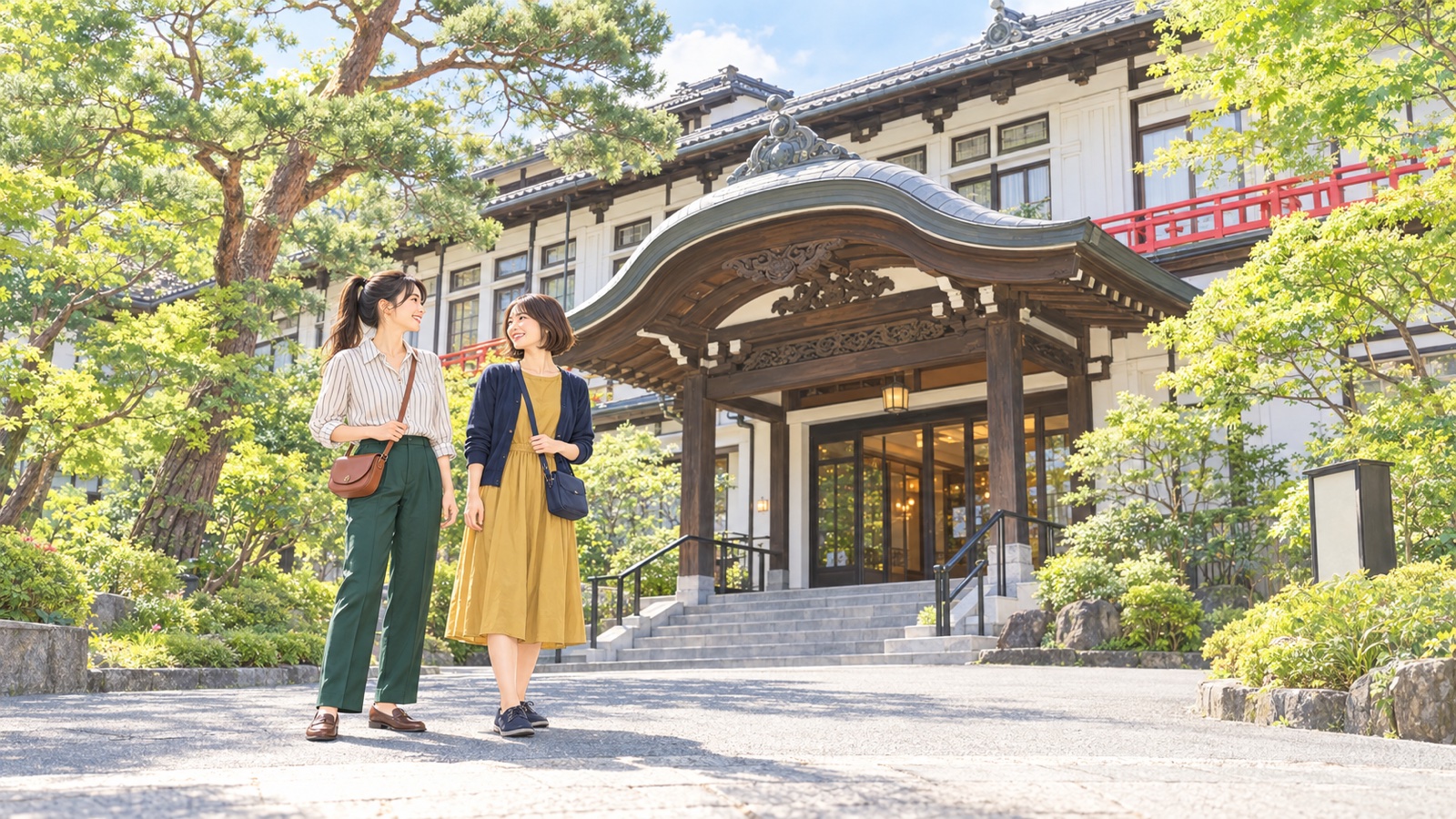
From the Odawara Relay Point, runners on Leg 5 climb the mountain road on National Route 1 from Hakone-Yumoto. Through 2014, the route passed through the Kanrei-do-mon tunnel, a nationally designated Important Cultural Property. The nearest bus stop is Tounosawa on the Hakone Tozan Bus.
Around the 9-km mark of Leg 5 is the hot-spring town of Miyanoshita. Rikkyo University chose “Miyanoshita Hot-Spring Town / in front of Fujiya Hotel” as a spectator point for the 102nd race. The following morning, Leg 6 runners speed down the mountain along the same street.
Fujiya Hotel was founded during the Meiji era by Sennosuke Yamaguchi and marked its 148th anniversary on July 15, 2026. Buildings including the Main Building, Western-style Building, and Flower Palace are registered tangible cultural properties of Japan. The address is 359 Miyanoshita, Hakone.
Fujiya Hotel Co., the company that operates Fujiya Hotel, also runs the Hakone Ekiden Museum by Lake Ashi. After watching the uphill runners pass through Miyanoshita, you can follow the history of that same fifth leg in the exhibits at the finish area.
- Location
- 359 Miyanoshita, Hakone, Ashigarashimo District, Kanagawa (in front of Fujiya Hotel)
- Connection to the race
- Hot-spring town traversed by the uphill outbound Leg 5 (around the 9-km mark) and downhill return Leg 6
- Note
- The Main Building, Western-style Building, and Flower Palace are registered tangible cultural properties; the operating company also runs the Hakone Ekiden Museum
Sources:Traffic News — Kanrei-do-mon tunnel / Rikkyo University — Spectator points for the 102nd Hakone Ekiden / Fujiya Hotel official site / Official Hakone Ekiden Museum — Visitor information (operator)
7Railroad Crossing Near Kowakudani Station | The Hakone Tozan Train Stops to Wait for Runners at the Course’s Only Crossing

At Kowakudani, a short climb from Miyanoshita, runners cross the Hakone Tozan Railway tracks. The crossing is right beside Kowakudani Station. It is the only place where runners cross a railroad on the Hakone Ekiden course.
When the runners pass, the train stops before the crossing and waits for them to go by. The director of the Hakone Ekiden Museum lists this unusual scene as one of the places to watch the race.
On the following morning, runners descend the mountain and cross the same tracks during Leg 6. You can watch the uphill fifth-leg runners on January 2 and the downhill sixth-leg runners on January 3 from the same place.
- Location
- Kowakudani, Hakone, Ashigarashimo District, Kanagawa (railroad crossing near Kowakudani Station)
- Connection to the race
- The course’s only crossing where runners in Legs 5 and 6 cross the Hakone Tozan Railway tracks
- Nearest station
- Beside Kowakudani Station on the Hakone Tozan Railway
Sources:Hakone Navi — Spectator points recommended by the director of the Hakone Ekiden Museum
8Highest Point on National Route 1 (Near Lake Shōjin) | Leg 5 at 16.2 km, the 874-Meter Summit

Leg 5 runs 20.8 km from Odawara to Lake Ashi. The mountain climb is called the “greatest challenge,” with an elevation gain of about 834 meters. Around the 16.2-km mark, runners reach the highest point on National Route 1 at an elevation of about 874 meters.
The highest point is where National Route 1 passes between Mount Komagatake and Mount Kami-Futago. On the north shore of nearby Lake Shōjin is the Motohakone Stone Buddhas, a group of Jizo statues that conveys the medieval Jizo faith of the Kamakura and Muromachi periods and is designated an Important Cultural Property. On the south shore are the Hakone Stone Buddhas and History Museum and a parking lot. Lake Shōjin is a one-minute walk from the Rikudojizo bus stop on the Hakone Tozan Bus.
Beyond the summit, the road turns downhill toward the large torii gate of Hakone Shrine after the 19-km mark. How quickly runners shift from climbing to descending affects their finish time.
In the 102nd race, Aoyama Gakuin University’s Asahi Kuroda ran Leg 5 in 1:07:16. That is the fastest time since the course took its current form in the 93rd race. Second is the 1:09:11 run by the same university’s Hiroki Wakabayashi in the 101st race—a difference of 1 minute, 55 seconds.
On the following morning, runners in Leg 6 climb for about 4 km, pass the summit, and descend toward Odawara. The mountains around Hakone are bitterly cold in the morning, and runners can be hit by unexpected stomach pain or cramps.
- Location
- Motohakone, Hakone, Ashigarashimo District, Kanagawa (near Lake Shōjin and the highest point on National Route 1)
- Connection to the race
- Highest point at about 874 m elevation around the 16.2-km mark of Leg 5 (passed in the first 4 km of Leg 6)
- Access
- One-minute walk from the Hakone Tozan Bus Rikudojizo stop to Lake Shōjin
Sources:Official Hakone Ekiden site — Course guide (Legs 5 and 6, and historical records) / Official Hakone Ekiden site — Elevation change on Leg 5 / Nippon Tabi Magazine — Motohakone Stone Buddhas and the highest point on National Route 1 / Nippon Tabi Magazine — Lake Shōjin
9Outbound Finish at Lake Ashi and the Hakone Ekiden Museum | The Overall Champion’s Trophy Through the 100th Race and the Monument to Past Winners

The outbound finish and return start are at the entrance to the Lake Ashi parking lot in Hakone, beside Hakone-machi Port. A plaque commemorating the 100th race is embedded in the nearby sidewalk, marking the outbound finish and return start. On January 2, teammates gather here to await the Leg 5 runner. At the 102nd race, the outbound winner’s award ceremony was also held nearby.
The museum director recommends watching from in front of the Hakone-machi Port bus terminal, where you can see the long straight just before the outbound finish and just after the return start. Another good spot is the straight in front of the Hakone Dollhouse Museum, with its climbs and descents, where you can watch runners for a long time. On race day, rather than heading directly from Hakone-Yumoto Station, taking the Hakone Pirate Ship from Togendai Port to Hakone-machi Port can help avoid crowds. Ships may be canceled because of wind or other conditions.
The Hakone Ekiden Museum marked its 20th anniversary in 2025. Tapestries representing the four schools in the first race hang above the entrance to the paid area: Meiji University, Waseda University, Keio University, and Tokyo Higher Normal School (now the University of Tsukuba). The History Zone looks back at the race with photographs dating from the first running.
The Episode Zone displays replicas of the outbound winner’s trophy, made with Hakone yosegi-zaiku wood marquetry. On July 19, 2025, a permanent exhibit began for the overall champion’s trophy used through the 100th running. The trophy was replaced for the 101st race. Visitors can now always see the old cup, whose base lists the winning schools from the first through the 100th race.
The uniform exhibit displays uniforms and sashes from universities that earned seeded places. There is also a search station where visitors can look up every entrant’s name and time, and an Olympic Zone introducing runners who went on to compete at the Olympics. One of the exhibits is the uniform of the late Kenzo Kono, a politician who ran the Hakone Ekiden as a student. On March 17, 2026, the museum converted its cafe into a theater room and began screening highlight videos from past and recent races.
On the same day, a special exhibition opened to mark the drama adaptation of Jun Ikeido’s novel Our Hakone Ekiden. It introduces original manuscripts, the background to the work, and how television broadcasters produce the race coverage. As of the announcement on March 17, 2026, no closing date had been set. At 10:45 a.m. on Tuesdays, Thursdays, and Saturdays, staff lead a roughly 20-minute “Hakone Ekiden Trivia Guide,” included with admission.
Admission is ¥750 for adults and ¥550 for elementary and junior high school students. The museum is open 10 a.m.–4:30 p.m. on weekdays and 9:30 a.m.–5 p.m. on weekends and holidays; last admission is 30 minutes before closing. At the museum shop, “Kanso-men,” dried noodles with a pun on “finish the race,” is a popular souvenir for spectators.
About a two-minute walk along Lake Ashi from the museum are several monuments: the “Tokyo-Hakone Collegiate Ekiden Race Monument,” a monument called “In Praise of the Ekiden” engraved with a poem by poet Sumio Katsu, and the bronze “Hakone Ekiden Glory Monument: In Praise of Young Strength,” erected for the 70th race. The base lists past champions and their times from the first race onward.
Across National Route 1, around the corner just before the outbound finish, is Ekiden Plaza. At its center is the stone monument “TASUKI,” installed in May 2003. Designed to evoke a runner finishing the race, its back is inscribed with the origin of the Ekiden and the Hakone course by leg.
- Location
- 167 Hakone, Hakone, Ashigarashimo District, Kanagawa (near Hakone-machi Port)
- Connection to the race
- Outbound Leg 5 finish and return Leg 6 start, with the Hakone Ekiden Museum directly across from the course
- Hours and admission
- Weekdays 10 a.m.–4:30 p.m.; weekends and holidays 9:30 a.m.–5 p.m. (last admission 30 minutes before closing); ¥750 adults, ¥550 elementary and junior high students
Sources:Hakone Navi — Have you heard of the Hakone Ekiden Museum? / Official Hakone Ekiden Museum — Floor guide / Official Hakone Ekiden Museum — Visitor information / Kanagawa Now — Permanent display of the overall champion’s trophy / Official Hakone Ekiden Museum — New theater room / Official Hakone Ekiden Museum — Special exhibition announcement / Official Hakone Ekiden Museum — Heritage guide / Official Hakone Ekiden Museum — Hakone Ekiden locations nearby / Nippon Tabi Magazine — Hakone Ekiden monuments / Nippon Tabi Magazine — Ekiden Plaza
10Showa Kinen Park | Finish of the Qualifier on October 17, 2026, Where Ten Schools Secured Places in the Main Race

Twenty-one teams compete in the main race: ten schools with seeded places after finishing in the top ten in the previous race, ten schools that advance through the October qualifier, and the Kanto Student Union Team. In the qualifier, runners from each school start together for a half marathon of 21.0975 km. The ten advancing schools are determined by the combined time of each school’s top ten runners.
The qualifier for the 103rd race started at 8:30 a.m. on Saturday, October 17, 2026, at the Japan Ground Self-Defense Force Tachikawa Garrison in Tachikawa, Tokyo. Runners pass through central Tachikawa, with the finish at Showa Kinen Park. Runners do not know whether they have qualified when they finish; at the results announcement, the Kanto Federation’s secretary-general reads out the advancing schools.
Toyo University finished first with a combined time of 10:31:30. In order from second, the advancing schools were Chuo Gakuin University, Tokai University, Senshu University, Tokyo University of Agriculture, Yamanashi Gakuin University, Daito Bunka University, Kanagawa University, Nippon Sport Science University, and Hosei University. The difference between tenth-place Hosei and eleventh-place Kokushikan University was 1 minute, 46 seconds. Individually, Brian Kipiego of Yamanashi Gakuin University was fastest overall in 1:00:48.
Showa Kinen Park is a 180-hectare national park developed on the former site of the U.S. military’s Tachikawa Airfield. Its first 70-hectare area opened on October 26, 1983. The address is 3173 Midori-cho, Tachikawa; adult admission is ¥450.
- Location
- 3173 Midori-cho, Tachikawa, Tokyo
- Connection to the race
- Finish venue for the 21.0975-km Hakone Ekiden qualifier that selects ten schools for the main race
- Admission
- ¥450 adults
Sources:Kanto Intercollegiate Athletics Federation — Rules for the 103rd qualifier / Kanto Intercollegiate Athletics Federation — Team results for the 103rd qualifier / Kanto Intercollegiate Athletics Federation — Overall results for the 103rd qualifier / Official Hakone Ekiden site — How can a school qualify? / Showa Kinen Park — About the park / Showa Kinen Park — Admission fees
Learn More About the Hakone Ekiden | Shiso Kanakuri’s Call and How 21 Teams Come Together
The Hakone Ekiden began with the wish of Shiso Kanakuri and others “to develop runners who could compete with the world.” Kanakuri was Japan’s first Olympic marathon representative. The race’s organizers and records from the first running in 1920 help explain the rules for qualifying and cheering along the course.
Shiso Kanakuri and the People Who Helped Found the Race
Shiso Kanakuri
In 1912, as a student at Tokyo Higher Normal School, he competed in the marathon at the Stockholm Olympics, Japan’s first Olympic appearance. He collapsed unconscious at the 26.7-km mark, realizing how far Japan was behind the rest of the world. That experience became a major reason he started the Hakone Ekiden. He is known as the “father of the marathon.”
Genzaburo Noguchi
A teacher at Tokyo Higher Normal School. The idea for the Hakone Ekiden emerged from a conversation in 1919 among him, Kanakuri, and Eiichi Sawada, who had served together as judges at a sports festival.
Eiichi Sawada
At the time, he was a student at Meiji University. He was one of the people who discussed the Hakone Ekiden idea with Kanakuri and Noguchi.
Akira Terada
He was the planning manager at Hochi Shimbun. Kanakuri first asked him for help in making the race happen.
Chiyosaburo Takeda
He was the director of Jingu Kogakkan. When Yomiuri Shimbun organized Japan’s first Ekiden in 1917, Takeda is said to have coined the word “Ekiden” from the Nara-period terms eki-uma and tenma, referring to relay stations and post horses.
Kenzo Futagi
Captain of Keio University’s mountaineering club, he ran Leg 5 in the first race. After crossing the dark mountain road, he reached Hakone in fourth place just before 10 p.m.
Sources:Official Hakone Ekiden site — What is the Hakone Ekiden? (history and trivia) / Keio University — Mita Review, “The Hakone Ekiden”
The First Race Began at 1 p.m. on February 14, 1920, With Four Schools
In 1917, Yomiuri Shimbun planned the “Tokaido Ekiden Walking Race to Celebrate the 50th Anniversary of the Transfer of the Capital to Tokyo,” as a supporting event for a large exhibition in Ueno. The race covered about 516 km from Sanjo Ohashi in Kyoto to Shinobazu Pond in Ueno, divided into 23 stages. It was a grand relay in which teams from eastern and western Japan ran continuously for three days and nights. Considered Japan’s first Ekiden, its success became the prototype for the Hakone Ekiden.
Encouraged, Kanakuri and his colleagues invited universities, normal schools, and vocational schools to take part. Four accepted: Waseda University, Keio University, Meiji University, and Tokyo Higher Normal School. At 1 p.m. on February 14, 1920, the first race began under the name “Four Great Schools Ekiden Race.” At the time, there were few students, and it was reportedly difficult even to recruit ten runners capable of covering 20 km.
There were few spectators along the course, and dusk fell partway through Leg 4. On the mountain road in Leg 5, local distance runners paced the competitors while a youth association lit the course with torches. At Keio University, a manager accompanying the team by bicycle reportedly bought lanterns. The return began before dawn the next day, and the first champions were the runners from Tokyo Higher Normal School, now the University of Tsukuba.
The race was not held in 1941 or 1942, or from 1944 through 1946 during World War II. In 1941, permission to use the roads was not granted because the Tokaido and Hakone roads were being used to transport military supplies. The January 2 and 3 schedule began with the 32nd race in 1956.
Sources:Official Hakone Ekiden site — What is the Hakone Ekiden? (history and interruptions) / Keio University — Mita Review, “The Hakone Ekiden” / Imidas — Hakone Ekiden
December 29 Lineup Entries and the Kanto Student Union Team
All universities affiliated with the Kanto Intercollegiate Athletics Federation are eligible to compete. On December 29, each participating university submits its lineup of ten runners for Legs 1 through 10 and six substitutes. Substitutions are accepted until 1 hour and 10 minutes before the start of the outbound and return races. Up to six substitutions are allowed across both days and no more than four in a single day; runners assigned to legs cannot swap legs with one another.
The Kanto Student Union Team is assembled from high-ranking runners at universities that did not qualify, with no more than one runner from any school. As an open-entry team, its team and individual results count as reference records. A runner may compete in the main race and qualifier only if they have appeared in fewer than four combined races.
Ahead of the 102nd race, Yomiuri Shimbun recorded a preview video on December 11, 2025. The narrator, editorial committee member Yuji Kondo, ran the Hakone course three times as a Waseda University runner.
Sources:Official Hakone Ekiden site — When are the ten runners decided? / Kanto Intercollegiate Athletics Federation — Rules for the 102nd race (lineup changes and participating schools) / Kanto Intercollegiate Athletics Federation — Rules for the 103rd qualifier (eligibility) / Yomiuri Shimbun Online video — Race preview
Spectator Rules Along the Course
The organizers ask spectators to stay on the sidewalk and never step into the road. Runners pass very close to the sidewalk, so reaching out or leaning over is dangerous. Tying banners or flags to guardrails or bridges violates the Road Traffic Act and other laws. Drones and selfie sticks are also prohibited around the course.
School banners and flags cannot be displayed within 100 meters before or after the start, finish, or relay points, or on bridges and at intersections. For the 102nd race, the official site posted crowding information for Kazamatsuri, Odawara, and Hakone-Yumoto stations. Depending on crowd levels, station entry may be restricted.
Sources:Official Hakone Ekiden site — Enjoying the Hakone Ekiden safely
The People and Broadcast Behind the Race | Student Organizers, Nippon TV’s Live Coverage, and a Bird’s-Eye Course Map
The 217.1-km course depends on more than the ten runners: student organizers, assistants, and broadcast crews are also essential. Students’ work, Nippon TV’s live coverage, the official course map, and the fall 2026 drama and symposium all involve many people in the race.
A Race Organized by Students for More Than 100 Years
The Kanto Federation is run primarily by student executive committee members selected from affiliated universities. While organizing the federation’s annual meets, these students prepare for the Hakone Ekiden as its largest event. Yasushi Ueta, the federation’s president, has written that more than 6,000 people support and help make the race happen.
At each university, many athletes who did not make the team lineup serve as support staff. They look after luggage, provide massages, and monitor runners’ physical condition; television broadcasts often show them helping runners who collapse at a relay point. Universities entering the qualifier provide at least ten assistants, and even schools that do not advance send at least 15 assistants to the main race.
Sources:Official Hakone Ekiden site — What do the behind-the-scenes staff do? / Official Hakone Ekiden Museum — Greeting from the Kanto Federation president / Kanto Intercollegiate Athletics Federation — Rules for the 103rd qualifier (assistants)
Live Coverage Since 1987, Made Possible by a Mountain Relay Station
Live television coverage was not possible for many years because radio signals could not reach through Hakone’s mountains. Nippon TV overcame this by setting up a relay station in the mountains, and live broadcasts began with the 63rd race in 1987. The highest average viewership rating was 32.1%, recorded during the return leg of the 95th race in 2019.
The 103rd race will air on Nippon TV and its affiliates. The outbound race is scheduled from 6:45 a.m. to 2:05 p.m. on January 2, 2027; the return will air from 6:45 a.m. to 2:18 p.m. on January 3. Both days will also be streamed live on TVer for smartphones.
From December 22 to 28, 2025, ahead of the 102nd race, decorations modeled on every team’s sash were displayed near the central ticket gates at JR Shinagawa Station. Planned by Nippon TV, the installation featured 21 sash-shaped decorations, each 3.2 meters long and 60 centimeters wide.
You can play this video in the official video at the top of this page ↑
Sources:Official Hakone Ekiden site — When did TV coverage begin? / Official Hakone Ekiden Museum — Television coverage since the 63rd race / Official Hakone Ekiden site — In the media / Yomiuri Shimbun Online video — Sash decorations at JR Shinagawa Station
The Official Course Map Drawn by Bird’s-Eye View Artist Tatsuya Kurosawa
The official site’s course guide features a map drawn by panoramic bird’s-eye view artist Tatsuya Kurosawa. Born in Miyagi Prefecture in 1950, Kurosawa studied design at Kuwasawa Design School. After working at an architectural perspective studio, he became an independent illustrator. His representative works include Diorama Tokyo, Heian-kyo, and Map of Edo at the End of the Shogunate.
Kurosawa says he aimed to make it easy to see the terrain and course runners are on, even for people unfamiliar with place names and topography. At the same time, he wanted people from the greater Tokyo area who know the course and Hakone well, and dedicated Ekiden fans, to enjoy every detail. The map can be enlarged by leg and includes elevation profiles and rankings of historical records for each leg.
Sources:Official Hakone Ekiden site — Course guide (map creator)
The Drama Our Hakone Ekiden, Which Began Airing in October 2026, and a Symposium About the Student Union Team
Nippon TV’s Saturday drama Our Hakone Ekiden began airing at 9 p.m. on October 10, 2026. Based on Jun Ikeido’s novel, it stars Yo Oizumi. It follows two parallel challenges: a fictional broadcaster, Dainichi TV, covering the Hakone Ekiden and the Kanto Student Union Team’s attempt to compete.
Yo Oizumi plays Ryo Tokushige, chief producer of Dainichi TV’s race coverage. Tomohisa Yamashita plays student union team coach Masato Kai, and Toranosuke Kobayashi plays captain Hayato Aoba. In Episode 3, scheduled to air October 24, Tokushige searches for a replacement after longtime lead announcer Hisashi Maeda is suddenly hospitalized.
It was announced that Toranosuke Kobayashi, who plays Hayato Aoba, and Tomoya Oku, who plays Keito Yano, will appear as guests at the November 20 Hakone Ekiden symposium. Panelists are Jun Hiratsuka, associate professor at Josai University; Akihito Kobari, coach of Tokyo International University’s Ekiden team; and Takuma Akiyoshi of MABP Maverick. Eiji Daigo, vice president of the Kanto Federation, will moderate. Every attendee will receive a commemorative calendar.
Sources:Nippon TV — Official site for the Saturday drama Our Hakone Ekiden / Nippon TV — Drama introduction / Official Hakone Ekiden site — Related programs / Official Hakone Ekiden site — 103rd Hakone Ekiden Symposium
From the First Race to the 103rd
Key events from Shiso Kanakuri’s 1912 Stockholm Olympics and the first race in 1920 to the start of live television coverage, the opening of the Hakone Ekiden Museum, and the 102nd and 103rd races.
- 1912
Shiso Kanakuri withdrew from the marathon at the Stockholm OlympicsPeople - 1917
A 516-km Tokaido Ekiden walking race from Kyoto to Ueno became Japan’s first EkidenBefore the first race - 1919
The idea for the race emerged from a conversation among Shiso Kanakuri, Genzaburo Noguchi, and Eiichi SawadaPlanning - 1920
February 14 The first race started in front of Hochi Shimbun in Yurakucho. Four schools competed, and Tokyo Higher Normal School won.Race - 1941〜1946
Races were canceled because of the war in 1941, 1942, and 1944–1946Race - 1956
The race moved to January 2 and 3 starting with the 32nd runningRace - 1987
Nippon TV began live coverage with the 63rd raceBroadcast - 1994
Yamanashi Gakuin University won the overall title in the 70th race with a time of 10:59:13Record - 2003
May The stone monument “TASUKI” was installed at Ekiden Plaza on Lake AshiMonument - 2005
The Hakone Ekiden Museum opened on the shore of Lake AshiFacility - 2006
The outbound Odawara Relay Point moved about 2.5 km back for the 82nd race; Leg 5 became the longest at 23.2 kmCourse - 2014
The final year that runners in Legs 5 and 6 passed through Kanrei-do-monCourse - 2017
For the 93rd race, the Odawara Relay Point returned to the area in front of Suzuhiro and Leg 5 shortened to 20.8 kmCourse - 2024
January The 100th race. Aoyama Gakuin University won its seventh overall titleRace - 2025
July 19 The museum began permanently displaying the overall champion’s trophy used through the 100th raceFacility - 2026
January 2 The 102nd race. Aoyama Gakuin University won its ninth overall title, and third in a row, in 10:37:34Raceand3 - 2026
March 17 The museum opened a special exhibition commemorating the drama adaptation and a theater roomFacility - 2026
October 10 The Nippon TV drama Our Hakone Ekiden began airingDrama - 2026
October 17 The qualifier for the 103rd race took place in Tachikawa; Toyo University advanced in first placeRace - 2026
November 20 The 103rd Hakone Ekiden Symposium was held at Yomiuri Otemachi HallEvent - 2027
January 2 103rd race (scheduled)Raceand3
Sources:Official Hakone Ekiden site — What is the Hakone Ekiden? / Official Hakone Ekiden site — Race years / Imidas — Hakone Ekiden / All About News — Odawara Relay Point relocation / Traffic News — Kanrei-do-mon / Nippon Tabi Magazine — Ekiden Plaza / Official Hakone Ekiden Museum — 100th race / Official Hakone Ekiden Museum — 102nd race / Kanto Intercollegiate Athletics Federation — Team results for the 103rd qualifier
The Oshi Lab Note | A Business Perspective: Turning an Annual Passing Point Into a Year-Round Exhibit and Experience
Suzuhiro Kamaboko Village, the site of the Odawara Relay Point, is a complex directly connected to Kazamatsuri Station. The free Kamaboko Museum offers hands-on workshops with artisans. Fujiya Hotel’s company operates the museum by Lake Ashi; it permanently displays the overall champion’s trophy and holds a trivia guide three times a week.
A feature of the Hakone course is that monuments and permanent displays remain at relay points and the finish, even though runners pass through in seconds and the race itself lasts only a few days. Plaques engraved with past champions, trophies, and each school’s sash let visitors trace the outbound and return routes outside the New Year season.
Related article from The Oshi Lab:Travel companies and destination product design
Sources
- Official Tokyo-Hakone Collegiate Ekiden Race site (Kanto Intercollegiate Athletics Federation and Yomiuri Shimbun)
- Official Hakone Ekiden site — What is the Hakone Ekiden?
- Official Hakone Ekiden site — Course guide
- Official Hakone Ekiden site — Enjoying the Hakone Ekiden safely
- Official Hakone Ekiden site — Race years
- Rules for the 102nd Tokyo-Hakone Collegiate Ekiden Race
- Rules for the 103rd Tokyo-Hakone Collegiate Ekiden qualifier
- Team results for the 103rd qualifier
- Overall results for the 103rd qualifier
- 103rd Hakone Ekiden Symposium
- Official Hakone Ekiden Museum
- Official Hakone Ekiden Museum — Visitor information
- Official Hakone Ekiden Museum — Hakone Ekiden locations nearby
- Official Hakone Ekiden Museum — Special exhibition announcement
- Kanagawa Now — Permanent display of the overall champion’s trophy
- Hakone Navi — How to enjoy the Hakone Ekiden in person
- MLIT Yokohama National Highway Office — Joint walking patrol before the Hakone Ekiden
- Suzuhiro Kamaboko Village
- Fujiya Hotel
- Showa Kinen Park
- Yomiuri Shimbun Online — Hakone Ekiden
- Keio University — Mita Review, “The Hakone Ekiden”
- Rikkyo University — Spectator points for the 102nd Hakone Ekiden
- All About News — Odawara Relay Point relocation
- Traffic News — Following the Hakone Ekiden by local bus: Tokyo to Yokohama
- Traffic News — Following the Hakone Ekiden by local bus: Shonan and Hakone
- Mynavi News — What was the first Hakone Ekiden like?
- Imidas — Hakone Ekiden
- Nippon Tabi Magazine — Hakone Ekiden monuments
- Nippon Tabi Magazine — Motohakone Stone Buddhas
- Nippon TV — Official site for the Saturday drama Our Hakone Ekiden
FAQ
When is the 103rd Hakone Ekiden?
The outbound race is Saturday, January 2, 2027, and the return is Sunday, January 3. Nippon TV’s broadcast is scheduled from 6:45 a.m. to 2:05 p.m. on January 2 and 6:45 a.m. to 2:18 p.m. on January 3. The previous, 102nd race started at 8 a.m. from Otemachi for the outbound and Lake Ashi for the return.
How long is the Hakone Ekiden course?
The outbound race covers five legs and 107.5 km from Otemachi to Lake Ashi; the return covers five legs and 109.6 km from Lake Ashi to Otemachi, for a total of 217.1 km. The longest legs are Legs 2 and 9, at 23.1 km each.
Which universities will compete in the 103rd race?
The field is 21 teams: ten seeded universities that finished in the top ten in the previous race, ten schools advancing from the qualifier, and the Kanto Student Union Team. The ten schools that advanced on October 17, 2026, were Toyo, Chuo Gakuin, Tokai, Senshu, Tokyo University of Agriculture, Yamanashi Gakuin, Daito Bunka, Kanagawa, Nippon Sport Science, and Hosei.
What should I keep in mind when cheering along the course?
Stay on the sidewalk and do not enter the road. Runners pass close to the sidewalk, so do not reach out or lean over. Do not tie flags or banners to guardrails or bridges; drones and selfie sticks are also prohibited.
What are the Hakone Ekiden Museum’s admission fee and opening hours?
Admission is ¥750 for adults and ¥550 for elementary and junior high school students. The museum is open 10 a.m.–4:30 p.m. on weekdays and 9:30 a.m.–5 p.m. on weekends and holidays; last admission is 30 minutes before closing. It has no regular closing days; contact the facility directly about winter hours.
How do I get to the Hakone Ekiden Museum?
It is at 167 Hakone, beside Hakone-machi Port. The bus ride from Odawara Station takes about 50 minutes; from Tokyo Station, public transit takes about 95 minutes. On race day, the museum director recommends taking the Hakone Pirate Ship from Togendai Port to Hakone-machi Port to avoid crowds.
What is the Shiso Kanakuri Award?
It is given to the most valuable runner of the race. It is named after Shiso Kanakuri, who represented Japan in the marathon at the 1912 Stockholm Olympics and called for the creation of the Hakone Ekiden.
Are there exhibits or events related to the drama Our Hakone Ekiden?
A special exhibition featuring original manuscripts and other materials from the novel opened at the Hakone Ekiden Museum on March 17, 2026. A Hakone Ekiden symposium is scheduled for November 20, 2026, at Yomiuri Otemachi Hall in Otemachi. Guests announced include Toranosuke Kobayashi and Tomoya Oku, who appear in the drama.


