

Nintendo Pilgrimage: Marufukuro, the Nintendo Museum, Four Stores, and More
Nintendo’s former headquarters still stands on Shomen-dori Street in Shimogyo Ward, Kyoto. Completed in 1930, it dates from the era when the company made and sold hanafuda and karuta cards. A new wing supervised by architect Tadao Ando was added, and the building opened as the Marufukuro hotel on April 1, 2022. In Uji, the Uji Ogura Factory, where Nintendo made playing cards and hanafuda, became the Nintendo Museum on October 2, 2024.
Nintendo began making hanafuda cards in Kyoto in 1889, under founder Fusajiro Yamauchi. In addition to Marufukuro, the former headquarters hotel, and the Nintendo Museum in Uji, destinations include the Saga Arashiyama Museum of Arts and Culture and four official stores in Japan. Its predecessor, Shigureden, was a Hyakunin Isshu facility whose construction was funded by Hiroshi Yamauchi, Nintendo’s president for 53 years. These eight destinations comprise the official stores in Kyoto, Osaka, Tokyo, and Fukuoka, plus Super Nintendo World at USJ.
Eight Nintendo-Related Places, Including the Former Headquarters Hotel in Kyoto, a Museum in Uji, and Four Official Stores
Four of the eight destinations are in Kyoto Prefecture, where Nintendo was founded. Marufukuro and Nintendo KYOTO are in central Kyoto City. The Saga Arashiyama Museum of Arts and Culture is in Arashiyama, and the Nintendo Museum is near Kintetsu Ogura Station in Uji. In Osaka, visitors can go to Nintendo OSAKA and Super Nintendo World at USJ; official stores are also in Tokyo and Fukuoka.
① Marufukuro
A hotel with 18 rooms that opened on April 1, 2022, combining Nintendo’s former headquarters, completed in 1930, with a new wing by Tadao Ando.
Explore Marufukuro② Nintendo Museum
A Nintendo public relations facility that opened on October 2, 2024, in a renovated Uji Ogura Factory, where Nintendo made playing cards and hanafuda and repaired game consoles.
Explore the Nintendo Museum③ Saga Arashiyama Museum of Arts and Culture
A museum that opened in November 2018, succeeding Shigureden, a Hyakunin Isshu facility whose construction was funded by Hiroshi Yamauchi.
Explore the Saga Arashiyama Museum of Arts and Culture④ Nintendo KYOTO
An official store opened on October 17, 2023, in Kyoto, where Nintendo was founded. Mario peeks out of a pipe at the first-floor entrance.
Explore Nintendo KYOTO⑤ Nintendo OSAKA
Opened on November 11, 2022, as Japan’s second official store and the first in western Japan.
Explore Nintendo OSAKA⑥ Super Nintendo World
The world’s first Nintendo-themed area opened at USJ in 2021. Donkey Kong Country was added in December 2024.
Explore Super Nintendo World⑦ Nintendo TOKYO
Japan’s first official Nintendo store, opened on November 22, 2019. There is a Mario statue at the entrance to the outside staircase.
Explore Nintendo TOKYO⑧ Nintendo FUKUOKA
Japan’s fourth official Nintendo store, opened on November 14, 2025. It is the first permanent Nintendo store in Kyushu.
Explore Nintendo FUKUOKA
1Marufukuro | Stay in Nintendo’s Former Headquarters, Where Hanafuda and Karuta Were Sold, and Its New Wing by Tadao Ando
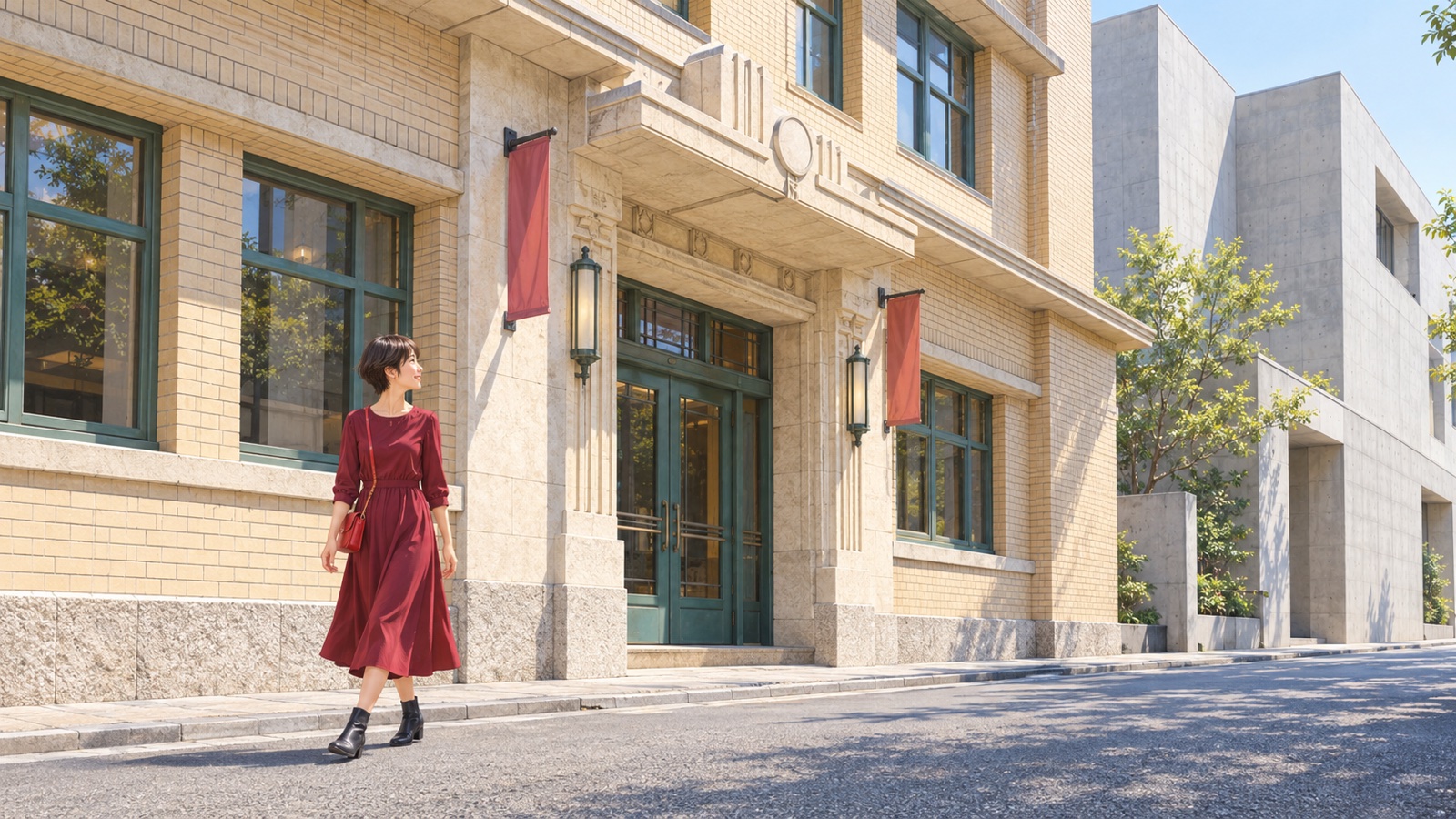
Marufukuro is a hotel at 342 Kagiya-cho, Shomen-dori, Shimogyo Ward, Kyoto City. Since its founding, Nintendo used the trade name Marufuku at this Kagiya-cho location. The hotel takes its name from that business name. Completed in 1930, the former headquarters is a four-story reinforced-concrete building comprising three wings: offices, residences, and a warehouse. It is in the Art Deco style popular in the early Showa period, characterized by straight lines, geometric patterns, and vivid colors.
The building was used for about 30 years, through 1959, and was also home to the founding Yamauchi family. After the headquarters moved that year to Fukunari Kamitakamatsu-cho in Higashiyama Ward, the building served as a warehouse for many years and was not open to the public. During renovation, a new exposed-concrete wing supervised by Tadao Ando was built on what had been a garden. The hotel is operated by Plan Do See Inc. and has 18 rooms, including four suites.
The four wings are named after the suits on playing cards. The former residence is the Heart Wing, the former warehouse is the Clover Wing, and the areas designed by Tadao Ando are the Spade and Diamond Wings. The Clover Wing, the first to be completed in 1930, retains its original elevator and has walls decorated with hanafuda and karuta. From its third-floor landing, visitors can see the three characters of “Nintendo” on the exterior wall. Stained glass from the former headquarters remains in the hallways and staircase of the Heart Wing, where the Yamauchi family lived.
Near the entrance, the library “dNa” presents Nintendo’s history and culture as interpreted by the Yamauchi family. One room features interactive art by Rhizomatiks inspired by hanafuda and works depicting the original Famicom. The guest lounge, formerly a reception room, contains furnishings from the old headquarters. In the dining lounge in the new wing, visitors can see works donated by Tadao Ando and pieces by Yayoi Kusama and other artists.
Only hotel guests may enter the building. Tempura Marufuku, which opened on November 1, 2025, in part of the former headquarters, accepts reservations from non-guests. The restaurant has 20 seats at a pale-wood counter, where chefs fry seasonal ingredients one by one. Dinner options are a 12-course omakase tempura kaiseki starting at 5 p.m. for ¥15,000, and a 15-course menu starting at 7 p.m. for ¥20,000. Both prices include tax and exclude service charge. From 10 p.m., the restaurant also serves a late-night menu called Yonaki Marufuku, including Chinese-style noodles. Reservations are accepted by phone or through TableCheck.
In July 2024, Otonami, an experience-booking site, offered a dinner that included a guided tour. Staff led guests through the historic and new wings. Visits without a meal are not available. The hotel is about a six-minute walk from Keihan Shichijo Station and a 15-minute walk from Kyoto Station. It has no parking.
- Location
- 342 Kagiya-cho, Shomen-dori, Shimogyo Ward, Kyoto City
- Connection to Nintendo
- An 18-room hotel making use of Nintendo’s former headquarters, completed in 1930
- Highlights
- The former headquarters’ design, the dNa library, and Tempura Marufuku
- Access
- About a six-minute walk from Keihan Shichijo Station and a 15-minute walk from JR Kyoto Station
Sources:Official Sources and Facility Information
2Nintendo Museum | Compare Nintendo’s Products at the Uji Ogura Factory and Play With the Ultra Hand
The Nintendo Museum is a Nintendo public relations facility at 56 Kagra-den, Ogura-cho, Uji City, Kyoto Prefecture. The building was constructed as the Uji Factory in 1969 and renamed the Uji Ogura Factory in 1988. It manufactured playing cards and hanafuda and served as a service center for repairing game consoles. Production moved to the Uji Factory in Makishima-cho, Uji, in 2004, and the service center followed in November 2016, and the site opened as a museum on October 2, 2024.
On the second floor of Exhibition Building 1, “Let’s Compare” displays products Nintendo has released over the years. Rather than providing detailed explanations, it invites visitors to compare the products with their own experiences and memories and talk about them. An art gallery opened on the same floor on September 3, 2025. Visitors can see concept art and illustrations for Super Mario, The Legend of Zelda, and Animal Crossing, as well as development materials for some games. Photography is prohibited in the exhibition area.
In the first-floor experience area, visitors use ten coins given at entry to try exhibits that recreate Nintendo’s historic play experiences with modern technology. At Ultra Hand SP, they use the Ultra Hand, released in 1966, to grab balls moving along a conveyor and drop them into a pipe. Love Tester SP measures the “love level” of two people holding hands, based on the 1969 Love Tester. At Ultra Machine SP, visitors bat balls thrown by the 1968 home pitching machine.
Zapper & Scope SP is based on Laser Clay, a leisure attraction from the 1970s, and lets visitors shoot at a Mario world projected on a giant screen with light guns. Shigureden SP is a Hyakunin Isshu experience inspired by the former Shigureden in Arashiyama. Visitors find the card with the second half of a poem read by a smartphone from a large display underfoot. Big Controllers, oversized versions of controllers from different generations, are operated by two people sharing the controls. Ten coins are not enough to try every exhibit, so visitors choose what to play. Photography is permitted in the experience area.
The Craft Room is a workshop where visitors make hanafuda using a special kit. They choose a design for any of the 12 months, color four cards, fold and assemble them, and take them home. The experience takes about 60 minutes and costs ¥2,000. In the Play Room, pairs can enjoy hana-awase, a classic hanafuda game. Using image recognition and projection, the experience takes about 30 minutes and costs ¥500 per person. Advance reservations are required on the day of the visit for both activities. The cafe serves custom hamburgers visitors assemble from their choice of ingredients, and the shop sells museum-exclusive merchandise.
For about a year starting September 9, 2026, visitors can choose a special admission pass design for the 40th anniversary of The Legend of Zelda. From November 5, 2026, the second volume of the official book, priced at ¥1,980, is scheduled to go on sale in the second-floor art gallery. It includes a feature on the 40th anniversary. A photo spot themed around the Master Sword is also scheduled to open that day.
Admission is ¥3,300 for adults, ¥2,200 for junior and senior high school students, and ¥1,100 for elementary school students. Admission is free for preschool children. Tickets are allocated by lottery through a Nintendo Account, and visitors’ identities are checked against photo ID on arrival. The museum is open from 10 a.m. to 8 p.m. and closed on Tuesdays, except public holidays, when it closes the following Wednesday, and from December 30 through January 3. It is a five-minute walk from the east exit of Kintetsu Ogura Station and an eight-minute walk from the north exit of JR Ogura Station. Visitors may not arrive by taxi, private car, motorcycle, or bicycle.
- Location
- 56 Kagra-den, Ogura-cho, Uji City, Kyoto Prefecture
- Connection to Nintendo
- A public relations facility renovated from the former Uji Ogura Factory
- Hours and closing days
- 10 a.m.–8 p.m.; closed Tuesdays, except public holidays, when it closes the following Wednesday, and December 30–January 3; advance lottery reservation required
- Access
- Five-minute walk from the east exit of Kintetsu Ogura Station and an eight-minute walk from the north exit of JR Ogura Station
Sources:Official Sources and Facility Information
3Saga Arashiyama Museum of Arts and Culture | Explore Hyakunin Isshu History at the Successor to Shigureden, Built With Funding From Hiroshi Yamauchi
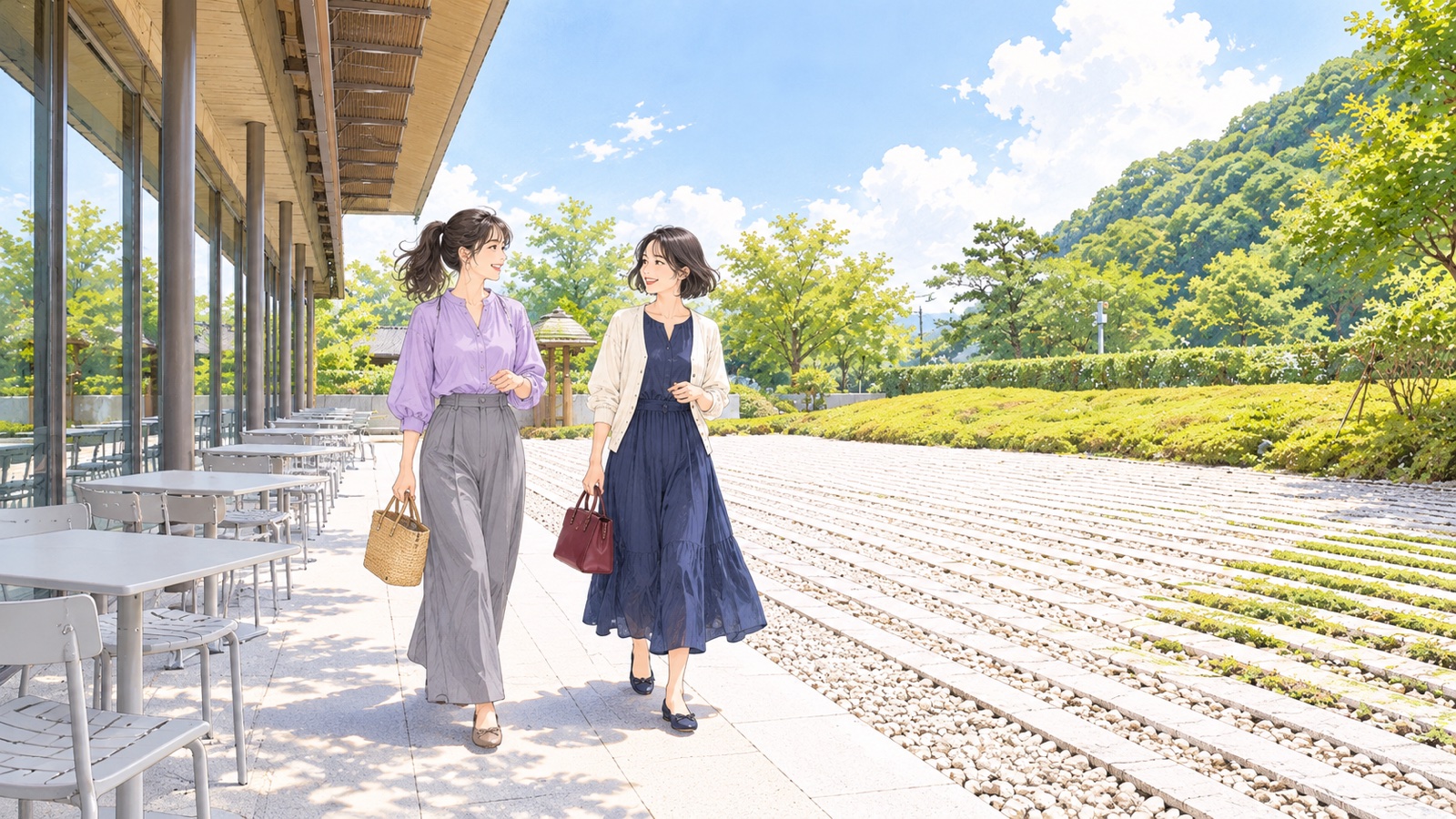
The Saga Arashiyama Museum of Arts and Culture is a museum of Hyakunin Isshu poetry and Japanese painting at 11 Saga-Tenryuji-Susukinobaba-cho, Ukyo Ward, Kyoto City. It succeeded Shigureden, a hall dedicated to the Hyakunin Isshu that opened on January 27, 2006. Its construction was funded by Hiroshi Yamauchi, who had stepped down as president in 2002 and become an adviser; Nintendo supported the project technically. Inside, visitors used Shigureden Navi, an information device based on a Nintendo DS with its buttons removed. On December 14 of its opening year, the Nintendo DS game Hyakunin Isshu DS Shigureden was also released.
Shigureden closed in April 2011 because its equipment had reached the end of its service life and reopened on March 17, 2012. It later reopened as the Saga Arashiyama Museum of Arts and Culture on November 1, 2018. The museum is operated by the Ogura Hyakunin Isshu Cultural Foundation, a public-interest foundation established in 2003 as part of the Kyoto Chamber of Commerce and Industry’s 120th-anniversary project.
The Ogura Hyakunin Isshu is an anthology said to have been selected by Fujiwara no Teika at the foot of Mount Ogura in Saga Arashiyama. The museum’s permanent exhibition, “The History of the Hyakunin Isshu,” runs through March 31, 2028. It has three chapters: “Teika and the Hyakunin Isshu,” “The Hyakunin Isshu as a Cultivated Pursuit,” and “From a Game to Competitive Karuta.” Exhibits include the 1792 woodblock-printed Ogura Nishiki Hyakunin Isshu with autumn leaves, karuta cards from the Edo period, and ita-karuta cards dating from 1945 onward.
From October 3, 2026, through February 28, 2027, the special exhibition “Discover Kyoto Through Paintings, Enjoy It More” introduces Kyoto through Japanese paintings from the early modern and modern periods. From the tatami-mat gallery on the second floor, visitors can see Mount Ogura behind the museum and the Ōi River and Arashiyama in the borrowed scenery. The museum is open from 10 a.m. to 5 p.m., with admission until 4:30 p.m. General and university student admission is ¥1,000. It is a five-minute walk from Randen Arashiyama Station. The garden-facing cafe, Arashiyama OMOKAGE Terrace, is also open.
- Location
- 11 Saga-Tenryuji-Susukinobaba-cho, Ukyo Ward, Kyoto City
- Connection to Nintendo
- A museum that succeeded the former Shigureden, whose construction was funded by Hiroshi Yamauchi
- Hours
- 10 a.m.–5 p.m.; last admission at 4:30 p.m.
- Access
- Five-minute walk from Randen Arashiyama Station
Sources:Official Sources and Facility Information
4Nintendo KYOTO | A Giant Mario Peeks Out of a Pipe at the Entrance to Kyoto Takashimaya S.C. [T8]
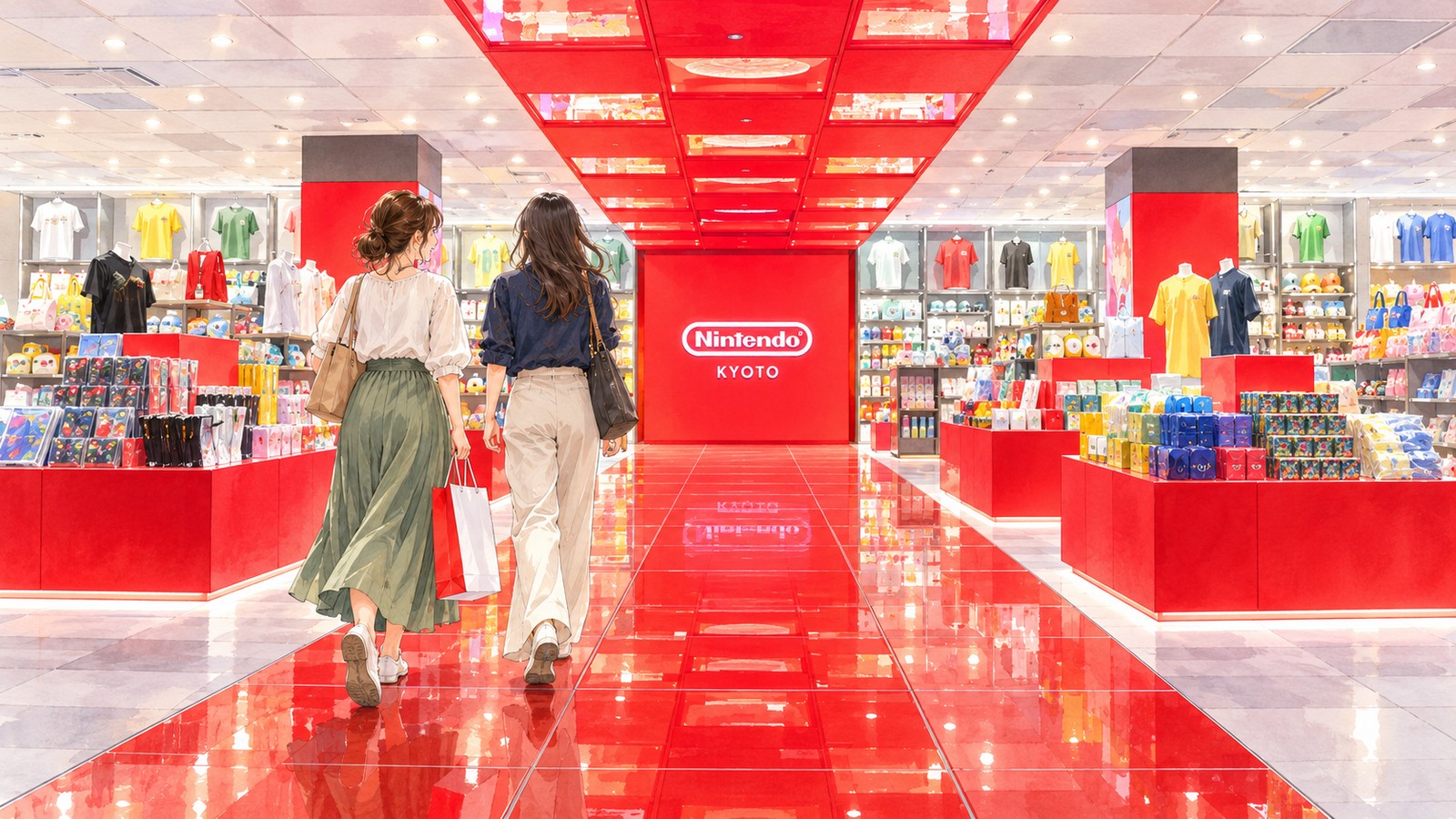
Nintendo KYOTO is an official Nintendo store on the seventh floor of Kyoto Takashimaya S.C. [T8]. Its address is 35 Otabi-cho, 2-chome, Shijo-dori Teramachi Higashi-iru, Shimogyo Ward, Kyoto City. It opened on October 17, 2023, with the launch of the T8 specialty-store zone, becoming Nintendo’s third official store in Japan after Tokyo and Osaka. It is directly connected underground to Hankyu Kyoto-kawaramachi Station and a five-minute walk from Keihan Gion-shijo Station.
At the first-floor entrance to T8 is a Mario figure peeking his head out of a pipe. His head alone is about as large as a person. On busy days such as weekends and holidays, numbered entry tickets are handed out in front of Mario before opening and in front of the store on the seventh floor afterward.
On the seventh floor, the store entrance is directly ahead after leaving the escalator. Sections for different franchises carry merchandise from Super Mario, The Legend of Zelda, Splatoon, Pikmin, and Animal Crossing. There are also Kirby products and a section for consoles and accessories.
When the store opened, it offered a jar-filling station where visitors could buy as many Pikmin erasers as they liked, as well as cookies in pipe-shaped containers. Towels, pouches, and cushions with the same pixel pattern as the store decor are also sold as part of the Nintendo KYOTO collection. The store is open from 10:30 a.m. to 8 p.m.
- Location
- 7th floor, Kyoto Takashimaya S.C. [T8], 35 Otabi-cho, 2-chome, Shijo-dori Teramachi Higashi-iru, Shimogyo Ward, Kyoto City
- Connection to Nintendo
- Nintendo’s third official store in Japan, opened on October 17, 2023, in Kyoto, where the company was founded
- Hours
- 10:30 a.m.–8 p.m.
- Access
- Direct underground connection to Hankyu Kyoto-kawaramachi Station; five-minute walk from Keihan Gion-shijo Station
Sources:Nintendo — Nintendo TOKYO/OSAKA/KYOTO/FUKUOKA / Nintendo — Opening of Nintendo KYOTO / Denfami NicoGamer — Inside Nintendo KYOTO / Game*Spark — Opening of Nintendo KYOTO
5Nintendo OSAKA | The First Official Store in Western Japan, on the 13th Floor of LUCUA SOUTH Near JR Osaka Station
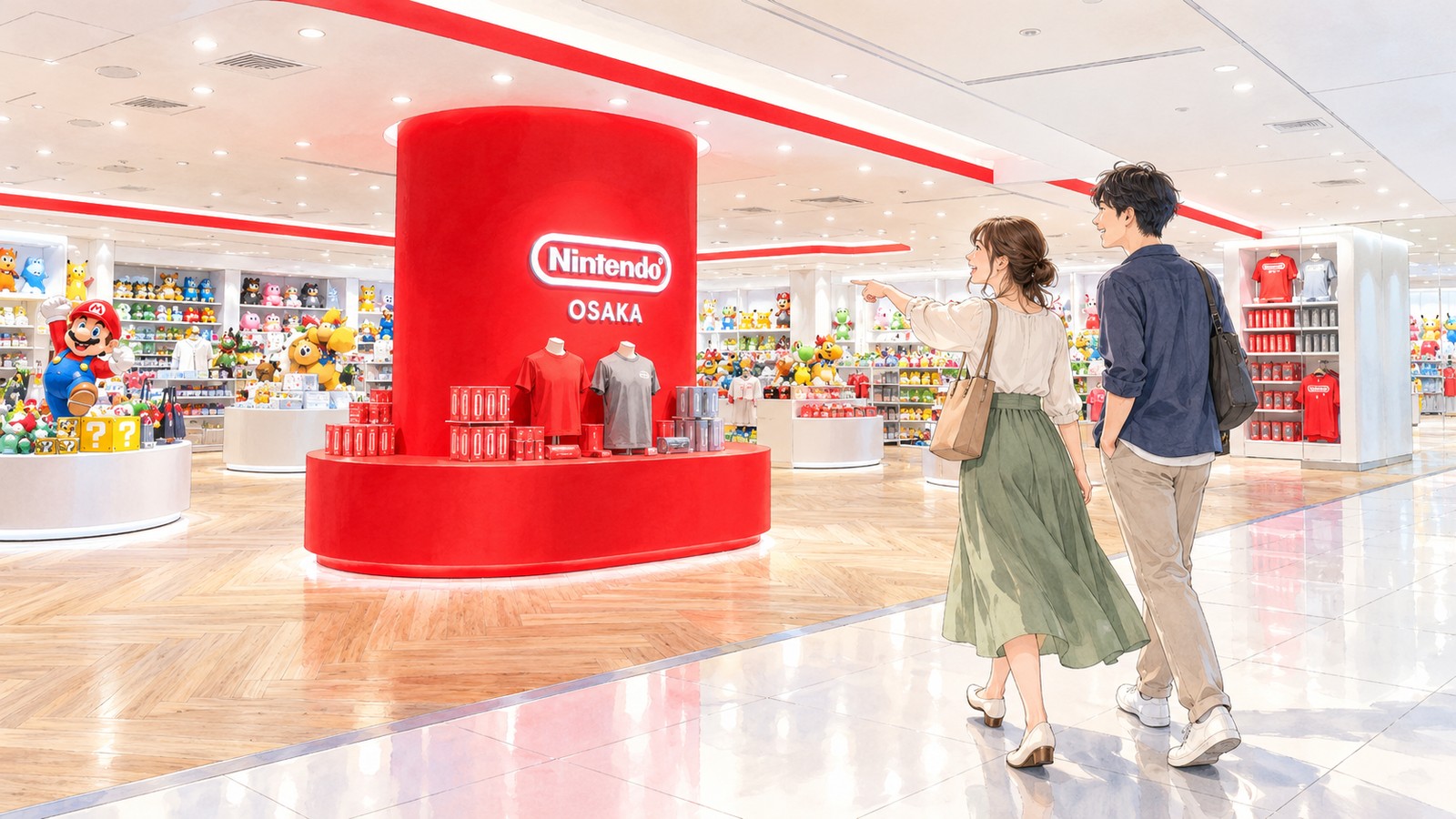
Nintendo OSAKA is an official store on the 13th floor of LUCUA SOUTH, 3-1-1 Umeda, Kita Ward, Osaka City. It opened on November 11, 2022, on the 13th floor of the Daimaru Umeda department store. It was Japan’s second official store after Nintendo TOKYO and the first in western Japan. It is about a five-minute walk from the central exit of JR Osaka Station and the west ticket gate on the first basement floor of Hanshin Osaka-Umeda Station.
When the store opened, giant figures of Mario and Link stood on the sales floor, as they did at Nintendo TOKYO. A new Pikmin section was added, along with a series of Yoshi-themed merchandise released on opening day. Nintendo positions its official stores as hubs for sharing information in Japan. In addition to selling consoles, software, and character merchandise, they host events and offer game experiences.
The store is open from 10 a.m. to 8 p.m. On days expected to be busy, numbered entry tickets are handed out at the South Gate Plaza on the first floor before opening and in front of the store on the 13th floor afterward.
- Location
- 13th floor, LUCUA SOUTH, 3-1-1 Umeda, Kita Ward, Osaka City
- Connection to Nintendo
- The first official Nintendo store in western Japan, opened on November 11, 2022
- Hours
- 10 a.m.–8 p.m.
- Access
- About a five-minute walk from the central exit of JR Osaka Station and the west ticket gate of Hanshin Osaka-Umeda Station
Sources:Nintendo — Nintendo TOKYO/OSAKA/KYOTO/FUKUOKA / Nintendo — Nintendo FUKUOKA opening and opening dates of existing stores / GAME Watch — Inside Nintendo OSAKA
6Super Nintendo World | Ride Mario Kart and Donkey Kong Mine Carts at USJ
Super Nintendo World opened in 2021 at Universal Studios Japan in Konohana Ward, Osaka City. It is the world’s first Nintendo-themed area. Pass through a pipe into Super Mario Land, a 360-degree Mushroom Kingdom. Peach’s Castle and Bowser’s Castle stand here, with a goal pole rising atop the mountain. Question Blocks and Note Blocks are interactive and can be hit.
There are two rides. Mario Kart: Koopa’s Challenge takes visitors in a kart to throw shells and race against Bowser’s team. Yoshi’s Adventure lets them ride on Yoshi’s back and follow Captain Toad. Wearing a Power-Up Band lets visitors join the Power-Up Band Key Challenge, where they collect keys by defeating enemies and take on a battle with Bowser Jr. The bands connect to the official USJ app to collect coins and digital stamps. They can also be used as amiibo corresponding to each character.
On December 11, 2024, Donkey Kong Country opened, bringing the area where Donkey Kong and his friends live. This expanded Super Nintendo World to about 1.7 times its previous size. The new ride, Mine-Cart Madness, is a roller coaster in a mine cart racing through the jungle. Riders protect the Golden Banana from Tiki Tong and jump over sections where the track appears broken. At the back of the area stands the Golden Temple, and visitors can also play Rambi’s Jungle Beat, drumming on congas to the music.
Toad’s Cafe is a restaurant where visitors can enjoy Chef Toad’s cooking. The gift shop, 1-Up Factory, sells merchandise available only in the park. Entry to the area requires an Area Timed Entry Ticket or an Area Timed Entry Ticket / Standby Entry Ticket issued by lottery.
- Location
- 2-1-33 Sakurajima, inside Universal Studios Japan, Konohana Ward, Osaka City
- Connection to Nintendo
- The world’s first Nintendo-themed area
- Highlights
- Super Mario Land and Donkey Kong Country
- Admission
- An Area Timed Entry Ticket or Area Timed Entry Lottery Ticket is required
Sources:Nintendo — Super Nintendo World / Nintendo — Company history / GAME Watch — Grand opening of Donkey Kong Country / Travel Watch — Expansion of the area
7Nintendo TOKYO | Japan’s First Official Store, Marked by the Mario Statue at the Outside Staircase Entrance on the Sixth Floor of Shibuya PARCO
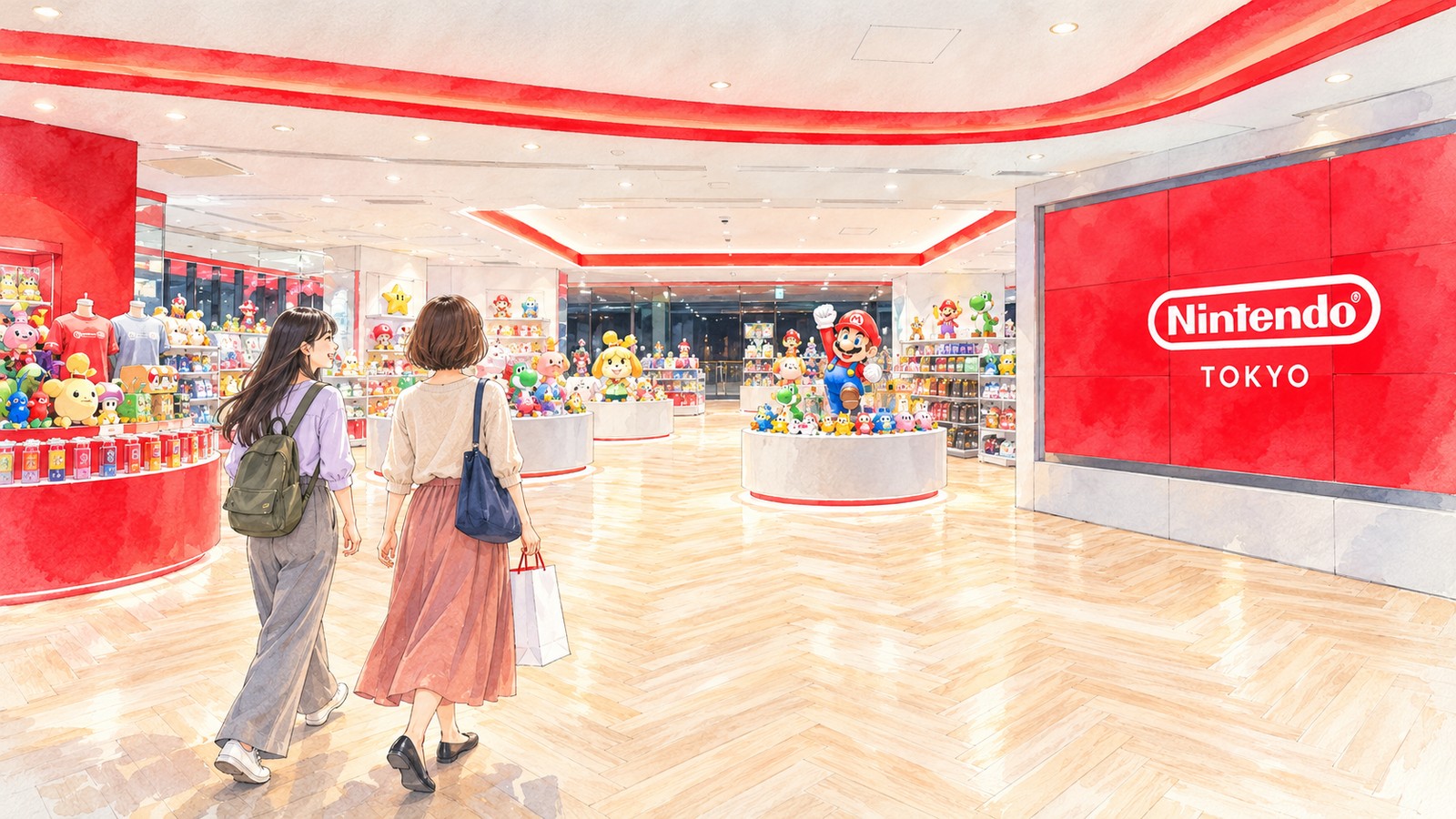
Nintendo TOKYO is an official store on the sixth floor of Shibuya PARCO, 15-1 Udagawa-cho, Shibuya Ward, Tokyo. It opened on November 22, 2019, as Japan’s first official Nintendo store. The company that began in Kyoto opened its first store of its own in Shibuya, Tokyo. It is a five-minute walk from Shibuya Station.
About half of the merchandise displayed at the preview before opening was original merchandise. The main collections were Super Mario, The Legend of Zelda, Animal Crossing, and Splatoon. Giant figures of Mario, Link, Isabelle, Timmy, and Tommy were on display. Visitors could try Ring Fit Adventure at a demo station, while music from Super Donkey Kong and Super Mario Land 2: 6 Golden Coins played in the store.
There is a Mario statue at the entrance to the outside staircase on the sixth floor. On days expected to be busy, numbered entry tickets are distributed in front of the statue after opening. Before opening, they are handed out on the first floor of Shibuya PARCO. The store is open from 10 a.m. to 9 p.m., the latest closing time of the four official stores.
- Location
- 6th floor, Shibuya PARCO, 15-1 Udagawa-cho, Shibuya Ward, Tokyo
- Connection to Nintendo
- Japan’s first official Nintendo store, opened on November 22, 2019
- Hours
- 10 a.m.–9 p.m.
- Access
- Five-minute walk from Shibuya Station
Sources:Nintendo — Nintendo TOKYO/OSAKA/KYOTO/FUKUOKA / Nintendo — Company history / GAME Watch — Nintendo TOKYO preview
8Nintendo FUKUOKA | Merchandise With Hidden Pikmin on the Eighth Floor of AMU PLAZA HAKATA, Directly Connected to JR Hakata Station
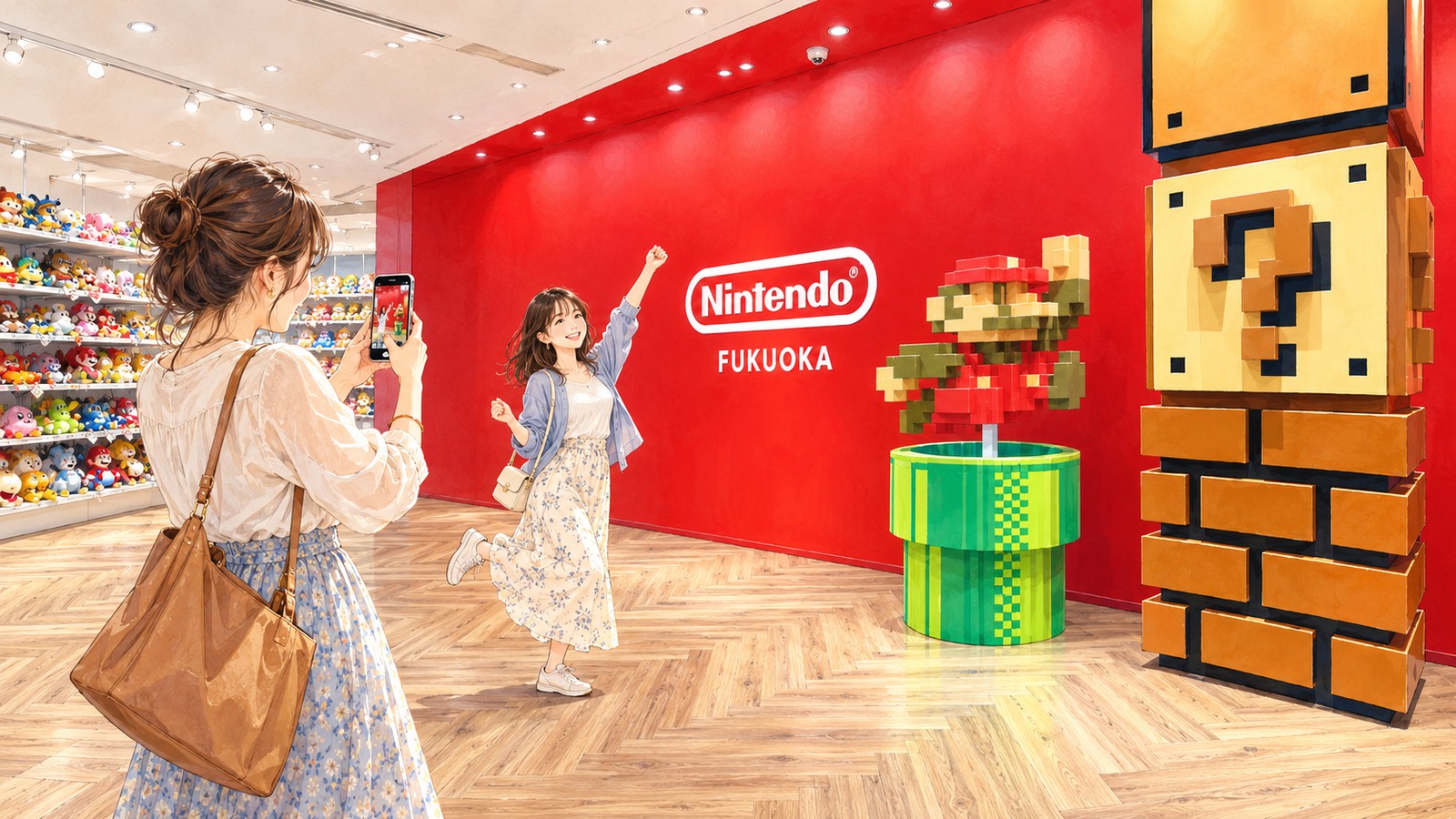
Nintendo FUKUOKA is an official store on the eighth floor of AMU PLAZA HAKATA, 1-1 Hakata-ekichuogai, Hakata Ward, Fukuoka City. Its opening was announced on May 19, 2025, and it opened as Japan’s fourth official store on November 14. It is the first permanent official Nintendo store in Kyushu. It is directly connected to JR Hakata Station and a three-minute walk from Hakata Station on the subway.
Nintendo characters greet visitors outside the store. Inside, large statues of Mario, an Inkling, and Link draw attention. Isabelle, Timmy and Tommy from Animal Crossing, and red, yellow, and blue Pikmin are also on display. Blocks are drawn on the floor, and Pikmin hide in the ceiling and other places. The photo spot is in front of the Nintendo FUKUOKA logo, pixel-art Mario, and a Question Block.
The two store-exclusive items at opening were a red logo T-shirt for ¥5,500 and a multifunction pen for ¥1,650. A 76.5-centimeter Donkey Kong plush toy is displayed near the checkout. There is also a My Mario section for young children. The store is open from 10 a.m. to 8 p.m. On busy days, numbered entry tickets are distributed on the second-floor deck before opening and in front of the store on the eighth floor afterward.
- Location
- 8th floor, AMU PLAZA HAKATA, 1-1 Hakata-ekichuogai, Hakata Ward, Fukuoka City
- Connection to Nintendo
- Kyushu’s first permanent official Nintendo store, opened on November 14, 2025
- Hours
- 10 a.m.–8 p.m.
- Access
- Directly connected to JR Hakata Station; three-minute walk from Hakata Station on the subway
Sources:Nintendo — Nintendo TOKYO/OSAKA/KYOTO/FUKUOKA / Nintendo — Nintendo FUKUOKA opening / Famitsu.com — Nintendo FUKUOKA opening
Dates, opening hours, and ticket information reflect the time of writing. Check each official site for the latest information before your visit.
Learn More About Nintendo | From Fusajiro Yamauchi’s Hanafuda to the Ultra Hand and Famicom
Marufukuro is housed in the building from the era when Nintendo sold hanafuda and karuta. The Nintendo Museum displays products ranging from toys to game consoles, while today’s game characters appear at official stores and USJ. Follow the people and products that connect these eight destinations.
From Founder Fusajiro Yamauchi to Shigeru Miyamoto, Who Discussed the Museum Exhibits
Fusajiro Yamauchi
Nintendo’s founder began making hanafuda in Shimogyo Ward, Kyoto, in 1889. The trade name Marufuku, used at Kagiya-cho since the company’s founding, gave Marufukuro its name.
Hiroshi Yamauchi
He became president at age 22 and led the company for 53 years, growing a hanafuda business into a global entertainment company. After becoming an adviser in 2002, he funded Shigureden in Arashiyama and a new hospital ward at Kyoto University. He died at age 85 in September 2013.
Masanobu Yamauchi
Hiroshi Yamauchi’s grandson and head of the family office Yamauchi No.10 Family Office. He led the plan to preserve the former headquarters as a hotel.
Tadao Ando
The architect who supervised the design of Marufukuro’s new wing. He has said he wanted the building, constructed about 100 years ago, to remain for another 50 or 100 years, and took care not to alter it too much.
Shigeru Miyamoto
Representative Executive Fellow at Nintendo. He was involved in planning the Nintendo Museum and led the development of exhibits and experience areas that make use of the Uji Ogura Factory.
Shuntaro Furukawa
Nintendo’s Representative Director and President. In his congratulatory remarks at Marufukuro’s opening ceremony, he said the building had served as the company’s head office from 1950 to 1959, after its incorporation.
Sources:Nintendo — Company history / Marufukuro — About / GameBusiness.jp — Hiroshi Yamauchi’s career / Forbes JAPAN — Masanobu Yamauchi / Denfami NicoGamer — Remarks at the opening ceremony / Nintendo — Company profile
From Hanafuda and Playing Cards to the Ultra Hand and Famicom
In 1902, Nintendo began producing playing cards for the first time in Japan. In 1947, it established Marufuku Co., Ltd. in Higashikawara-cho, Imakumano, Higashiyama Ward, Kyoto City. The company name changed to Nintendo Karuta Co., Ltd. in 1951 and to the present Nintendo Co., Ltd. in 1963. In 1953, it began mass-producing plastic playing cards for the first time in Japan. In 1959, it released playing cards featuring Disney characters.
In the 1960s, Nintendo expanded from making cards to toys. The Ultra Hand, the basis for a museum experience, was released in 1966. The Ultra Machine pitching machine followed in 1968, and the Love Tester in 1969. In 1968, the company developed an automatic card-backing machine for applying backing to karuta. In 1973, it created the commercial Laser Clay Shooting System, the inspiration for Zapper & Scope SP.
The era of video game consoles began with the 1977 Color TV-Game 15 and Color TV-Game 6. The 1983 Family Computer inspired a work displayed in the dNa library at Marufukuro. Donkey Kong, introduced as an arcade game in 1981, became a character with his own area at USJ in 2024. In 1985, Nintendo released Super Mario Bros. for the Famicom. Mario now greets visitors at entrances and on sales floors at all four official stores.
Sources:Nintendo — Company history / GAME Watch — Products that inspired the museum experiences
Shigureden, the predecessor to the Saga Arashiyama Museum of Arts and Culture, was a hall dedicated to the Hyakunin Isshu. The following book is useful for anyone who wants to learn more about the history of karuta.
Development and Background | The Yamauchi Family Turned the Former Headquarters Into a Hotel, and Nintendo Turned a Factory Into a Museum
Marufukuro was opened by the founding family, while the Nintendo Museum was opened by the company; both facilities make buildings that had fallen out of use accessible to the public. The circumstances of their openings and comments from people involved have been recorded.
How Nintendo’s Former Headquarters, Once a Warehouse, Opened to the Public as a Hotel
At the preview and opening ceremony on March 29, 2022, Masanobu Yamauchi explained the process leading to the hotel’s opening. He said they wanted to make the building public precisely because it had long been hidden from view, and that after many discussions they decided to open it as a hotel. Katsuhito Yamauchi, appearing as the family’s representative, said the building would be passed down for the next 100 years and beyond. He described the mission as continuing to convey the spirit of the company’s founding and development.
Fan graffiti was written on the window grilles along the side of the building. Masanobu Yamauchi said he felt the fans’ affection through the graffiti. After reports that the building would become a hotel, the messages changed all at once. Seeing heartfelt pleas asking them not to turn it into a hotel made him realize they had to move forward with resolve, he said.
At the ceremony, Nintendo President Shuntaro Furukawa gave congratulatory remarks, and then-Kyoto Mayor Daisaku Kadokawa also spoke. The dNa library space was supervised by Makoto Tanijiri and Ai Yoshida’s SUPPOSE DESIGN OFFICE. On November 7, 2025, the hotel received awards in three categories, including Architectural Design, at the World Luxury Hotel Awards 2025.
Sources:Denfami NicoGamer — Marufukuro preview and ceremony / Forbes JAPAN — The graffiti and Masanobu Yamauchi’s comments / Marufukuro — Library / Marufukuro — World Luxury Hotel Awards 2025 awards / Nintendo — Company history
The History of the Uji Ogura Factory and Shigeru Miyamoto’s Approach to Building the Museum
When it was built in 1969, the Uji Ogura Factory was a major plant for making toys. After a new Uji Factory opened in Makishima-cho, Uji, in 1983, it served as a branch factory and warehouse. Following an extension in 1988, it handled product inspection and shipping. When the head office factory moved in 1996, it became a production base for playing cards and karuta. In 2003, it also housed a service center that consolidated repair departments from across Japan.
On June 2, 2021, Nintendo announced plans to renovate the factory as the provisionally named “Nintendo Gallery.” Responding to Uji City’s desire to revitalize the area around Kintetsu Ogura Station, the plan aimed to create a visitor attraction with exhibits and interactive experiences. It was initially scheduled for completion in fiscal 2023, but the museum opened on October 2, 2024.
In an interview at the preview, Nintendo Representative Executive Fellow Shigeru Miyamoto said they had decided to use the existing factory rather than build a flashy castle. They chose the Uji Ogura Factory in part because it was well served by buses and trains. Selling the property had been considered, but they decided to preserve it as a place of memories, he said.
The second-floor products have no detailed explanations because the museum wanted to avoid a format common to art exhibitions. Miyamoto disliked the way visitors gathered to read a timeline at the entrance and then walked past important exhibits farther inside. They also aimed for displays visitors from overseas could understand just by looking. The ten coins for the first-floor experience area were chosen to balance the number of visitors. Miyamoto explained that letting everyone try everything would limit attendance to 500 people a day, and mentioned the possibility of increasing the number of coins in the future.
In Nintendo Museum Direct, released on August 20, 2024, before the museum opened, Shigeru Miyamoto walks through the building and introduces its exhibits and experience areas.
You can play this video in the official video at the top of this page ↑
Sources:Nintendo Museum — History of the Uji Ogura Factory / Nintendo — Plans for use of the Uji Ogura Factory / GAME Watch — Interview with Shigeru Miyamoto / Nintendo official channel — Nintendo Museum Direct
Nintendo’s Headquarters in Minami Ward, Kyoto, and Its Four Official Stores
Nintendo’s current headquarters is at 11 Hokotate-cho, Kamitoba, Minami Ward, Kyoto City, where it moved in 2000. On April 12, 2022, the company announced it had acquired about 10,000 square meters of city-owned land adjoining its headquarters. The site, which includes a former industrial-support factory, will house the provisionally named Head Office Second Development Building to expand research and development. The 12-story steel-frame building will stand about 72 meters tall and is scheduled for completion in December 2027.
The official stores began with Tokyo in November 2019 and have expanded to four locations in Osaka, Kyoto, and Fukuoka. These four are the only stores where visitors can buy Nintendo’s original merchandise in person. Some products are also available through the online Nintendo Store. All four stores are free to enter and do not accept game-product repairs.
Sources:Nintendo — Acquisition of land adjoining the headquarters / Nintendo — Company history / Nintendo — Nintendo TOKYO/OSAKA/KYOTO/FUKUOKA
From Hanafuda Production to the Former Headquarters Hotel, Museum, and Four Official Stores
A timeline of Nintendo’s history, from the start of hanafuda production in 1889 and completion of the former headquarters in 1930 to Shigureden and the Saga Arashiyama Museum of Arts and Culture, the official stores in Japan, Marufukuro, and the Nintendo Museum.
- 1889
Fusajiro Yamauchi begins making hanafuda in Shimogyo Ward, KyotoFounding - 1902
Begins producing playing cards for the first time in JapanProduct - 1930
The headquarters building at Kagiya-cho, now Marufukuro, is completedBuilding - 1947
Marufuku Co., Ltd. is established in Higashiyama Ward, Kyoto CityCompany - 1953
Begins mass production of Japan’s first plastic playing cardsProduct - 1959
Headquarters moves to Fukunari Kamitakamatsu-cho in Higashiyama WardBuilding - 1963
Company name changes to Nintendo Co., Ltd.Company - 1966
Releases the Ultra Hand toyProduct - 1969
Builds the Uji Factory in Ogura-cho, Uji, later renamed the Uji Ogura FactoryFactory - 1983
Releases the Family Computer and establishes the Uji Factory in Makishima-choProduct - 2000
Headquarters moves to Kamitoba Hokotate-cho, Minami Ward, Kyoto CityBuilding - 2006
January 27 Shigureden, the Hall of the Ogura Hyakunin Isshu, opens in ArashiyamaArashiyama - 2016
November The service center at the Uji Ogura Factory moves to the Uji FactoryFactory - 2018
November 1 Shigureden opens as the Saga Arashiyama Museum of Arts and CultureArashiyama - 2019
November 22 Nintendo TOKYO opens at Shibuya PARCOOfficial store - 2021
Super Nintendo World opens at USJFacility - 2021
June 2 Nintendo announces plans to renovate the Uji Ogura Factory as a museumFactory - 2022
April 1 The former headquarters opens as the Marufukuro hotelBuilding - 2022
April 12 Plans announced for the provisionally named Head Office Second Development BuildingHeadquarters - 2022
November 11 Nintendo OSAKA opens at Daimaru UmedaOfficial store - 2023
October 17 Nintendo KYOTO opens at Kyoto Takashimaya S.C. [T8]Official store - 2024
October 2 Nintendo Museum opens in Uji CityMuseum - 2024
December 11 Donkey Kong Country opens at USJFacility - 2025
September 3 An art gallery opens at the Nintendo MuseumMuseum - 2025
November 1 Tempura Marufuku opens at MarufukuroBuilding - 2025
November 14 Nintendo FUKUOKA opens at AMU PLAZA HAKATAOfficial store - 2026
September 9 The museum begins issuing admission passes for The Legend of Zelda’s 40th anniversaryMuseum - 2027
December The provisionally named Head Office Second Development Building is scheduled for completionHeadquarters
Sources:Official Sources and Facility Information
The Oshi Lab Note | A Business Perspective: Turning Disused Headquarters and Factories Into Places That Showcase a Company’s Founding History
Marufukuro is an example of a founding family’s office turning its former headquarters into lodging after it became a warehouse following the 1959 relocation. The Nintendo Museum is an example of Nintendo itself turning a factory into a museum after its service center moved in November 2016. Uji City’s desire to revitalize the area around Kintetsu Ogura Station was also a factor.
Both facilities make use of the buildings’ original purposes in their design, from wing names based on playing-card suits to a workshop where visitors can make hanafuda. Former headquarters and factories where products were actually made and shipped now serve as hubs for telling the story of the company since its founding.
Related Oshi Lab article:Product Design for Travel Agencies and Tourist Destinations
Sources
- Nintendo — Company history
- Nintendo — Company profile
- Nintendo — Plans for use of the Uji Ogura Factory (June 2, 2021)
- Nintendo — Acquisition of land adjoining the headquarters (April 12, 2022)
- Nintendo — Opening of Nintendo KYOTO (April 14, 2023)
- Nintendo — Opening of the Nintendo Museum (August 20, 2024)
- Nintendo — Opening of Nintendo FUKUOKA (May 19, 2025)
- Nintendo — Nintendo TOKYO/OSAKA/KYOTO/FUKUOKA
- Nintendo — Super Nintendo World
- Nintendo — Nintendo DS software released in 2006
- Official Nintendo Museum site
- Nintendo Museum — Museum guide
- Nintendo Museum — Visitor information
- Nintendo Museum — The Legend of Zelda 40th anniversary (September 8, 2026)
- Nintendo official channel — Nintendo Museum Direct
- Marufukuro — About
- Marufukuro — Lounge and library
- Marufukuro — Tempura Marufuku
- Marufukuro — Frequently asked questions
- Marufukuro — Access
- Marufukuro — Dinner with a guided tour (July 9, 2024)
- Marufukuro — Winner at the World Luxury Hotel Awards 2025 (November 7, 2025)
- Plan Do See — Opening of Tempura Marufuku at Marufukuro
- Forbes JAPAN — Nintendo’s former headquarters becomes a hotel (April 29, 2022)
- Denfami NicoGamer — Marufukuro preview (March 31, 2022)
- Saga Arashiyama Museum of Arts and Culture
- Saga Arashiyama Museum of Arts and Culture — About the operator
- Saga Arashiyama Museum of Arts and Culture — Permanent exhibition: The History of the Hyakunin Isshu
- Saga Arashiyama Museum of Arts and Culture — About the museum
- Saga Arashiyama Museum of Arts and Culture — Visitor information
- Saga Arashiyama Museum of Arts and Culture — Access
- GameBusiness.jp — Shigureden renovation (December 21, 2011)
- GameBusiness.jp — Hiroshi Yamauchi’s career (September 21, 2013)
- GAME Watch — Nintendo Museum experience area (September 25, 2024)
- GAME Watch — Interview with Shigeru Miyamoto (September 25, 2024)
- Famitsu.com — Nintendo Museum art gallery (September 3, 2025)
- Denfami NicoGamer — Inside Nintendo KYOTO (October 13, 2023)
- Game*Spark — Opening of Nintendo KYOTO (October 17, 2023)
- GAME Watch — Inside Nintendo OSAKA (November 10, 2022)
- GAME Watch — Nintendo TOKYO preview (November 19, 2019)
- Famitsu.com — Nintendo FUKUOKA opening (November 14, 2025)
- GAME Watch — Grand opening of Donkey Kong Country (December 11, 2024)
- Travel Watch — Super Nintendo World expansion (December 5, 2023)
- Nintendo official YouTube channel
FAQ
What is Marufukuro?
It is a hotel in Shimogyo Ward, Kyoto, that preserves Nintendo’s former headquarters. The 1930 office, residence, and warehouse wings remain, alongside a new wing supervised by Tadao Ando. It opened on April 1, 2022, has 18 rooms, and is operated by Plan Do See Inc.
Can I enter Marufukuro without staying there?
Only hotel guests may enter the building, and visits without a meal are not available. Tempura Marufuku, in part of the former headquarters, accepts reservations from non-guests. Reservations are accepted by phone or through TableCheck.
How much does admission to the Nintendo Museum cost, and how do I get tickets?
Admission is ¥3,300 for adults, ¥2,200 for junior and senior high school students, and ¥1,100 for elementary school students. Preschool children enter free. Tickets are allocated by lottery through a Nintendo Account, and the fee is charged only if selected. Visitors’ identities are checked against photo ID on arrival.
What was the Nintendo Museum building before it became a museum?
It was a Nintendo factory built as the Uji Factory in 1969 and renamed the Uji Ogura Factory in 1988. It made playing cards and hanafuda and served as a repair center for game consoles. Production moved to the Uji Factory in Makishima-cho, Uji, in 2004, and the service center followed in November 2016; the renovated building opened as a museum on October 2, 2024.
What can I do at the Nintendo Museum?
On the second floor, you can compare products Nintendo has released and see original artwork and concept art in the art gallery. On the first floor, ten admission coins let you try experiences such as Ultra Hand SP and Shigureden SP. With a same-day reservation and an additional fee, you can also make hanafuda in the workshop or play a hanafuda game in the Play Room.
How is the Saga Arashiyama Museum of Arts and Culture connected to Nintendo?
It succeeded Shigureden, a hall dedicated to the Ogura Hyakunin Isshu that opened in 2006. Nintendo president Hiroshi Yamauchi funded its construction, and Nintendo provided technical support. It reopened as the Saga Arashiyama Museum of Arts and Culture on November 1, 2018. The museum’s Shigureden SP experience is inspired by the former Shigureden.
Where are Nintendo’s official stores in Japan?
There are four. Nintendo TOKYO is on the sixth floor of Shibuya PARCO; Nintendo OSAKA is on the 13th floor of LUCUA SOUTH; Nintendo KYOTO is on the seventh floor of Kyoto Takashimaya S.C. [T8]; and Nintendo FUKUOKA is on the eighth floor of AMU PLAZA HAKATA. Admission is free. On busy days such as weekends and holidays, entry may require a numbered ticket.
Can I tour Nintendo’s headquarters?
Nintendo’s headquarters in Kamitoba Hokotate-cho, Minami Ward, Kyoto City, is not a visitor attraction. To see Nintendo’s history and products, visit the Nintendo Museum in Uji.


