

Swing Girls Pilgrimage: Nine Okitama Film Locations from Akayu to Arato and Kawanishi
Ride the Yamagata Railway Flower Nagai Line to follow the train journey in Swing Girls, when a group of high-school girls dozes off clutching boxes of lunch on their way to deliver them. Akayu Station and Arato Station, where the scene of the girls playing inside the train stopped by snow was filmed, are both still in service.
The film follows students who sneak out of remedial classes and eventually form a big band, falling in love with jazz. Visit nine filming locations in Yamagata’s Okitama region, where the movie was shot, including the Yonezawa ballpark where the lunches were delivered and the hall used for the climax.
Nine places in Okitama: from Akayu Station to Yonezawa’s ballpark, Arato Station, and Kawanishi Friendly Plaza
The film’s setting was created by connecting scenes shot across three cities and three towns in the Okitama region. The four Flower Nagai Line stations are introduced in order from the line’s starting point at Akayu to its terminus at Arato: Akayu, Ringo, Shirousagi, and Arato. Scenes at the ballpark, riverside, and embankment were filmed in Yonezawa; the climactic music festival was filmed in Kawanishi. Event dates, opening hours, and ticket details reflect information available when this article was written. Check each official website for the latest information before your visit.
1. Akayu Station
Filming location for the station where Tomoko and her friends doze off on the train and miss their stop while delivering lunches.
Learn more about Akayu Station2. Ringo Station
Filming location for the station where Tomoko and her friends get off, still clutching their lunch boxes, after missing their stop.
Learn more about Ringo Station3. Yonezawa City Baseball Stadium
The ballpark where Tomoko and her friends arrive late with the lunches, and the band members who eat them are hospitalized with stomachaches.
Learn more about Yonezawa City Baseball Stadium4. Matsukawa Riverside
The embankment where band members jog while grumbling, and the bridge where trumpeter Yoshie Saito practices in winter, were filmed here.
Learn more about Matsukawa Riverside5. Naceba
The library that hosted the special exhibition “Looking Back at the Film Swing Girls” from November 2022 through January 2023.
Learn more about Naceba6. Nagai Station
The gateway to Nagai City and one of the filming locations. After the film’s release, a citizens’ support group welcomed fans.
Learn more about Nagai Station7. Shirousagi Station
The nearest station to the track where the bus carrying Ms. Itami and the others approaches the train stranded in a blizzard.
Learn more about Shirousagi Station8. Arato Station
Filming location for the scene where the group takes out their instruments and starts playing inside the train stopped by snow.
Learn more about Arato Station9. Kawanishi Friendly Plaza
The hall used for the Tohoku Student Music Festival in the film. Starting the year after its release, a music festival for movie fans was held here for ten years.
Learn more about Kawanishi Friendly Plaza
1Akayu Station | Where Tomoko and her friends dozed off clutching lunch boxes and missed their stop

The story begins during summer remedial classes at Yamakawa High School. The 13 girls in math class, including protagonist Tomoko Suzuki (Juri Ueno), have lost all motivation. Then word comes that the catering company cannot deliver lunch to the brass band members at their baseball game. Eager to escape class, Tomoko and her friends volunteer to bring the lunches to the ballpark.
The group boards a train on the Flower Nagai Line. After sneaking bites of the lunches, all of them fall asleep in the carriage and miss the station where they were supposed to get off. The scene of the sleeping group overshooting their stop was filmed at Akayu Station in Nanyō City. In reality, Akayu is the line’s starting point, so it is impossible to miss it by riding too far. A winter filming-location tour in February 2006 also introduced Akayu Station as “the station the girls overshot.”
Akayu Station is served by three lines: the Yamagata Shinkansen and Ōu Main Line operated by JR, and the Flower Nagai Line. The JR east exit has a station building designed to resemble a paraglider. The west exit, which serves as the gateway to the Flower Nagai Line, has a log-cabin-style station building. A monument to children’s poet Yoshio Yūki, who was born in Nanyō, stands in the west-exit plaza.
The Flower Nagai Line runs 30.5 kilometers from Akayu to Arato and has 17 stations. The section from Akayu to Ringo opened in 1913 as the Nagai Light Railway; the full line to Arato opened in 1923. Since October 25, 1988, the line has been operated by Yamagata Railway, a third-sector company that took over the former JR Nagai Line.
- Location
- Akayu Station, Yamagata Railway’s Flower Nagai Line and JR Ōu Main Line, Nanyō, Yamagata Prefecture
- Connection to the film
- Filming location for the station where Tomoko and her friends doze off on the train and miss their stop while delivering lunches
- Highlights
- The Flower Nagai Line’s log-cabin-style west-exit station building and Yoshio Yūki’s monument
Sources:Toho — Swing Girls story (archived) / Shirataka Town — Koho Shirataka, November 12, 2004 issue / Swing Girls Okitama Support Team — Filming location: Akayu Station / Swing Girls Okitama Support Team — Event information / Yamagata Railway — Akayu Station: Then and Now / Yamagata Railway — History of the Nagai Line / Yamagata Railway — Company information
2Ringo Station | Where the girls got off after missing their stop, and the rice field they fell into

After missing their stop, Tomoko and her friends get off the train clutching their lunch boxes. Ringo Station in Nanyō City, the fourth stop from Akayu, was used for this scene. From there, the group walks along the tracks in the scorching sun toward the ballpark. Along the way, they fall into a rice field beside the tracks and end up covered in mud.
The scene of the girls walking along the tracks was filmed on August 23, 2003. The story calls for a day so hot that the lunches might spoil, so a clear sky was essential. It had been a cloudy summer, and the crew worried about the weather until late in the shoot. The day turned out to be sunny, and they completed the scene of the girls walking straight down the tracks—an area normally closed to the public.
A “rice-field dive” spot near Ringo Station was included in the autumn filming-location tour in November 2005. The itinerary also planned a commemorative photo near the tracks.
When Ringo Station opened on October 26, 1913, it was the terminus, with a single island platform serving two tracks. The track beside the station building has been removed, but a broad curve before the station remains from that era. The current log-cabin-style waiting room was rebuilt by Nanyō City in 1999.
The rice fields along the railway are farmland cultivated by local residents. To enjoy the scenery, stay at the station or on a road where you will not interfere with train operations.
- Location
- Ringo Station on Yamagata Railway’s Flower Nagai Line, Takehara, Nanyō, Yamagata Prefecture
- Connection to the film
- Filming location for the station where Tomoko and her friends get off clutching their lunches after missing their stop
- Highlights
- The log-cabin-style waiting room rebuilt in 1999 and the curve of the former island platform
- Access
- Four stops from Akayu Station on the Flower Nagai Line
Sources:Swing Girls official site — Location map: Ringo Station (archived) / Swing Girls official site — Filming diary, August 23–25 (archived) / Toho — Swing Girls story (archived) / Shirataka Town — Koho Shirataka, November 12, 2004 issue / Swing Girls Okitama Support Team — Filming-location tour / Yamagata Railway — Ringo Station: Then and Now
3Yonezawa City Baseball Stadium | The ballpark where the band is hospitalized after eating the late-delivered lunches

Covered in mud, Tomoko and her friends wash their uniforms in the river before heading to the ballpark. The riverside scene was filmed on August 23, the same day as the rice-field scene. It was extremely hot, and some of the girls reportedly swam in the river for real. The filming location was on the Matsugane Bridge riverbank in Yonezawa.
The lunches were meant for a baseball game. Filming took place at Yonezawa City Baseball Stadium in Shioi-machi Shiono, Yonezawa. After eating lunches that had been exposed to the midsummer sun for a long time, band members develop stomachaches one after another during the game and are hospitalized. First-year brass band member Takuo Nakamura (Yuta Hiraoka), who was spared because the girls had already sampled the lunches, is the one who escapes the trouble.
To be ready to cheer at the next game, Takuo tries to form an impromptu band. But he cannot find the 25 people needed for a brass band. He gathers 13 girls—including Tomoko—who want to skip remedial class, along with three people who can play only the recorder, guitar, or bass. Even with Takuo, they have just 17 members. Then he sees the cover of a jazz record and realizes they could play in a big band instead.
The ballpark scenes were filmed on August 13 and 14, 2003. More than 500 extras played spectators, joined by university baseball teams and local brass bands. It rained from the morning of August 14, when music teacher Yayoi Itami (Miho Shiraishi) was scheduled to film. The rain stopped just as Shiraishi arrived from Tokyo, then reportedly started again as soon as filming wrapped.
The main grandstand at the municipal ballpark is a steel-reinforced concrete structure built in fiscal year 1991. It is the only ballpark in Yonezawa where hardball baseball can be played.
- Location
- Yonezawa City Baseball Stadium, Shioi-machi Shiono, Yonezawa, Yamagata Prefecture
- Connection to the film
- Filming location for the game where Tomoko and her friends deliver the lunches and the band members collapse with stomachaches
- Facility overview
- The city’s only hardball baseball stadium; its main grandstand was built in fiscal year 1991
Sources:Yamagata Okitama Film Commission — Okitama filming-location tour map / Swing Girls official site — Filming diary, August 13–14 (archived) / Swing Girls official site — Filming diary, August 23–25 (archived) / Swing Girls Okitama Support Team — Filming location near Matsugane Bridge / Toho — Swing Girls story (archived) / Eiga.com — Swing Girls / Yonezawa City — Draft individual facility plan for the comprehensive management plan for public facilities
4Matsukawa riverbank and Matsukawa Bridge | The embankment where the band ran and the bridge where Yoshie practiced alone

Matsukawa flows east of downtown Yonezawa. It joins the Okitama Shirakawa in Nagai and becomes the Mogami River. The riverbank was used for the band’s conditioning scenes, where the members jog while grumbling, “Why do we have to run when we play instruments?” The scene of a bicycle tumbling down the embankment was filmed there as well.
The embankment scenes were filmed on August 2 and 3, 2003. During a bicycle-fall scene, a stunt performer injured a shoulder during testing, and the crew could not finish filming on the first day. The next morning, another stunt performer practiced repeatedly and completed the scene beautifully by evening.
Just as rehearsals are getting underway, the hospitalized brass band members return. The borrowed instruments are returned, and the summer’s makeshift band comes to an end. Tomoko and her friends, who had been putting on a brave face, start crying as soon as they leave school. In the second term, they cannot forget how much they enjoyed playing, so they decide to form their own big band. But they have no instruments and nowhere to practice.
The scene of trumpeter Yoshie Saito (Shihori Kanjiya) practicing alone in winter was filmed beneath a bridge near Matsukawa Bridge on February 19, 2004. A heavy blizzard hit the wide riverbank originally planned for the shoot, so the crew moved beneath the bridge they had scouted earlier.
At an intersection near Aioi Bridge in Yonezawa, the scene was filmed where trombonist Kaori Sekiguchi (Yuika Motokariya) hears the sound of a traffic signal and wonders, “Is this jazz?” The signal sound was specially created for filming. A row of cherry trees follows the riverside, making it a pleasant walk under the blossoms in spring.
- Location
- Matsukawa riverbank and area around Matsukawa Bridge, Yonezawa, Yamagata Prefecture
- Connection to the film
- Filming locations for the embankment where band members ran and the bridge where Yoshie Saito practiced trumpet in winter
- Nearby filming location
- The intersection near Aioi Bridge where Kaori Sekiguchi notices the traffic signal’s sound
Sources:Swing Girls official site — Location map: Mogami River (archived) / Swing Girls official site — Filming diary, August 1–3 (archived) / Swing Girls official site — Filming diary, February 19–21 (archived) / Swing Girls Okitama Support Team — Matsukawa riverbank filming location / Same — Filming location near Matsukawa Bridge / Same — Intersection near Aioi Bridge / Toho — Swing Girls story (archived) / Yamagata Okitama Film Commission — Okitama scenery (Matsukawa and the source of the Mogami River)
5Naceba (Yonezawa City Library) | The library that hosted “Looking Back at the Film Swing Girls”

Naceba, at 1-chōme Chūō in Yonezawa, houses Yonezawa City Library and the Yonezawa Civic Gallery. It opened in July 2016. The library’s mezzanine has a local figures tribute corner. As the 20th anniversary of the film’s start of principal photography in July 2003 approached, the corner hosted the exhibition “Looking Back at the Film Swing Girls” from November 25, 2022, through January 25, 2023.
The exhibition looked back at the film alongside trends and bestselling books from the time of its 2004 release. The general-books feature section included a related display, “Looking Back at Swing Girls and the Heisei Era: Memories of 2004.” Alongside books related to the film, it presented news and books from a year marked by the Korean Wave, the Athens Olympics, and the release of new banknotes.
The exhibition also highlighted actor Hidekazu Mashima, who is from Yonezawa. He played Takashi, the older brother in a duo who work at an automobile factory, and contributed to the production as a dialect coach. Although the exhibition has ended, the library is open weekdays from 10 a.m. to 7 p.m., until 8 p.m. on weekdays from April through September, and from 9 a.m. to 7 p.m. on weekends and national holidays. It is closed on the fourth Thursday of each month and other days.
- Location
- 1-10-6 Chūō, Yonezawa, Yamagata Prefecture
- Connection to the film
- Hosted “Looking Back at the Film Swing Girls” from November 2022 through January 2023
- Opening hours and closing days
- Weekdays 10 a.m.–7 p.m. (until 8 p.m. April–September); weekends and national holidays 9 a.m.–7 p.m.; closed on the fourth Thursday of each month and other days
Sources:Yonezawa City Library — Special exhibition “Looking Back at the Film Swing Girls” / Yonezawa City Library — Feature corner: “Memories of 2004” / Yonezawa City Library — Library newsletter, Vol. 25 / Swing Girls official site — Cast (archived)
6Nagai Station | Ozawa’s music lessons and the citizens’ support group that welcomed fans

Nagai, midway along the Flower Nagai Line, is another filming location. The autumn filming-location tour in November 2005 included a bus trip to the “classroom the teacher attended” in Nagai. It was the music school that mathematics teacher Tadahiko Ozawa (Naoto Takenaka) secretly attends.
Mr. Morishita, played by Kei Tani, teaches jazz at the school. He is a Yamaha Music School instructor whose specialty is trombone. The classroom scene was filmed on August 7, 2003, with Kei Tani, Naoto Takenaka, and Naomi Nishida, who played Masumi, one of the students.
While getting his hair cut at a salon, Takuo spots Mr. Ozawa going into the music school. The students Masumi and Satoshi are written as enjoying teasing a middle-aged man who comes to their jazz class.
After the film was released, local volunteers in Nagai formed a support group to welcome fans to the filming locations. The Nagai Chamber of Commerce and Industry set up an exhibit with filming photos and cast autographs. Yamagata Railway also ran a train with a film-inspired design and, for a time, a guided “Swing Girls Train.”
Since 2021, Nagai Station has been housed in a station building integrated with Nagai City Hall. The station counter is open from 9:30 a.m. to 5 p.m., with breaks during the day. It sells tickets, original goods, and commemorative tickets, although the items available vary by counter.
- Location
- Nagai Station on Yamagata Railway’s Flower Nagai Line, Nagai, Yamagata Prefecture
- Connection to the film
- A gateway to the city’s filming locations, including the music school Tadahiko Ozawa attends
- Station counter hours
- 9:30 a.m.–5 p.m.; the counter closes for breaks during the day
- Station building
- Since 2021, an integrated station and Nagai City Hall complex
Sources:Swing Girls Okitama Support Team — Autumn-only filming-location tour / Same — Music school filming location / Same — Hair salon filming location / Swing Girls official site — Cast (archived) / Swing Girls official site — Cast 2 (archived) / Swing Girls official site — Filming diary, August 7–9 (archived) / Eiga.com — Swing Girls / Ministry of Land, Infrastructure, Transport and Tourism — Regional tourism development example (Nagai, Yamagata) / Yamagata Railway — Station information / Seijiyama — Nagai City Hall integrated with the station
7Shirousagi Station | The track where Ms. Itami’s bus approaches the train stranded in a blizzard
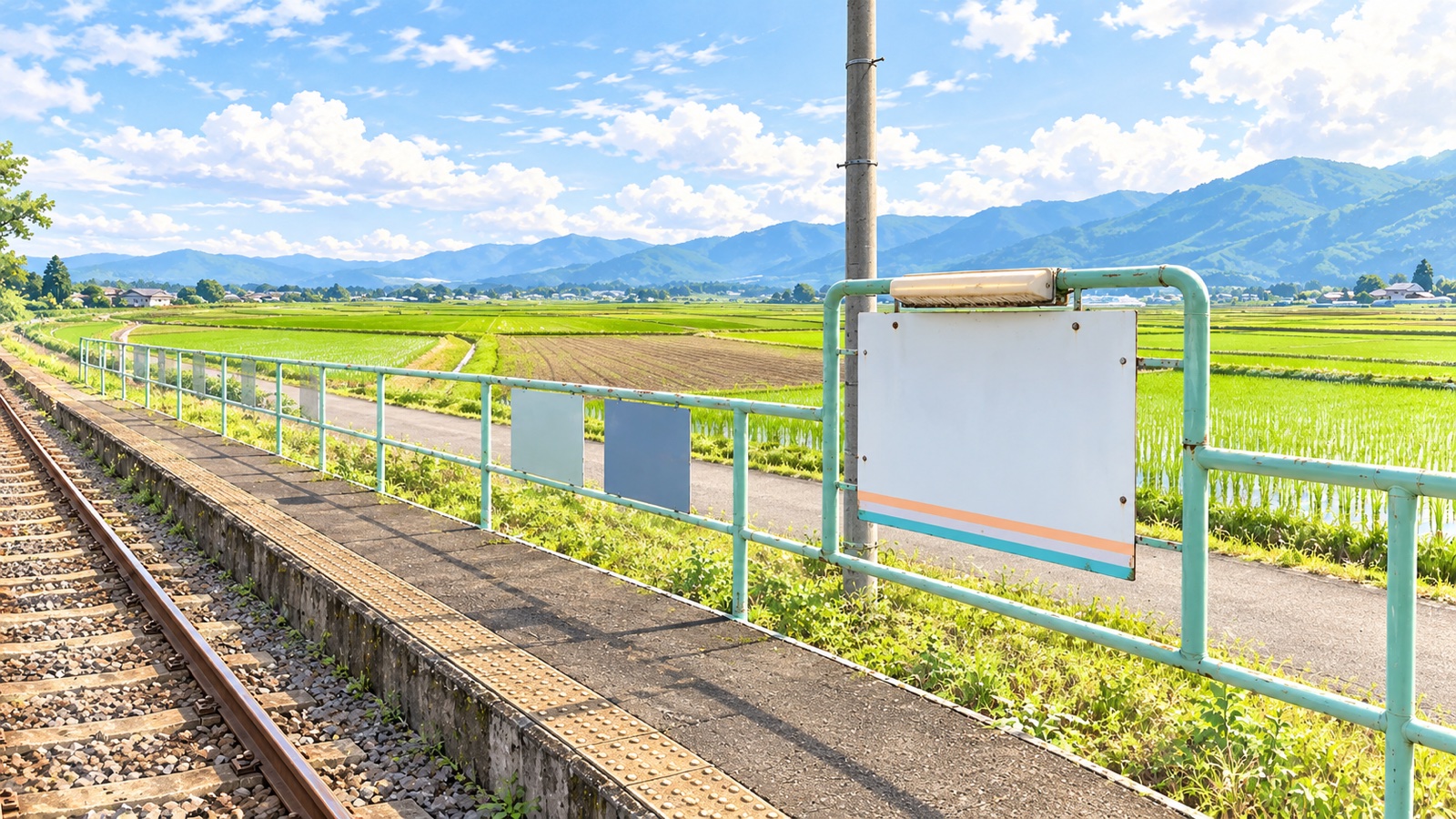
In winter, Tomoko and her friends set their sights on competing in the Tohoku Student Music Festival. But the train taking them to the venue is stranded in a blizzard. A bus arrives carrying Ms. Itami and the brass band members.
The scene of the bus approaching the train was filmed along the tracks between Shirousagi Station in Nagai and Uzen-Narita Station. This location was chosen because a road runs alongside the railway, allowing the real train and a full-size bus to appear in the same shot. The Nishiyama mountain range rises in the background, with broad rice fields in view.
The February 2006 winter filming-location tour also introduced Shirousagi Station as “the place where the train stopped in the snow.”
Shirousagi Station opened on December 16, 1989. Its small waiting room in the fields is decorated with an illustration of rabbit ears. Walk straight northwest from the station to reach Haysama Shrine and the Shirousagi weeping cherry tree, about 150 years old and one of Japan’s 33 notable weeping cherry trees.
- Location
- Shirousagi Station on Yamagata Railway’s Flower Nagai Line, Nagai, Yamagata Prefecture
- Connection to the film
- The station nearest the tracks where Ms. Itami’s bus approaches the train stranded by the blizzard
- Highlights
- A waiting room decorated with rabbit ears and the weeping cherry tree at nearby Haysama Shrine
Sources:Swing Girls Okitama Support Team — Filming location near Shirousagi Station / Same — Intersection in front of Shimizuya Liquor Store / Same — Winter filming-location tour / Swing Girls official site — Winter location shoot, February 16–18 (archived) / Yamagata Railway — Shirousagi Station: Then and Now / Yamagata Railway — History of the Nagai Line
8Arato Station | The terminus where the band starts playing inside the stopped train, and the Meiji-era Arato Bridge

The scene where the group takes out their instruments and starts playing inside the stopped train was filmed inside Arato Station, the terminus of the Flower Nagai Line in Shirataka. It is one of the film’s signature moments: passengers sway along with the high-school girls’ jazz.
The train scenes were shot by coupling a filming car to a vehicle in regular service. Winter filming began with an onboard rehearsal on February 16, 2004, followed by scenes with the stopped train on the 17th. Although the story called for a heavy snowfall, sunlight came out that day, and filming moved ahead when snow began to fall in the afternoon. With the engine off, there was no heat inside the car, and cold air blew in whenever crew members entered or left.
The intersection in Arato was used for another scene: the bus carrying Ms. Itami and the brass band members passes Tomoko, who cannot bring herself to tell her friends that she will not be able to attend the music festival. The bus scene on the way to the festival venue was filmed on the Hatafuchi Bypass in Shirataka. The road is lined with magnolia trees, the town’s official flower. Winter filming continued through February 25, with lead actress Juri Ueno finishing her scenes last.
Near Arato Station, the Flower Nagai Line crosses the Mogami River on a bridge popularly known as Arato Railway Bridge. Built using technology and materials imported from Britain, the Meiji-era structure was relocated here in 1923.
In 2008, together with a bridge of the same name on the JR Aterazawa Line, it was selected as a Civil Engineering Heritage Site by the Japan Society of Civil Engineers. The citation notes that it is Japan’s oldest active railway bridge made entirely of wrought iron, a double Warren truss dating from the Meiji era. In 2009, it was also designated a Heritage of Industrial Modernization by the Ministry of Economy, Trade and Industry. Near the station is Yaotome Hachiman Shrine, where girls from Arato Elementary School offer a dance each summer. A handmade neighborhood map made by local residents greets visitors in front of the station. The Arato Station counter is open weekdays from 10 a.m. to 5 p.m.
- Location
- Arato Station on Yamagata Railway’s Flower Nagai Line, Arato-kō, Shirataka, Nishiokitama District, Yamagata Prefecture
- Connection to the film
- Filming location for the scene where the group begins playing inside the train stopped by snow
- Station counter hours
- Weekdays, 10 a.m.–5 p.m.
- Nearby highlights
- Arato Railway Bridge (Mogami River Bridge), completed in 1923, and Yaotome Hachiman Shrine
Sources:Swing Girls Okitama Support Team — Arato Station filming location / Same — Intersection in front of Shimizuya Liquor Store / Same — Hatafuchi Bypass filming location / Yamagata Okitama Film Commission — Okitama filming-location tour map / Swing Girls official site — Location map: Flower Nagai Line (archived) / Swing Girls official site — Filming diary, August 10–12 (archived) / Same — Filming diary, winter shoot, February 16–18 (archived) / Same — Filming diary, February 24–25 (archived) / Yamagata Railway — Arato Station: Then and Now / Japan Society of Civil Engineers — Civil Engineering Heritage: Mogami River Bridge / Yamagata Railway — History of the Nagai Line
9Kawanishi Friendly Plaza | The hall used as the stage for the Tohoku Student Music Festival in the film

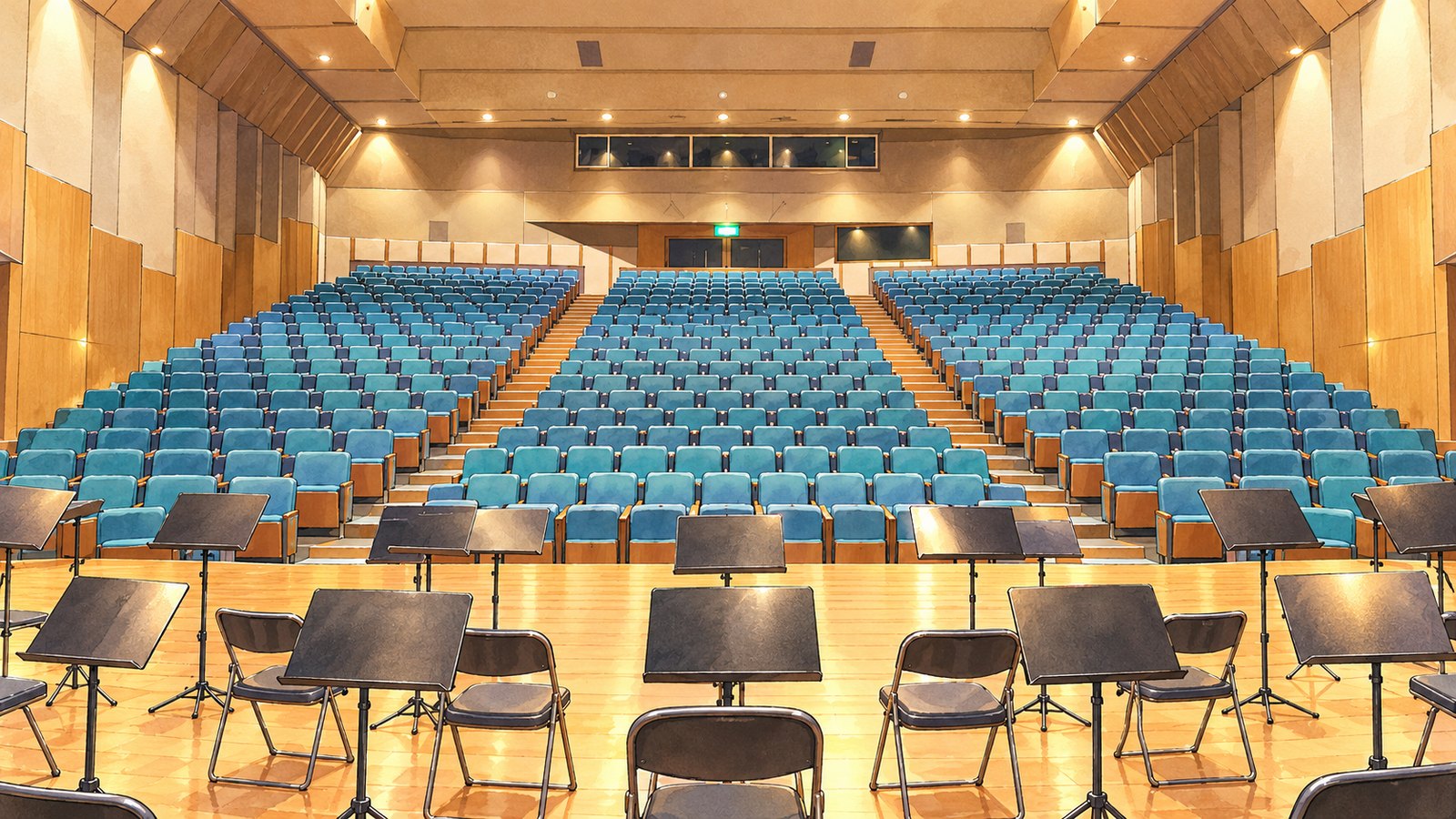
Just when it seems the music festival is over, Tomoko and her friends rush in and begin to play—the climax of the film. The hall at Kawanishi Friendly Plaza is the venue for the Tohoku Student Music Festival in the story. Although the film’s story is set in winter, the hall scenes were shot around the Obon holiday in August 2003. Extras in the audience wore sweaters, coats, and scarves while the entire building’s air conditioning was running.
Filming began with preparations and rehearsal on August 15. On the 16th, the brass bands from five schools performed in the opening of the festival scene. Local students played the musicians, wearing uniforms borrowed from schools in Tokyo. More than 600 extras gathered on the 17th, when the crew focused on the excited audience. On August 18 and 19, three cameras filmed the performance scene, which lasts just over ten minutes.
The exterior of the venue was filmed the following February, in 2004. To shoot the road to the front entrance from a different direction than usual, the crew used a snow blower to move snow and removed the winter protective fencing to create a temporary road.
Friendly Plaza is a cultural complex that includes a theater, Kawanishi Town Library, and Chippendo Bunko. It opened in 1994. The hall is a medium-sized venue with 712 seats, and plays by Hisashi Inoue have been performed there since it opened. Chippendo Bunko houses 220,000 books and documents donated by Inoue, an author and playwright from Kawanishi. There is also an exhibition corner about his work.
For ten years beginning in 2005, the hall hosted the real “20th Tohoku Student Music Festival,” using the same name as the one in the film. In October 2024, it also held a screening and mini-concert for the film’s 20th anniversary. Visitors can sit in the hall on performance and screening days. A screening of two Showa-era classics, The Man Who Caused a Storm and Abashiri Prison, was also planned for November 23, 2026. From Uzen-Komatsu Station on the JR Yonesaka Line, it is a five-minute walk from the east exit.
- Location
- 1037-1 Kamikomatsu, Kawanishi, Higashiokitama District, Yamagata Prefecture
- Connection to the film
- Venue for the Tohoku Student Music Festival in the film; hosted the real festival for ten years starting the following year
- Facilities
- A 712-seat medium-sized hall, Kawanishi Town Library, and Chippendo Bunko, which houses Hisashi Inoue’s collection
- Access
- Five-minute walk from the east exit of Uzen-Komatsu Station on the JR Yonesaka Line
Sources:Swing Girls Okitama Support Team — Kawanishi Friendly Plaza filming location / Swing Girls official site — Filming diary, August 15–16 (archived) / Same — Filming diary, August 17–20 (archived) / Kawanishi Friendly Plaza — Swing Girls screening / About Kawanishi Friendly Plaza / Kawanishi Friendly Plaza — Theater / Kawanishi Friendly Plaza — Showa-era film screening / Kawanishi Friendly Plaza — Access
Learn more about the film | A big band born from a lunch-delivery mishap: 16 girls and one boy
Swing Girls is a 105-minute film produced by Fuji Television, Altamira Pictures, Toho, and Dentsu, and distributed by Toho. Junko Yaguchi assisted with the screenplay, and the music was composed by Mickey Yoshino and Hiroshi Kishimoto. The promotional tagline was “Let’s play jazz!” It earned ¥2.2 billion at the box office.
A year at Yamakawa High School: from summer remedial lessons to the winter music festival
The story follows the seasons from summer through fall and winter. In summer, the girls’ lunch-delivery mishap leads them to form a band in place of the brass band; when the brass band returns, they give back the instruments. The makeshift group practices hard with borrowed instruments until they can just about play “Take the ‘A’ Train.”
In fall, they form their own band but cannot afford instruments. Tomoko gives up her computer and her younger sister’s game console, then gets a used saxophone at a pawnshop. The pawnshop scene was filmed at a real shop in Yonezawa, whose interior was completely redecorated by the art department.
The group gets part-time jobs at a supermarket but makes one mistake after another. After a performance in the parking lot, the first snow begins to fall. The scene was filmed on August 22, 2003, using two crane trucks to make snow. While waiting between setups, someone started playing “Sing, Sing, Sing,” and the whole group joined in. Director Shinobu Yaguchi later said this was when he decided to start playing the saxophone.
To earn money, the group trespasses on someone else’s matsutake mountain and ends up taking down a wild boar they encounter. The award ceremony was filmed at Takahata Town Hall. Although the script placed the scene in the mayor’s office, they used the actual mayor’s office, and the mayor and town staff appeared in the film.
The matsutake mountain scenes were filmed on a real matsutake mountain in Takahata. People from the local hunting association played the hunters. A live boar was also brought to a mountain in Yamanashi Prefecture for the collision scene. The boar was weak that day and did not charge, so the footage was not used in the final film.
In winter, the girls take on the Tohoku Student Music Festival, a snowbound train, and the festival performance. The scenes where they sneak onto the roof of a school covered in snow to play, then have a snowball fight, were filmed on February 20 and 21, 2004.
Sources:Toho — Swing Girls story (archived) / Swing Girls official site — Introduction (archived) / Swing Girls official site — Location map: shop where they buy the used saxophone (archived) / Same — Location map: supermarket (archived) / Same — Filming diary, August 4–6 (archived) / Same — Filming diary, August 21–22 (archived) / Same — Filming diary, August 29–September 1 (archived) / Same — Filming diary, February 19–21 (archived) / Same — Filming diary, February 22 (archived) / Swing Girls Okitama Support Team — Pawnshop filming location / Same — Matsutake mountain filming location / Same — Takahata Town Hall filming location / Eiga.com — Swing Girls details / Fuji Television Movies — First and last concert
Five members at the heart of the band and two teachers
Tomoko Suzuki
The protagonist, played by Juri Ueno, who plays tenor saxophone. She becomes obsessed with jazz after volunteering to deliver lunches as a way to sneak out of remedial class.
Takuo Nakamura
A first-year brass band member played by Yuta Hiraoka. He is the only band member who avoids eating the lunches. He forms a band with Tomoko and her friends and plays piano.
Yoshie Saito
A band member played by Shihori Kanjiya who plays trumpet. In winter, she practices alone beneath a bridge near Matsukawa Bridge.
Kaori Sekiguchi
A band member played by Yuika Motokariya who plays trombone. At an intersection in Yonezawa, she hears the traffic signal and wonders, “Is this jazz?”
Naomi Tanaka
A drummer played by Yukari Toshima. Toshima is from Hokkaido and passed the audition for this film while attending a music college.
Tadahiko Ozawa
A mathematics teacher at Yamakawa High School, played by Naoto Takenaka. He dislikes children and is not sociable, spending his days off at home immersed in his hobbies. Secretly, he loves jazz and attends music lessons.
Yayoi Itami
A music teacher who arrived at the school three years earlier, played by Miho Shiraishi. In winter, she takes a bus with brass band members to the music festival venue.
Sources:Toho — Swing Girls cast (archived) / Swing Girls official site — Cast (archived) / Eiga.com — Swing Girls details / Toho — Swing Girls story (archived) / Swing Girls Okitama Support Team — Filming-location map
From “Take the ‘A’ Train” to “Sing, Sing, Sing”: swing jazz in the film
The film’s big band is a jazz ensemble with nine or more musicians. A typical group of just under 20 includes trumpets, trombones, saxophones, and a rhythm section. The rhythm section consists of piano, bass, drums, and guitar.
The film uses swing-jazz standards familiar to many listeners throughout. “Take the ‘A’ Train” was written by Billy Strayhorn in 1939 and is best known through Duke Ellington’s orchestra. It is the first song Tomoko and the others rehearse as a full group, in a scene filmed on August 4, 2003. Because the same song had to be performed many times for filming, band director Reo Yamaguchi conducted with a device that kept the beat held to his ear.
“Moonlight Serenade” and “In the Mood” were both written in 1939, and both appear in The Glenn Miller Story. “Mexican Flyer” is a 1965 song by British band Ken Woodman and the Piccadilly Brass. In Japan, it was also used as the theme for the video game Space Channel 5. “Sing, Sing, Sing” was written by Louis Prima in 1936 and became a hit through Benny Goodman’s orchestra.
Sources:Toho — Swing Girls: Music and big band (archived) / Toho — Main songs performed (archived) / Swing Girls official site — Filming diary, August 4–6 (archived) / Kawanishi Friendly Plaza — Screening (staff and cast)
For readers who want to enjoy the story in prose, there is a novelization written by Shinobu Yaguchi himself. It is the newly formatted edition published by KADOKAWA’s MF Bunko Da Vinci.
Production and background | 17 musicians’ training, Okitama dialect, and the train run by local residents
From instrument practice and dialect coaching to the schools and railway used for filming, this section follows what happened in Okitama before and after the shoot.
In May 2003, after auditions, 17 band members began practicing
The 17 performers in the band “Swing Girls & a Boy” were selected through auditions held over six months, beginning in January 2003. More than 1,000 candidates applied. The band in the story consists of 16 girls and one boy.
The selected members were all jazz beginners, and five had never played an instrument before. Practice began in May 2003 at a rehearsal studio in Tokyo with “Take the ‘A’ Train.” They met after school every day except Wednesdays and Sundays, then held training camps by Lake Kawaguchi in June and in Yonezawa in July.
Practice continued after filming began, right up to the end of the final location shoot. In Yonezawa, the group rented a lodge at Onogawa Ski Resort as a rehearsal space. All the performances in the film were played by the cast without musical stand-ins.
Principal photography began on July 25, 2003. It rained on the first day, so the planned embankment scene was replaced with a classroom scene at Takahata High School. The summer shoot around Yonezawa lasted about 40 days, with many Yonezawa residents volunteering as extras. On September 1, the crew filmed small props at a Tokyo studio, wrapping the summer shoot.
Around the film’s release, the band also performed outside the movie. After a completion press conference on July 5, 2004, they played in Shibuya on September 18 and in New York on October 6. On December 27 and 28, 2004, they held the SWING GIRLS First & Last Concert at Hotel Nikko Tokyo, bringing the band’s activities to a close.
Sources:Toho — Swing Girls introduction (archived) / Swing Girls official site — Filming diary: getting started (archived) / Same — Filming diary, July 25–27 (archived) / Same — Filming diary, August 29–September 1 (archived) / Toho — Swing Girls music (archived) / Toho — Swing Girls details (archived) / Fuji Television Movies — Swing Girls / Fuji Television Movies — First and last concert
Okitama dialect coaching continued from script readings through the shoot
Director Shinobu Yaguchi wanted to set a film in a Tohoku town where people spoke in dialect. Starting in January 2003, he visited high schools across the region and made three script-research and location-scouting trips before choosing Okitama. The dialogue uses the local Okitama dialect. Yonezawa-born actor Hidekazu Mashima and Sayuri Ito served as dialect coaches. Ito later wrote about the coaching process on a local fan-support website.
Some cast members attended the pre-shoot script readings still wearing their school uniforms after class. Juri Ueno reportedly asked eagerly whether sentence endings should rise in pitch or consonants should be voiced. Yuta Hiraoka struggled with a long line explaining music. Between takes, the cast members reportedly spoke to one another in the Yonezawa dialect.
Director Yaguchi often added lines on the spot during filming. Each time, the dialect coaches converted them into Yonezawa speech and passed along the differences in intonation they had heard during rehearsal before the cameras rolled. Naoto Takenaka, who played Mr. Ozawa, spoke the Yonezawa dialect so naturally that even local teachers appearing as extras could not outdo him.
Sources:Swing Girls official site — Filming diary: script scouting (archived) / Same — Filming diary, July 25–27 (archived) / Swing Girls Okitama Support Team — Dialect-coaching stories / Kawanishi Friendly Plaza — Screening (Okitama dialect and dialect coaching) / Yonezawa City Library — Special exhibition
The former Takahata High School, which became Yamakawa High School, and Takahata Town Hall
The former school building of Yamagata Prefectural Takahata High School in Takahata served as Yamakawa High School. Many scenes were filmed there—in classrooms, the music room, hallways, and the schoolyard—and students and teachers appeared as extras. Filming began with principal photography on July 25, 2003, and returned to the school repeatedly in summer and winter. For the opening scene, when a tour bus enters the schoolyard, the crew removed a roadside fence to widen the entrance.
On August 27, 2004, a thank-you screening was held for all students at Takahata High School. They traveled to the theater in a convoy of nine buses. Before the screening, director Yaguchi and Juri Ueno performed “Take the ‘A’ Train” together.
The old school building was demolished after the school moved into a new one and no longer exists. Before demolition, it was opened to the public on May 28, 2005. Visitors could see the classrooms, music room, and home economics room used in the film, along with scripts, signed posters, instruments, and panels of production photos. In the afternoon, the brass band performed as the music room underwent a ceremonial first cut with a saw.
On October 22 that same year, the Swing Girls Takahata Support Team held a farewell event at the old school. The schoolyard was opened to the public for that day only. Visitors ate imoni stew and took commemorative photos; demolition was scheduled to begin later in October.
Takahata Town Hall, where the award ceremony after the wild-boar incident was filmed, began operating in its new building on May 7, 2025. The old building was more than 50 years old and had become a concern due to insufficient earthquake resistance and aging facilities.
Sources:Swing Girls official site — Location map: Takahata High School (archived) / Same — Filming diary, July 25–27 (archived) / Same — Report: Thank-you screening at Takahata High School, August 27, 2004 (archived) / Swing Girls Okitama Support Team — Takahata High School filming location / Same — Public viewing and farewell event at the old school building / Okamura — Takahata Town Hall case study / Takahata Town
The wrapped train and the “Swing Girls Train”
On September 10, 2004, the day before the film’s release, a movie-wrapped train began running on the Flower Nagai Line. Its body was decorated with the “SWING GIRLS” logo and musical notes, and the promotional phrase “Let’s play jazz!” was printed by the doors. The cast members’ handwritten autographs were displayed inside.
On October 23, 2004, the reservation-only “Swing Girls Train” was unveiled. A screening of a making-of video created for the train was also held, drawing more than 200 people from inside and outside the prefecture. From October 30, the train ran between Akayu and Arato. Four monitors inside showed a making-of video specially edited for the train by the production company.
Advertisements for the obstetrics and gynecology clinic and the band-member recruitment notice from the film were displayed inside. The wild boar that appeared in the movie was also exhibited, and members of the local Okitama Support Team rode along to share filming stories. With a reservation, passengers could also order a ¥1,000 “Girls’ Lunch,” inspired by the lunches at the center of the mishap. The train ran on weekends and holidays through December 26, then returned from March 20 through May 5, 2005, to coincide with the DVD release.
The Flower Nagai Line still runs from Akayu to Arato through countryside and fields of flowers. Yamagata Railway’s official YouTube channel has released footage of the line in spring and early summer.
Sources:Toho — Wrapped train service begins (archived) / Swing Girls official site — Report: Train unveiled, October 23, 2004 (archived) / Same — Report: Service begins, October 30, 2004 (archived) / Swing Girls Okitama Support Team — Flower Nagai Line / Shirataka Town — Koho Shirataka, November 12, 2004 issue / Yamagata Railway official YouTube — Beautiful Flower Nagai Line
From filming through ten years of the Tohoku Student Music Festival and the 2024 screening
A timeline from the opening of the Nagai Line, predecessor of the Yamagata Railway Flower Nagai Line, through filming and release in Okitama in 2003–2004, the ten-year run of the Tohoku Student Music Festival, and the 20th-anniversary screening.
- 1913
October 26 Nagai Light Railway opens between Akayu and RingoRailway - 1923
April 22 The Nagai Line is completed through to AratoRailway - 1988
October 25 Yamagata Railway begins operationsRailway - 1994
Kawanishi Friendly Plaza opensFacility - 2003
May The 17 band members begin practicingFilm - 2003
July 25 Principal photography begins at Takahata High SchoolFilm - 2004
February 25 Winter filming ends; principal photography wrapsFilm - 2004
September 10 The wrapped train begins running on the Flower Nagai LineRailway - 2004
September 11 The film opens nationwideFilm - 2004
October 30 Reservation-only Swing Girls Train begins serviceCommunity - 2004
December 27 First & Last Concert at Hotel Nikko TokyoPerformance - 2005
February 12 The first Tohoku Student Music Festival is held at Friendly PlazaCommunity - 2005
May 28 The former Takahata High School building opens to the public before demolitionCommunity - 2006
February 11 Tohoku Student Music Festival 2006 is held at Friendly PlazaCommunity - 2008
Arato Railway Bridge is designated a Civil Engineering Heritage SiteRailway - 2022
November 25 Naceba opens the special exhibition “Looking Back at the Film Swing Girls”Exhibition - 2024
October 26 20th-anniversary screening and mini-concert at Friendly PlazaCommunity
Kawanishi’s Tohoku Student Music Festival began with the film’s sign and ran for ten years
The music festival at Kawanishi Friendly Plaza began the year after the film’s release. Organizers wanted to hold a real Tohoku Student Music Festival at the filming location used for the festival in the movie. It is organized by the Tohoku Student Music Festival Committee, whose office is at the plaza.
The first festival was held on February 12, 2005. The organizers displayed the sign actually used in the film and, from the very first event, called it the “20th Tohoku Student Music Festival,” just as in the story. Performers were selected through video auditions. Four groups from local middle and high schools and a guest band took part. Director Yaguchi and cast members also visited.
After the screening, a commemorative band of 75 musicians, including people who had traveled from Osaka and Fukuoka, performed. The mayor of Kawanishi joined them on trumpet. At the end, audience members who had brought instruments joined in to play “Moonlight Serenade.”
At “Tohoku Student Music Festival 2006” on February 11, 2006, applications were open to student and community groups of ten or more. For the finale, sheet music for a small ensemble was handed out to people who had brought instruments. That year also saw auditions for “Swing Girls of Friendly Plaza.” It was an all-female big band for players aged 16 to under 30, with one man on piano—a lineup that recalled the band in the film. The third festival, on February 11, 2007, was also called the “20th Tohoku Student Music Festival.”
The music festival continued for ten years. On October 26, 2024, ten years after its final event, the same hall hosted a screening of the film. After the afternoon screening, the big band Swing Friends Jazz Orchestra performed. Guest trumpeter Reo Yamaguchi had worked as the film’s music coach. He also performed at the 2004 First & Last Concert.
The festival was not the only event inspired by the film in Okitama. In 2005, Shirataka’s “Shirataka Music Film School” hosted a session where Daisuke Sekiguchi, a producer at Fuji Television, shared behind-the-scenes stories. A talk by director Shinobu Yaguchi was planned for 2007, and his appearance aboard the August 4 “Akanagi Live Train” was also announced.
Sources:Swing Girls official site — Report: Tohoku Student Music Festival, February 12, 2005 (archived) / Kawanishi Friendly Plaza — Swing Girls screening / Swing Girls Okitama Support Team website — Tohoku Student Music Festival and related events / Fuji Television Movies — First and last concert / Toho — Swing Girls introduction (archived) / Yamagata Railway — History of the Nagai Line / About Kawanishi Friendly Plaza / Yonezawa City Library — Special exhibition
Research note | A business perspective: Turning a fictional music festival into a ten-year event at the filming location
Kawanishi Friendly Plaza held a real Tohoku Student Music Festival in the same hall where the fictional festival was filmed, and continued it for ten years. The event displayed the movie’s festival sign and, from its first year, used the same “20th” designation as in the film. A set used for filming became a venue for real musicians to perform.
At a 2019 city council meeting, the mayor of Nagai said the film may have increased ridership on the Flower Nagai Line by around 100,000 passengers. That was an assessment offered in the mayor’s remarks, not a figure measuring the effect of the music festival alone. When considering whether to continue a project, it is useful to distinguish such assessments of regional impact from records of performers, audience members, and operating costs for each event. The example shows how a recreation of a fictional event can become an opportunity for local musicians to keep performing.
Sources:Nagai City Council — Minutes of the March 2019 regular session Related research article:Municipal collaboration examples
Sources
- Swing Girls official site — Location map (archived)
- Swing Girls official site — Filming diary (archived)
- Swing Girls official site — Reports (archived)
- Swing Girls official site — Introduction (archived)
- Swing Girls official site — Cast (archived)
- Toho — Swing Girls details (archived)
- Toho — Swing Girls story (archived)
- Toho — Swing Girls introduction (archived)
- Toho — Swing Girls music (archived)
- Toho — Main songs performed (archived)
- Toho — Swing Girls cast (archived)
- Fuji Television Movies — Swing Girls
- Fuji Television Movies — First and last concert
- Yamagata Okitama Film Commission — Okitama filming-location tour map
- Swing Girls Okitama Support Team (office: Shirataka Tourism Association) — Location map
- Swing Girls Okitama Support Team website
- Kawanishi Friendly Plaza — Swing Girls screening
- About Kawanishi Friendly Plaza
- Kawanishi Friendly Plaza — Theater
- Kawanishi Friendly Plaza — Showa-era film screening
- Kawanishi Friendly Plaza — Access
- Yamagata Railway — History of the Nagai Line
- Yamagata Railway — Company information
- Yamagata Railway — Station information
- Yamagata Railway — Akayu Station: Then and Now
- Yamagata Railway — Ringo Station: Then and Now
- Yamagata Railway — Shirousagi Station: Then and Now
- Yamagata Railway — Arato Station: Then and Now
- Yamagata Railway official YouTube — Beautiful Flower Nagai Line
- Japan Society of Civil Engineers — Civil Engineering Heritage: Mogami River Bridge
- Ministry of Land, Infrastructure, Transport and Tourism — Regional tourism development example (Nagai, Yamagata)
- Nagai City Council — Minutes of the March 2019 regular session
- Shirataka Town — Koho Shirataka, November 12, 2004 issue
- Yonezawa City — Draft individual facility plan for the comprehensive management plan for public facilities
- Yonezawa City Library — Special exhibition “Looking Back at the Film Swing Girls”
- Yonezawa City Library — Feature corner: “Memories of 2004”
- Yonezawa City Library — Library newsletter, Vol. 25
- Okamura — Takahata Town Hall case study
- Seijiyama — Nagai City Hall integrated with the station
- Eiga.com — Swing Girls
- Yamagata Railway Flower Nagai Line official channel (YouTube)
FAQ
Where was Swing Girls filmed?
In the Okitama region of southern Yamagata Prefecture, across Yonezawa, Nagai, Nanyō, Takahata, Kawanishi, and Shirataka. The girls’ train journeys use the Yamagata Railway Flower Nagai Line.
Which stations appear in the scenes where Tomoko and her friends overshoot their stop?
The scene of the sleeping group riding past their stop was filmed at Akayu Station in Nanyō. Ringo Station in the same city is where they get off clutching their lunch boxes. A November 2005 filming-location tour included the “rice-field dive” spot near Ringo Station.
Where is the ballpark where the girls deliver the lunches?
It is Yonezawa City Baseball Stadium in Shioi-machi Shiono, Yonezawa. After eating lunches spoiled by the summer sun, brass band members are hospitalized one after another with stomachaches, prompting Tomoko and her friends to form a band in their place.
Where was the scene inside the train stopped by snow filmed?
The scene of the members playing inside the train was filmed at Arato Station, the Flower Nagai Line terminus in Shirataka. The scene where a bus approaches the snowbound train was filmed alongside the tracks near Shirousagi Station in Nagai. The winter scenes were shot in February 2004.
Can visitors tour the school building used as Yamakawa High School?
Yamakawa High School was filmed at the former building of Yamagata Prefectural Takahata High School. It was demolished in 2005 after the school moved into a new building and no longer exists.
Can I visit the hall used for the music festival?
Kawanishi Friendly Plaza’s 712-seat hall is open to visitors on performance and screening days. A screening of the Showa-era classics The Man Who Caused a Storm and Abashiri Prison was also planned for November 23, 2026. The same building houses the town library and Chippendo Bunko.
Was the Tohoku Student Music Festival from the film held in real life?
A festival recreating the one in the film was held at Kawanishi Friendly Plaza for ten years, starting February 12, 2005. From its first year, it displayed the actual sign from the movie and was called the “20th” festival. On October 26, 2024, ten years after the final festival, the same hall hosted a screening and mini-concert.
Did the cast really play the instruments?
The 17 performers selected for the band began practicing in May 2003 and attended two training camps before filming. The cast performed all the music in the film themselves, without instrumental doubles.


