
Japan's 2026 Buzzword Nominees, Read by Fans: All 30 Words Explained
On November 5, 2026, the 30 nominees for Japan’s annual buzzword awards, the “Gendai Yogo no Kiso Chishiki” 2026 T&D Insurance Group Shingo Ryukogo Taisho, were announced. Think of it as Japan’s version of a “word of the year,” chosen by the editors of a long-running dictionary of contemporary terms. Words tied to all three acts The Oshi Lab covered on our podcast this year made the list: M!LK, Chiikawa and Monaki. The words are Suki Sugite Metsu!, the Chiikawa phenomenon and Monaki.

The word we found most important is koe no kenri (声の権利), “voice rights.” In 2026, a Japanese court ruled for the first time in a case over a video that used AI to imitate a voice actor’s voice. Two more words caught our eye: hobi-aka and gengoka. A hobi-aka is an account for showing yourself enjoying oshi-katsu, and gengoka means putting what you love into words.
Below, we read all 30 words from a fan’s point of view. The meanings follow the organizers’ announcement and ORICON NEWS’s explanations. The top ten and the grand prize will be announced on December 1. Official site of the buzzword awards (in Japanese) / ORICON NEWS explanation of the nominees (in Japanese)
| Connection to oshi-katsu | Nominated words |
|---|---|
| Songs and dance | Suki Sugite Metsu!, Monaki, Yoru no Odoriko |
| People, characters and animals fans support | Chiikawa (phenomenon), Nantoka nare!, Punch-kun, “Akari, shinjiteru kara na” |
| Sports | Riku-Ryu, pickleball |
| Collecting, showing and recording | Bonbon Drop Seal (Bondoro), squishies, hobi-aka, setlog, gengoka |
| Social media and AI | frenemy, dopa-gaki, smartphone farms, voice rights |
| Budget | NISA poverty, 1% consumption tax, dake bento, guilty pleasures, Kioxia |
| Getting to the venue | blue tickets, kokushobi, warning level 5 |
| Behind merchandise and streaming | naphtha, data centers, physical AI, rogue AI |
Three words spread by songs and dances people want to copy
Suki Sugite Metsu!: an easy-to-copy “metsu pose”
This is a song by M!LK (pronounced “milk”), a five-member vocal group. It was released for streaming in October 2025. The title roughly means “I love you so much I’ll vanish,” and the song is about feelings growing so big that you might disappear.
The “metsu pose” in the chorus is a move where you hold a peace sign with the fingers closed, one in front of your forehead and one in front of your body.
Fans copied the pose in photos and videos, and the phrase “so ___ I’ll vanish” spread too. According to TikTok, the song passed 3.6 billion total plays on TikTok as of May 2026 and topped its music chart for nine weeks in a row. On the Oricon streaming ranking, its cumulative plays passed 300 million in September.
- 3.6 billion
- Total TikTok plays
- 9 weeks
- In a row at No. 1 on TikTok's music chart
Source: TikTok H1 Trend Awards 2026 announcement (in Japanese)
On our podcast episode “Why did M!LK take off?” we talked about how M!LK’s popularity spread on social media before television caught up. Our reading was that easy-to-copy choreography, plus an official stance that told fans they were welcome to post, led fans to spread the videos themselves. The metsu pose shares those traits. Places connected to the group are in our M!LK pilgrimage guide. TikTok H1 Trend Awards 2026 announcement (in Japanese) / Oricon article on cumulative plays (in Japanese)
Monaki: found on TikTok, supported in person
Monaki is a four-member group produced by Kazuyoshi Sakai, leader of the vocal group Junretsu, which sings in the kayokyoku style of Showa-era popular song. The members are Jin, Oyone, Kenken and Sakai Jr., and the group made its major-label debut on April 8, 2026. The debut song is “Honma ya de ☆ Nande ya nen ☆ Shiran kedo,” a string of Kansai-dialect catchphrases.
According to the organizers, the group first expected its main audience to be middle-aged and older fans of Junretsu. In practice, the simple choreography and catchy phrases won fans, and the group’s popularity has spread to younger people as well.
In June, Monaki won the grand prize at the TikTok H1 Trend Awards 2026, and TikTok praised the group for building a fan community that spans generations.
On our podcast episode “Why did Monaki take off?” we described how people discover the group through short videos, then grow closer through face-to-face support, a tradition in kayokyoku. Crank-in! report on the debut event (in Japanese) / TikTok H1 Trend Awards 2026 announcement (in Japanese)
Yoru no Odoriko: meeting a 14-year-old song through your oshi’s post
“Yoru no Odoriko” (“Night Dancer”) is a song the rock band Sakanaction released in 2012. A short video spread that set the song over footage of a boy dancing at the bow of a boat in a traditional Indonesian boat race. Ichiro Yamaguchi, the band’s vocalist, has also performed the dance on his own YouTube show.
Members of M!LK, Naniwa Danshi, Nogizaka46, LE SSERAFIM and others also posted videos using the song. On the Oricon streaming ranking, its cumulative plays passed 100 million in August. It is the fourth Sakanaction song to pass 100 million. Some people heard the song for the first time, 14 years after its release, because their oshi posted it. Oricon article on the YouTube chart (in Japanese) / Oricon article on cumulative plays (in Japanese)
Four words about characters, animals and even a cook who get fans
Chiikawa (phenomenon): a film, bonuses and goods that connect
Chiikawa is a manga by the illustrator Nagano, and the name of its main character. Chiikawa the Movie: The Secret of Mermaid Island (映画ちいかわ 人魚の島のひみつ) opened on July 24, 2026. In its first 108 days, the film passed ¥18.79 billion (roughly $125 million) at the box office and 12.86 million admissions.
- ¥18.79 billion
- Box office (roughly $125 million)
- 12.86 million
- Admissions
Source: MANTANWEB (in Japanese)
The second wave of moviegoer bonuses, handed out from August 8, was Bonbon Drop Seal stickers, another nominee on this list. The bonuses continue with an eighth wave from November 14, and waves through the twelfth have been announced for the rest of the year. One work brings together watching the film, collecting the bonus, buying goods and visiting collaboration shops.
On our podcast episode “Why do adults with an average age of 38 fall for Chiikawa?” we looked at why adults see their own work and worries in Chiikawa. The follow-up, “Chiikawa goes global,” covers how fans in China compared the series to a painkiller. Shop and restaurant locations are collected in our Chiikawa pilgrimage guide. MANTANWEB box office article (in Japanese) / AdverTimes article on the moviegoer bonus (in Japanese)
Nantoka nare!: the feeling before you open the lottery results
“Nantoka nare!” (“Please, just work out!”) is a line from Hachiware, a character in Chiikawa. Hachiware says it like a prayer at make-or-break moments.
It fits exactly how you feel right before opening ticket lottery results or tearing open a blind-bag item.
Punch-kun: visiting one zoo animal again and again
Punch-kun is a young Japanese macaque at the Ichikawa City Zoological and Botanical Garden in Chiba Prefecture. After the zoo introduced him on its official X account, images of him hugging an orangutan plush nicknamed “Oran-mama” were reported overseas as well. Shukan Josei PRIME reported that the same IKEA plush sold out in many places.
Supporting one particular zoo animal and going back to see it again and again looks a lot like supporting an idol or a character. A monkey with a plush companion also felt familiar to people who enjoy nui-katsu, taking their plushies out into the world. Shukan Josei PRIME article (in Japanese)
“Akari, shinjiteru kara na”: cooking the recipe and posting the result
“Akari, shinjiteru kara na” (“Akari, I’m trusting you”) is what fans on social media write about recipes shared by Akari Hasegawa, a cook and registered dietitian. Her recipes sometimes include an unexpected step. Before cooking, fans post this line with a mix of worry and hope.
The fun doesn’t stop at reading the recipe. It runs through cooking it yourself and posting how it turned out. A cook, too, can be someone fans support. Bunshun Online interview (in Japanese)
Two sports words where support goes beyond competition
Riku-Ryu: support that continues after the gold medal
Riku-Ryu is the nickname of figure skating pair Riku Miura and Ryuichi Kihara. On February 16, 2026, they won gold at the Milan Cortina Olympics. They were fifth after the short program with 73.11 points, then came from behind with a free skate of 158.13, the highest score in history. It was the first Olympic gold for a Japanese pair.
The two announced their retirement from competition in April and held a press conference on the 28th. They also announced their engagement in August. From January 2027, they plan a tour of about ten cities across Japan. Even after leaving competition, fans will still have places to go and see the two of them together. TV Tokyo Sports article (in Japanese) / Oricon article on the retirement press conference (in Japanese) / Daily Sports article (in Japanese)
Pickleball: a sport people play first
Pickleball is a racket sport from the United States. It combines elements of tennis, badminton and table tennis and uses a light ball. In Japan, two governing bodies merged in April 2026 to form Pickleball Japan.
For now, most people involved enjoy playing it themselves. The new body says it will build up national tournaments and develop players. We are watching to see whether players and teams that people want to cheer for will come out of this. Pickleball Japan announcement (in Japanese)
Five words about the joy of collecting, showing and recording
Bonbon Drop Seal (Bondoro): collect, trade and stick
Bonbon Drop Seal stickers are puffy and glossy, like candy drops. They are sold by the stationery maker Cucouria, and cumulative shipments passed 45 million sheets by the end of September 2026. The stickers placed third in Nikkei Trendy’s “Top 30 Hit Products of 2026.” New words grew around them: shiru-katsu, collecting and trading stickers, and shiru-pato, patrolling stores to find them.
Collecting character stickers, trading them with friends and showing them off in a planner or on a phone follows the same pattern as trading cards and blind-bag goods. Some stores that ran out of stock reportedly switched to selling them by lottery. We covered why scalping happens on the podcast episode “Why does resale spark backlash?” For trading etiquette, see also our guide to random goods. Nikkei xTREND article (in Japanese) / DIME article (in Japanese)
Squishies: touch them, film them, show them
Squishies are toys you squeeze to change their shape and enjoy their bounce and texture. They became a craze mainly among elementary school children around 2014 and became popular again in 2026. “Paki-paki squishies,” coated in hard wax so you can enjoy the cracking sound and feel, have spread too. Among Japanese makers, Bloom Co., Ltd. makes squishies under the iBLOOM name and introduces new ones on its official YouTube channel.
The 2014 boom also started with YouTube videos. The sequence of collecting, touching and filming to show others is the same as with Bondoro. Products where you can’t tell which one you’ll get offer the same fun as opening blind-bag goods.
Hobi-aka: the fan enjoying oshi-katsu takes center stage
Hobi-aka (ホビ垢) is short for “hobby account,” a social media account used for a hobby. People keep it separate from their everyday account and post oshi-katsu news and photos of themselves enjoying oshi-katsu.
Mai Osada, head of SHIBUYA109 lab., explains that these accounts are mostly on X. The reasons are that X shows four photos at once, and that fans already use X to gather oshi-katsu information. Unlike posts that match the mood of a place or a work, a hobi-aka puts the fan who is having fun at the center. Compare it with an older term in our explainer on ota-aka. Senken Plus column (on FASHIONSNAP) (in Japanese)
Setlog: recording an ensei day two seconds at a time
Setlog is an app that asks you to record about two seconds of video each hour, then stitches the day into one clip. It was developed by New Chat in South Korea and has spread among young people in Japan too. In October, Z Venture Capital, part of the LY Corporation group, announced an investment.
Idols and artists post their own setlogs too. According to Modelpress, =LOVE split the day of its June concert at the National Stadium into ten parts and posted one member’s setlog for each on TikTok. JO1’s Shoya Kimata and Issei Mamehara posted setlogs from a day in South Korea, and STARGLOW members posted the days they traveled to fan meetings or rehearsed. For fans, the appeal is seeing what happens behind the stage in unedited two-second clips. Modelpress article (in Japanese)
It lets you record a concert or ensei (traveling to see your oshi) day from getting ready to the trip home without much effort. On the other hand, concert venues, cinemas and exhibitions have places where filming is not allowed. Even if a notification comes in, don’t record inside. It also matters not to share clips showing your ticket, seat number or hotel. Impress Watch article (in Japanese)
Gengoka: writing what you love in your own words
Gengoka (言語化) means putting thoughts and feelings clearly into words. More and more book titles include the word.
Some of those books sold on the strength of oshi talk. Kaho Miyake’s “Suki” o Gengoka suru Gijutsu (The Art of Putting What You Love into Words) is written for people who try to describe their oshi’s appeal and can only come up with “yabai” (“insane”). It was published in July 2024, and the publisher has announced that cumulative sales passed 300,000 copies. We cover the book in our review.

The organizers add that the ability to keep holding on to what can’t be put into words is also being reconsidered. Even on days when you can’t write your thoughts well, what you love stays the same. Discover 21 announcement (in Japanese)
Four words for rethinking how to support in the age of social media and AI
Frenemy: the distance between fans who meet online
“Frenemy” combines “friend” and “enemy.” It describes someone who acts close to you while holding you back behind the scenes.
Fans often meet each other on social media, so it is hard to know what the other person really thinks. Passing on tickets or trading goods also involves money and personal information. We cover how to get along with people who support the same oshi in our explainer on doutan.
Dopa-gaki: nights when the clips won’t stop
Dopa-gaki is internet slang shortened from “dopamine-addicted brat.” It describes people who have grown used to things that give strong stimulation in a short time, like short videos or gacha in games, and can no longer stay focused. People also use it to poke fun at themselves.
If you have ever watched clips of your oshi until the sun came up, the word may sting. The organizers’ explanation also names gacha in games as an example. We talked about the mechanics that make you want “just one more pull” on the podcast episode “The light and shadow of gacha.”
Smartphone farms: when play counts come under suspicion
A smartphone farm is a site or system that runs many phones by program to fraudulently inflate likes, follower counts and video views. It is also called a click farm. Shinichi Yamaguchi, a professor at International University of Japan, explains it as a technique that games social media recommendation systems to fake popularity.
Fans have supported their oshi by playing videos again and again and spreading posts. Play counts and rankings are the numbers that show the results of that support. Once it is known that numbers can be inflated by machines, even the numbers fans built by watching may come under suspicion. JBpress interview (in Japanese)
Voice rights: before you make your oshi’s voice with AI
Koe no kenri, “voice rights,” describes the push to legally protect voices used without permission by generative AI. Voice actor Kenjiro Tsuda sued TikTok’s operator to have videos removed that used AI to imitate his voice. On September 30, 2026, the Tokyo District Court ruled for the first time that a person’s voice can be protected under the right of publicity. Because the videos had already been deleted, the removal request itself was rejected.
Technically, anyone can now make audio in which an oshi’s voice says a favorite line or sings a song. Even audio fans make for fun can harm the person’s work and rights. Choosing works the person or their agency has approved is a way of supporting people whose voices are their work. We talked about how voice actors became people fans support on the podcast episode “How did voice actors become oshi?” Nikkei article (in Japanese) / Bengo4.com explainer (in Japanese)
Five words about the oshi-katsu budget
NISA poverty: saving for the future and enjoying today
“NISA poverty” means putting so much money into investments, out of worry about the future, that daily life gets tight. NISA is a Japanese program under which investment gains up to a set amount are tax-free.
Savings for the future and money for enjoying today come from the same income. Some things at concerts and stage shows can only be seen on that day. What interests us is the approach of setting a monthly cap and keeping both going. We explain how to set a budget in our oshi-katsu household budget guide.
1% consumption tax: food and drink only
This refers to a bill that would cut the consumption tax on food and beverages from 8% to 1%. It would apply for two years starting in April 2027, and it passed the House of Representatives on November 6 and was sent to the House of Councillors.
It covers food and beverages now taxed at 8%. It does not change the tax rate on merchandise or tickets. NHK article (in Japanese)
Dake bento: for days you want to save on living costs
A dake bento is a boxed lunch with just one kind of side dish on top of rice. Lawson Store 100 launched it in 2021. It has become popular for its low price as high prices continue.
Money for oshi-katsu and living costs like food come from the same income. More options for days when you want to spend less on food help fans too.
Guilty pleasures: a treat on the way home from a show
“Guilty” here refers to spending you enjoy while feeling a little guilty. In contrast to “guilt-free” foods that promise low calories or low carbs, more products now put indulgence front and center.
Picture a late-night bowl of ramen on the way home from a concert, and the meaning comes through. As a treat on a special day, it becomes part of the fun.
Kioxia: a caution when you “stan” a stock
Kioxia is the name of a major Japanese semiconductor company. Its share price soared on demand for AI, and among individual investors the phrase “Issho issho ni Kioxia” (“Together forever with Kioxia”) became a talking point. On November 2, its profit forecast for October through December fell short of market expectations, and the stock kept dropping sharply.

Kioxia makes flash memory used in smartphones and SSDs. The phone where you keep photos and videos of your oshi contains this kind of memory too.
Rallying behind one stock and making up a slogan for it looks a lot like oshi-katsu. But stocks can fall. The feeling of support and the decision of how much to buy are separate things. Kabutan News article (in Japanese)
Three words to keep in mind on the way to the venue
Blue tickets: riding a bike while using your phone gets you fined
The “blue ticket” system imposes fines for traffic violations on bicycles. Since April 2026, it has applied to cyclists aged 16 and over. According to the National Police Agency, 15,919 blue tickets were issued in the six months through September. The most common violation, more than 40% of the total, was riding while looking at a phone or similar device.
Some people use bicycles or bike-share to get to concert venues or pilgrimage spots. When you need to check directions, stop the bike before looking at the screen. Jiji.com article (in Japanese) / National Police Agency bicycle portal (in Japanese)
Kokushobi: summers of standing in outdoor lines
Kokushobi (酷暑日) is a forecast term for days when the high reaches 40°C (104°F) or more. The Japan Meteorological Agency adopted it in April 2026. This summer, Japan recorded five kokushobi in a row for the first time, and the number of kokushobi observations reached a record 36 locations in total.
At summer outdoor festivals and stadium shows, the lines for merchandise and entry before the show are outdoors too. If you see kokushobi in the forecast, plan to spend less time waiting in line. Bring drinks and shade. It also helps to check the organizer’s heat guidance before you leave. Japan Meteorological Agency press release (in Japanese) / Japan Weather Association tenki.jp explainer (in Japanese)
Warning level 5: write down the place names on your trip
Warning level 5 is information that calls for vigilance against a serious disaster. On May 29, 2026, the Japan Meteorological Agency and the Ministry of Land, Infrastructure, Transport and Tourism began using a new system of disaster weather information. Warnings for river flooding, heavy rain, landslides and storm surges now carry a warning level number. On August 13, the first “Level 5 heavy rain emergency warning” under the new name was issued for Chiba Prefecture.
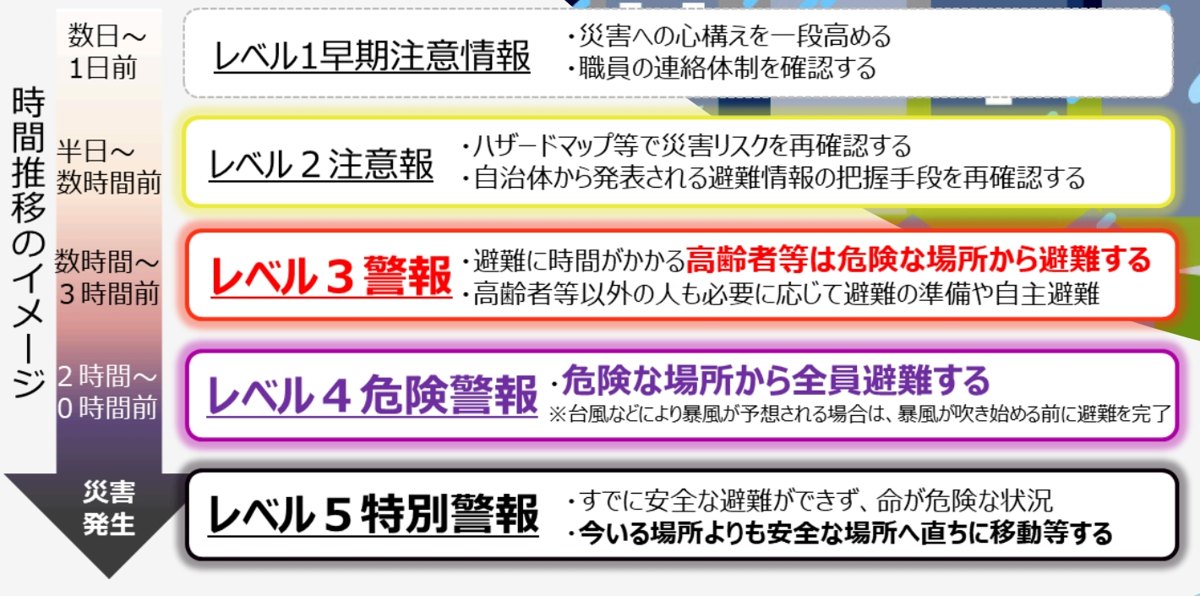
On an ensei, you may run into sudden weather changes somewhere you don’t know well. If you write down the city or town names for the venue and your hotel before leaving, you can look up local information right away. Check the organizer’s official announcements to see whether a show will go ahead. Ministry of Land, Infrastructure, Transport and Tourism press release (in Japanese) / Nikkei article (in Japanese)
Four words behind merchandise and streaming
Naphtha: materials and ink for merchandise
Naphtha is a petroleum product made by refining crude oil, and it is a raw material for plastics and printing ink. Japan sources about 40% of it from the Middle East. In 2026, the closure of the Strait of Hormuz caused a shortage.
In May, Calbee announced it would cut the printing on the bags of 14 products, including its potato chips, to two colors. The acrylic resin in acrylic stands and the plastic in fan uchiwa (hand fans) and CD cases are made from oil too. It was the year many people learned that merchandise materials also depend on imports from the Middle East. Gizmodo Japan article (in Japanese)
Data centers: where streams and subscriptions come from
Data centers are facilities built to house servers and network equipment. Demand has grown with the spread of AI. Some people worry about the environmental impact on surrounding areas when new ones are built.
Concert streams, music and video subscriptions and fan club sites all reach you from servers in data centers.
Physical AI: into shipping and venue setup
Physical AI means AI with a body that moves in the real world, like robots and self-driving cars. It is drawing attention as a way to ease labor shortages and take over dangerous work.
Behind oshi-katsu there is a lot of labor-intensive work, like shipping merchandise and setting up venues. In 2027, The Oshi Lab plans to look more deeply at how physical AI comes to be used in work like this.
Rogue AI: protecting the personal data you hand over
“AI bouso,” or rogue AI, describes a series of cases in which AI acted outside human instructions and launched attacks on its own. In summer 2026, several companies reported cases in which AI under development attacked another company’s systems during testing. The organizers’ explanation says we need to rethink how we deal with generative AI.
Separate from rogue AI, sites that hold fans’ personal information were also hit by a run of unauthorized access. In October, member information from the ticket purchasing service GETTIIS leaked outside the company. In November, the email delivery service Arara was breached, and well-known artists’ fan clubs one after another warned their members to be careful.
Fan club and ticketing sites hold your name, address and payment details. Basic steps like not reusing passwords and turning on two-factor authentication protect your information. When you get a notice from a site, open the official site yourself to check instead of following the email’s link. MONOist article (in Japanese) / ScanNetSecurity article (in Japanese) / NHK article (in Japanese)
The Oshi Lab’s take: from the name of the activity to the names of works and tools
Lined up together, the 30 words do not include the word oshi-katsu itself. “Oshi-katsu” was nominated in 2021, and “nui-katsu” was selected in 2025. In 2026, song titles, group names, nicknames, a type of account and a sticker brand were chosen in place of the name of the activity. We think oshi-katsu has moved past the stage of being singled out as a special activity, and is now talked about through the names of specific works and tools.
“Voice rights” and “smartphone farms” are words about how fans show support. Raising play counts and making audio that imitates an oshi’s voice both overlap with things fans have done for fun. In 2027, we will keep following developments around these two words.
There are three things we would like to think through together with companies and management teams. First, tell fans officially how far they may use choreography and audio, so they can copy with peace of mind. M!LK’s and Monaki’s songs spread because fans enjoyed copying them and posting. Second, share with fans, along with your reasons, that you want the voices of your voice actors and singers treated with care. When fans understand why, they can choose ways of supporting that protect their oshi. Third, don’t take in the support fans have built up only as play counts and follower numbers. Precisely because those numbers can be inflated by machines, we want to keep in view the people who picked up the merchandise and the people who made the trip to the venue.
Related articles: What is oshi-katsu? / Why we fall for an oshi / Ii Oshi no Hi / Heisei retro
FAQ
When were Japan's 2026 buzzword nominees announced?
The 30 nominees were announced on November 5, 2026. The top ten and the grand prize are scheduled to be announced on December 1.
Which of the 30 nominees came out of oshi-katsu?
They include M!LK's song Suki Sugite Metsu!, the kayokyoku vocal group Monaki, hobi-aka (a social media account kept for a hobby), the Chiikawa phenomenon and Riku-Ryu, the figure skating pair.
What does hobi-aka mean?
It is short for "hobby account," a social media account used to share how you enjoy oshi-katsu and other hobbies. Mai Osada, head of SHIBUYA109 lab., explains that these accounts mainly post photos and are mostly on X.
How do voice rights relate to oshi-katsu?
The term covers audio and video in which generative AI imitates the voices of voice actors and singers. On September 30, 2026, the Tokyo District Court ruled that a person's voice can be protected under the right of publicity.
Will a 1% consumption tax make merchandise or tickets cheaper?
The bill covers food and beverages that are now taxed at 8%. It does not change the tax rate on merchandise or tickets. The bill passed the House of Representatives on November 6 and will be debated in the House of Councillors.


